Meet the King Cobra
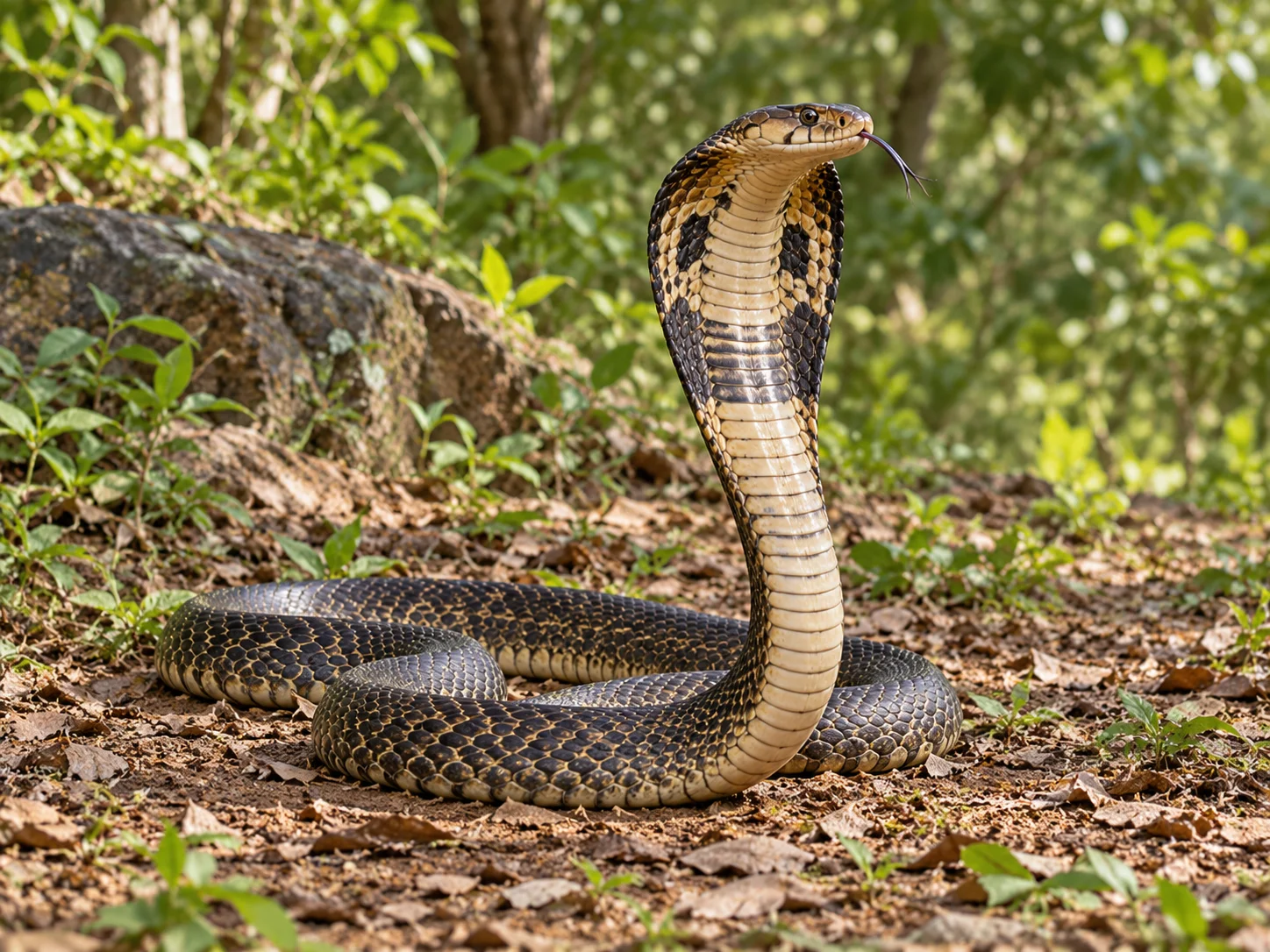
The king cobra is the longest venomous snake in the world, reaching 18 feet. Raised in a defensive posture, a large one can lift the front third of its body and look a grown adult in the eye.
It eats other snakes almost exclusively, which is where its scientific name comes from.
And it does something no other snake does: the female builds a nest out of leaves for her eggs and guards it until they hatch.
Scientific Name and Classification
The king cobra’s scientific name is Ophiophagus hannah. Ophiophagus means “snake eater”, which is an unusually literal description.
- Kingdom: Animalia
- Phylum: Chordata
- Class: Reptilia
- Order: Squamata
- Family: Elapidae
- Genus: Ophiophagus
- Species: Ophiophagus hannah
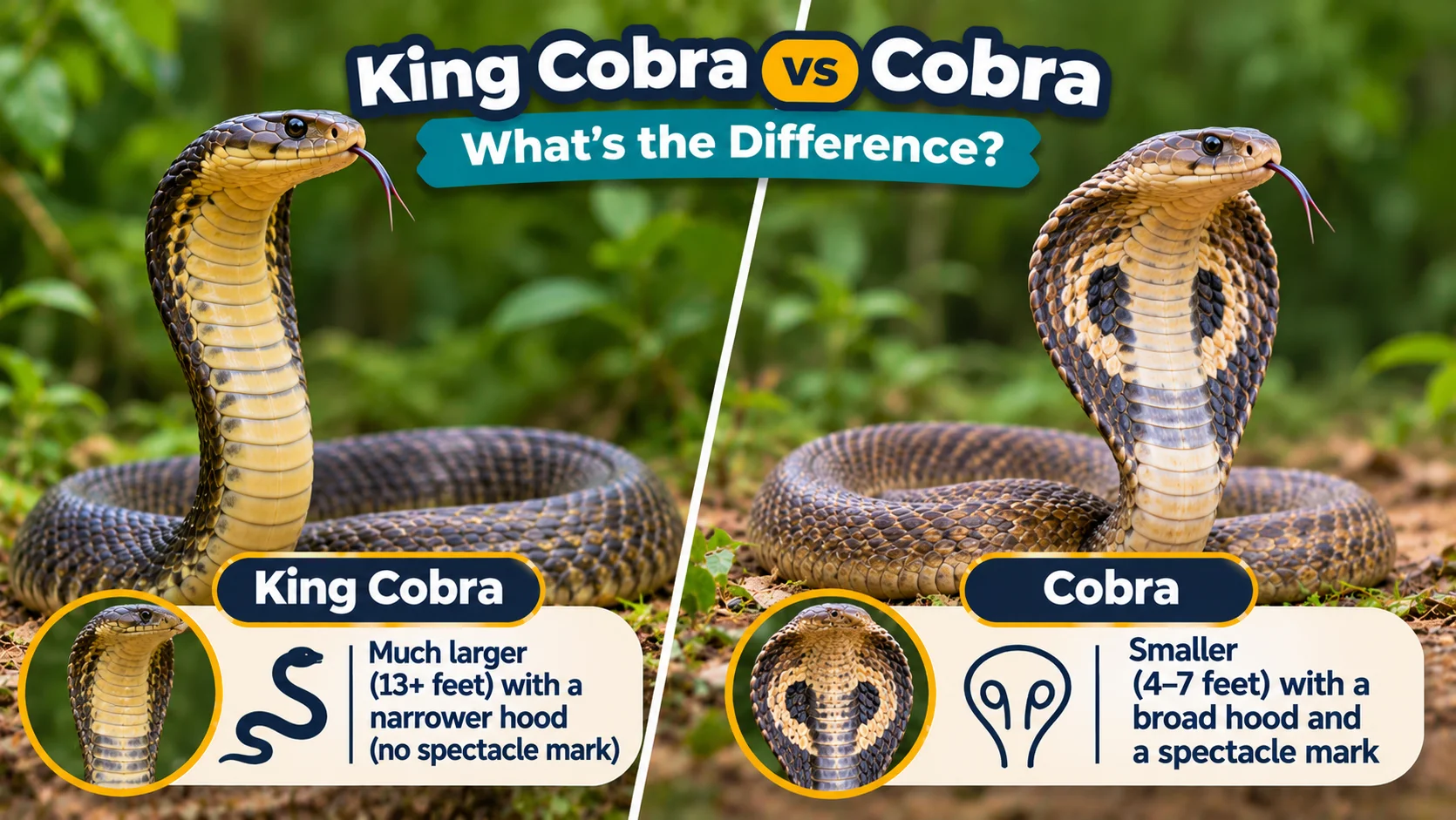
Here is the part that surprises people: the king cobra is not a true cobra. True cobras belong to the genus Naja. The king cobra sits in a genus of its own, closer to mambas than to the cobras it is named after.
Research published in 2024 went further and split the king cobra into four separate species, having long been treated as one widespread animal.
How Dangerous Is a King Cobra?
Dangerous, but not in the way its reputation suggests.
Drop for drop its venom is less potent than that of several other snakes, including the Indian cobra. What makes a bite serious is the quantity: a king cobra can inject a very large dose in one bite, enough venom in principle to kill an elephant. Untreated bites are often fatal, and the venom attacks the nervous system, causing paralysis and eventually stopping breathing.
But king cobras bite remarkably few people. They are shy, avoid humans, and live mostly in forest away from villages. Far more people are killed by Indian cobras, kraits and vipers, which live in farmland and near houses.
A threatened king cobra gives a clear warning first: it rears up, spreads a narrow hood, and growls. The sound is genuinely a growl rather than a hiss, produced in pouches in the windpipe and pitched far lower than any other snake.
It will also strike with the mouth closed as a warning before delivering a real bite, and often injects little or no venom in a first defensive strike.
Appearance and Anatomy
King cobras typically measure 10 to 13 feet, with the longest recorded at over 18 feet. They weigh 15 to 20 pounds, which is slender for that length.
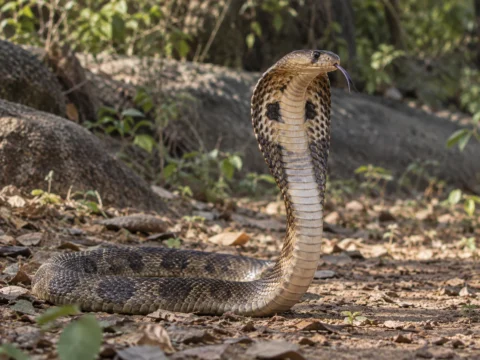
- Hood. Narrower than a true cobra’s, formed by spreading ribs in the neck, and without the spectacle marking Indian cobras carry.
- Fangs. Short and fixed at the front of the mouth, so the snake chews slightly to work venom in.
- Color. Olive, tan, brown or black, often with pale bands, and lighter underneath.
- Tongue. Forked, flicked to collect scent and pressed to a sensory organ in the mouth, which is how it tracks other snakes.
- Scales on the head. A pair of large plates at the back of the crown that other cobras lack, useful for identification.
They are good climbers and strong swimmers, and move surprisingly fast over ground.
Habitat and Range
King cobras live across South and Southeast Asia: India, Nepal, Bhutan, Bangladesh, Myanmar, Thailand, Vietnam, Malaysia, Indonesia, the Philippines and southern China.
They prefer dense forest, especially near streams, along with bamboo thickets, mangrove swamps and plantations.
They need forest with plenty of other snakes in it, which is why forest clearance hits them harder than it hits snakes that adapt to farmland.
Diet and Feeding
King cobras are carnivores that eat almost nothing but other snakes.
Rat snakes are the staple, and they also take pythons, kraits, other cobras, and king cobras smaller than themselves. When snakes are scarce they will eat lizards, and occasionally eggs or small mammals.
They hunt by scent, tracking a snake through forest by tongue-flicking, then seizing it behind the head and holding on while the venom works.
They have some resistance to the venom of the snakes they eat, which matters when your food fights back with the same weapon you use.
A large meal lasts a long time. A king cobra may go weeks or months between feeds.
Behavior and Lifestyle
King cobras are solitary, active mainly by day, and shy of people.
They are considered among the most intelligent snakes. Keepers report that king cobras recognize individual handlers, track movement with apparent attention, and behave with a wariness that looks a good deal like assessment.
Unlike most snakes, they can rear a third of their body off the ground and move forward while staying raised, which is how a 12-foot snake ends up at eye level.
Males fight each other during breeding season by wrestling, pushing each other’s heads down, without biting. The venom is reserved for food.
Reproduction and Life Cycle
This is what makes the king cobra genuinely unique among snakes.
The female builds a nest. She gathers leaves and forest debris by looping her body around them and dragging them into a mound, then lays 20 to 40 eggs inside and covers them over. Rotting vegetation warms the eggs, and she builds a second chamber above where she lies on guard.
No other snake in the world builds a nest like this.
She stays with it for two to three months, driving off anything that approaches, which is when king cobras are at their most defensive.
Then she leaves, usually just before the eggs hatch. One suggested reason is that she would otherwise eat her own young, since she is a snake eater by trade.
Hatchlings are about 18 inches long and fully venomous from the moment they emerge. King cobras live around 20 years.
Predators and Threats
Adult king cobras have few predators. Mongooses are the famous one, partly resistant to the venom and quick enough to avoid the strike, though a mongoose attacking a full-grown king cobra is far from guaranteed to win. Large birds of prey take younger snakes.
Human pressures are the real danger: deforestation across Southeast Asia removing both habitat and prey, killing out of fear, and collection for skins, traditional medicine and the pet trade.
Snake charming has declined and is illegal in India, but it still takes animals in places.
Conservation Status
The king cobra is listed as Vulnerable, with numbers falling across its range.
Forest loss is the main cause. A snake that eats other snakes needs a functioning forest full of prey, so it disappears well before the habitat is entirely gone.
The 2024 split into four species complicates the picture, because each of the four has a smaller range and a smaller population than the single species was thought to have, and each may need assessing separately.
It is protected by law in India and several other countries.
Role in the Ecosystem
The king cobra is the apex predator of snakes, and that is an unusual job. By eating rat snakes and other mid-sized snakes it holds their numbers down, which affects everything those snakes eat in turn.
Oddly, this can mean more rodents rather than fewer, since it eats the rodent-eaters. The effect runs through the food web in ways researchers are still untangling.
Its venom is medically valuable. Compounds from snake venom have been developed into painkillers and drugs for blood disorders, and king cobra venom is part of that research.
It also carries real cultural weight across South and Southeast Asia, appearing in Hindu and Buddhist tradition, which has given it a degree of protection that fear alone would not.