Meet the Chicken
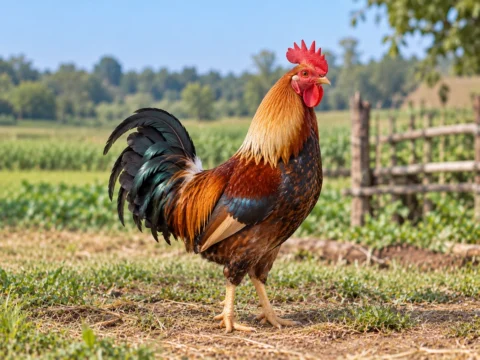
The chicken is the most numerous bird on Earth, and it is not close. There are more chickens alive right now than all wild bird species put together.
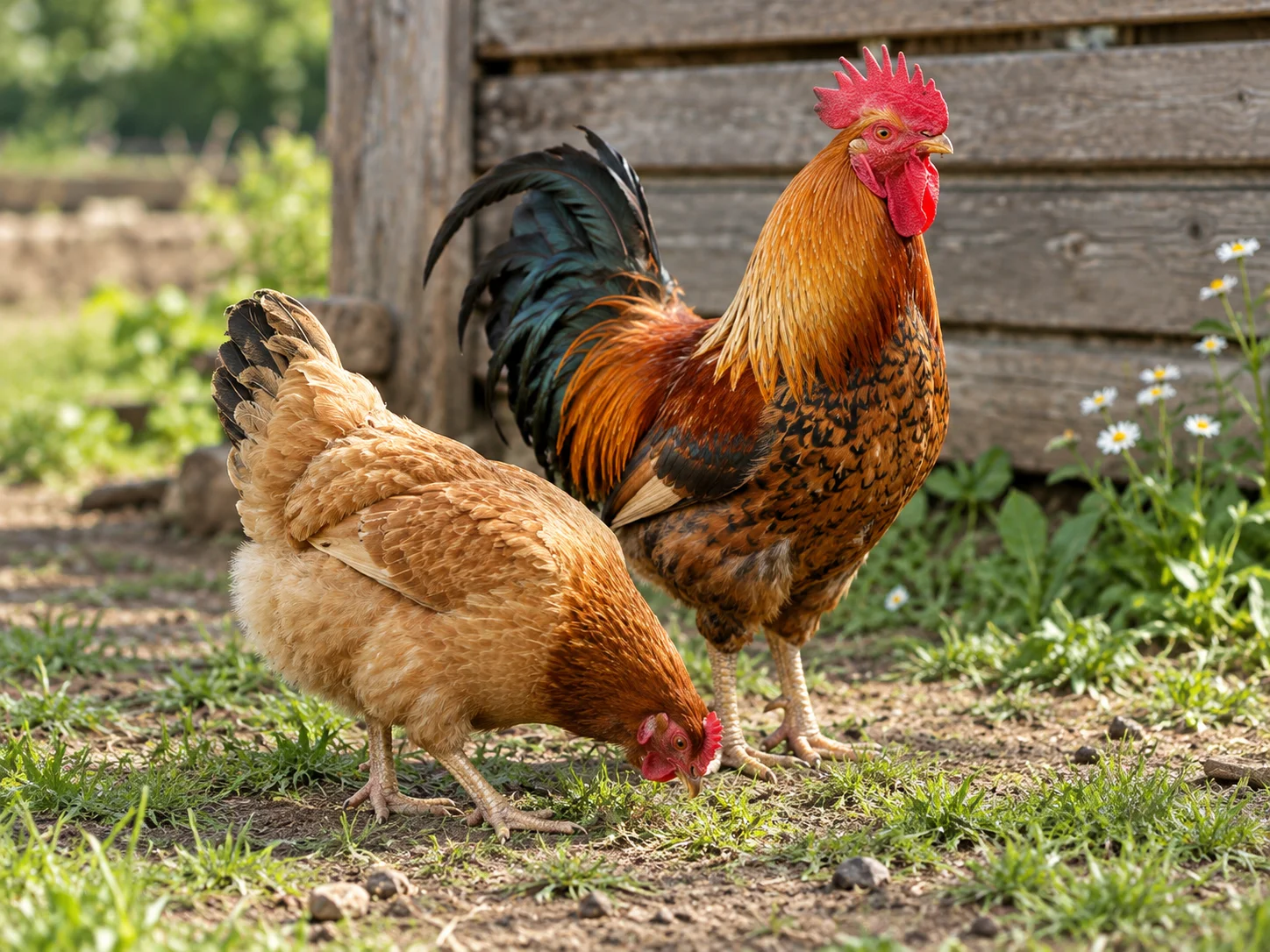
Like cattle, chickens come with a set of words that describe the same species at different ages and sexes. An adult male is a rooster, an adult female is a hen, and a youngster is a chick or a pullet.
They are also a good deal cleverer than the word “birdbrain” suggests. Chickens recognize scores of individual faces, pass information to each other with specific alarm calls, and talk to their chicks before those chicks have hatched.
Scientific Name and Classification
The chicken’s scientific name is Gallus gallus domesticus. The three-part name marks it as a domesticated form of the red junglefowl, Gallus gallus, a wild bird still living in the forests of South and Southeast Asia.
- Kingdom: Animalia
- Phylum: Chordata
- Class: Aves
- Order: Galliformes
- Family: Phasianidae
- Genus: Gallus
- Species: Gallus gallus domesticus
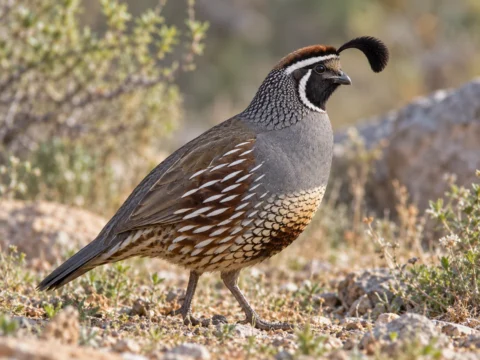
That family also holds pheasants, partridges, quail and peafowl, which is why a rooster’s tail looks faintly like a pheasant’s.
The domestication story was rewritten recently. A 2022 study examined chicken remains from around 600 archaeological sites in 89 countries and concluded that the earliest certain domestic chickens come from central Thailand, roughly 1650 to 1250 BCE. That is far later than people long assumed, and it ruled out the Indian subcontinent as the starting point.
What drew the birds in appears to have been rice. As farmers began growing and storing cereals, the grain acted as a magnet for junglefowl living in the surrounding forest, and the birds gradually moved into the human world of their own accord.
Rooster, Hen, Chick: What Is the Difference?
| Word | What it means |
|---|---|
| Rooster or cock | Adult male |
| Hen | Adult female |
| Cockerel | Young male, under a year |
| Pullet | Young female, under a year |
| Chick | Newly hatched bird of either sex |
| Capon | Castrated male |
And the question everyone asks: hens lay eggs without a rooster anywhere nearby. A rooster is only needed if you want those eggs to hatch into chicks.
Appearance and Anatomy
Chickens stand roughly 1 to 2.5 feet tall and weigh from about 1 pound in bantam breeds to 12 pounds or more in the largest. Roosters are bigger than hens of the same breed.
- Comb and wattles. The fleshy red crest on the head and the flaps under the chin. They are not decoration: blood flowing through them sheds heat, which is how a bird with no sweat glands cools down.
- Beak. No teeth. Food is swallowed whole.
- Crop and gizzard. Food is stored in the crop, then ground up in the muscular gizzard with the help of small stones the bird swallows deliberately.
- Feet. Four toes, with strong claws for scratching through soil and leaf litter.
- Wings. Working, but barely. Chickens can flap up to a branch or over a fence, and manage short bursts of maybe 10 or 15 seconds.
A useful oddity: in many breeds the color of a hen’s earlobes predicts the color of her eggs. White lobes, white eggs; red lobes, brown eggs. It is a rough rule rather than a law, but it holds surprisingly often.
Habitat and Range
Chickens live on every continent except Antarctica, anywhere people do. They are kept in back gardens, on smallholdings, on free-range farms and in large commercial units.
Their wild ancestor still lives in forest edges and scrub from India through Southeast Asia, roosting in trees at night, and domestic chickens have kept that instinct. Given the chance, a chicken will take itself up to a perch at dusk, which is why coops have roosting bars.
What they need is dry shelter, a place to perch, loose ground to scratch and dust-bathe in, and protection from predators at night.
Diet and Feeding
Chickens are omnivores, and they are far more carnivorous than most people picture.
They eat seeds, grain, grass, leaves and fruit, but also insects, worms, slugs, spiders and the occasional mouse, frog or small lizard. A flock turned loose on a garden is an efficient pest control system.
Foraging means scratching. A chicken rakes backwards with its feet, steps back and inspects what it has uncovered, over and over, all day.
Having no teeth, they swallow grit and small stones on purpose. These sit in the gizzard and grind food as the muscle contracts, doing the job teeth would do.
Behavior and Lifestyle
Chickens live in flocks with a strict social ranking, and the phrase “pecking order” comes from exactly this. Higher-ranked birds eat first and take the best perches, and the order is usually settled by posturing rather than real fighting.
They are good at faces. Chickens can learn and remember 100 or more individual birds, and recognize familiar humans too.
Their calls carry real information. Chickens use different alarm calls for a threat from the air and a threat on the ground, and the rest of the flock reacts appropriately to each: look up, or run for cover.
Dust bathing is a daily ritual. A chicken works loose dirt through its feathers to soak up excess oil and smother mites, then shakes it all out. Birds often do it together.
Reproduction and Life Cycle
A hen begins laying at around five to six months old. Laying breeds produce an egg roughly every 24 to 26 hours in their first year, which is why a good hen can lay 250 to 300 eggs a year.
Fertilized eggs hatch after about 21 days of incubation. A broody hen turns the eggs several times a day and barely leaves the nest.
The most charming detail comes at the end of that period. In the last days before hatching, the hen clucks softly to the eggs and the chicks inside answer her, peeping through the shell. They are communicating before they are born.
Chicks hatch covered in down, eyes open, and are walking and pecking within hours. Chickens can live 8 to 10 years and sometimes longer, though commercial birds live far shorter lives.
Predators and Threats
Almost everything eats chickens. Foxes, hawks, eagles, owls, raccoons, weasels, snakes, dogs and rats all take birds or eggs, and night is the dangerous time.
Their defenses are limited: watchfulness, alarm calls, the roosting instinct, and a rooster willing to put himself between the flock and a threat.
Disease is the other major risk, avian influenza above all, which has caused the culling of enormous numbers of birds worldwide in recent years.
Conservation Status
Chickens are domestic birds and are not assessed by the IUCN. With tens of billions alive at any moment, they are the most numerous bird on the planet.
Two related concerns are real. Traditional breeds are vanishing as commercial farming narrows down to a handful of high-output lines, taking genetic variety with them. And the wild red junglefowl faces a quieter problem: it interbreeds so readily with domestic chickens near villages that genetically pure wild birds are becoming hard to find.
Role in the Ecosystem
On a farm or in a garden, chickens are useful workers. They eat insect pests, including ticks and slugs, scratch and turn the soil surface, and their droppings are a rich fertilizer.
Rotating chickens through orchards and vegetable beds is a long-standing practice for exactly these reasons.
At scale the picture changes. Raising tens of billions of birds demands vast quantities of feed crops, mainly soy and maize, and that drives land clearance in several parts of the world. Intensive poultry units also concentrate waste and act as a focus for disease. The chicken is simultaneously one of the most efficient food animals we have and, by sheer numbers, a heavy environmental load.