
Meet the Frog
A frog drinks through its bottom. It has a patch of skin on its belly and thighs so thin that water passes straight through it, which is why you will never see a frog take a sip of anything. Frogs are an order of tailless amphibians, the Anura, with around 7,500 species on every continent except Antarctica.
It also blinks to swallow. A frog’s eyeballs sink down into its head and press food down its throat, which is why a frog shuts its eyes every time it eats.
There are around 7,500 species, found on every continent except Antarctica, and they are in more trouble than almost any other group of animals on Earth.
Scientific Name and Classification
Frogs form the order Anura, which means “without tail”, so there is no single two-word name for them.
- Kingdom: Animalia
- Phylum: Chordata
- Class: Amphibia
- Order: Anura
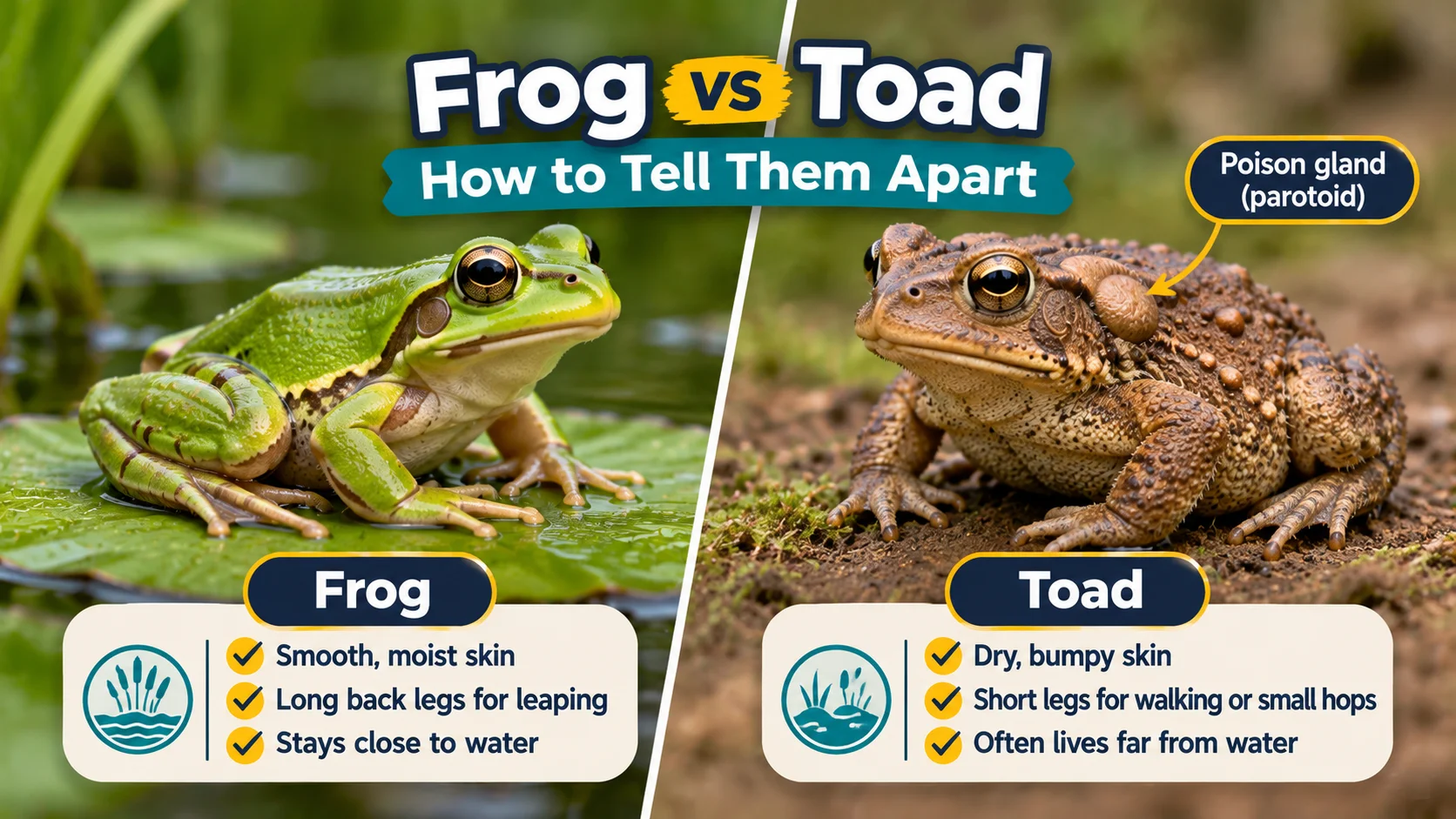
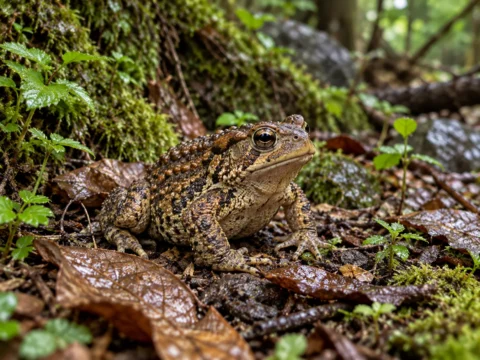
Here is a thing that surprises people: all toads are frogs. “Toad” is not a scientific group. It is a word for frogs that happen to have dry warty skin and short legs, and those traits evolved several times in different frog families.
So every toad sits inside Anura, but not every frog is a toad.
Appearance and Anatomy
Frogs range from Paedophryne amauensis of Papua New Guinea at about a third of an inch, the smallest vertebrate in the world, to the goliath frog of West Africa at over a foot long and 7 pounds.
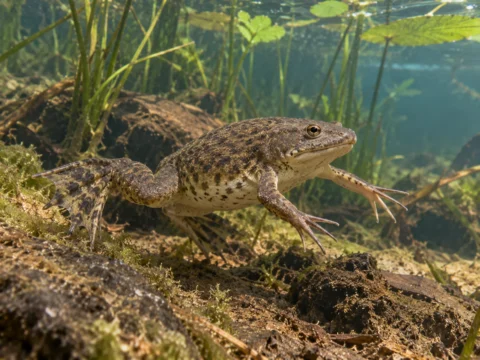
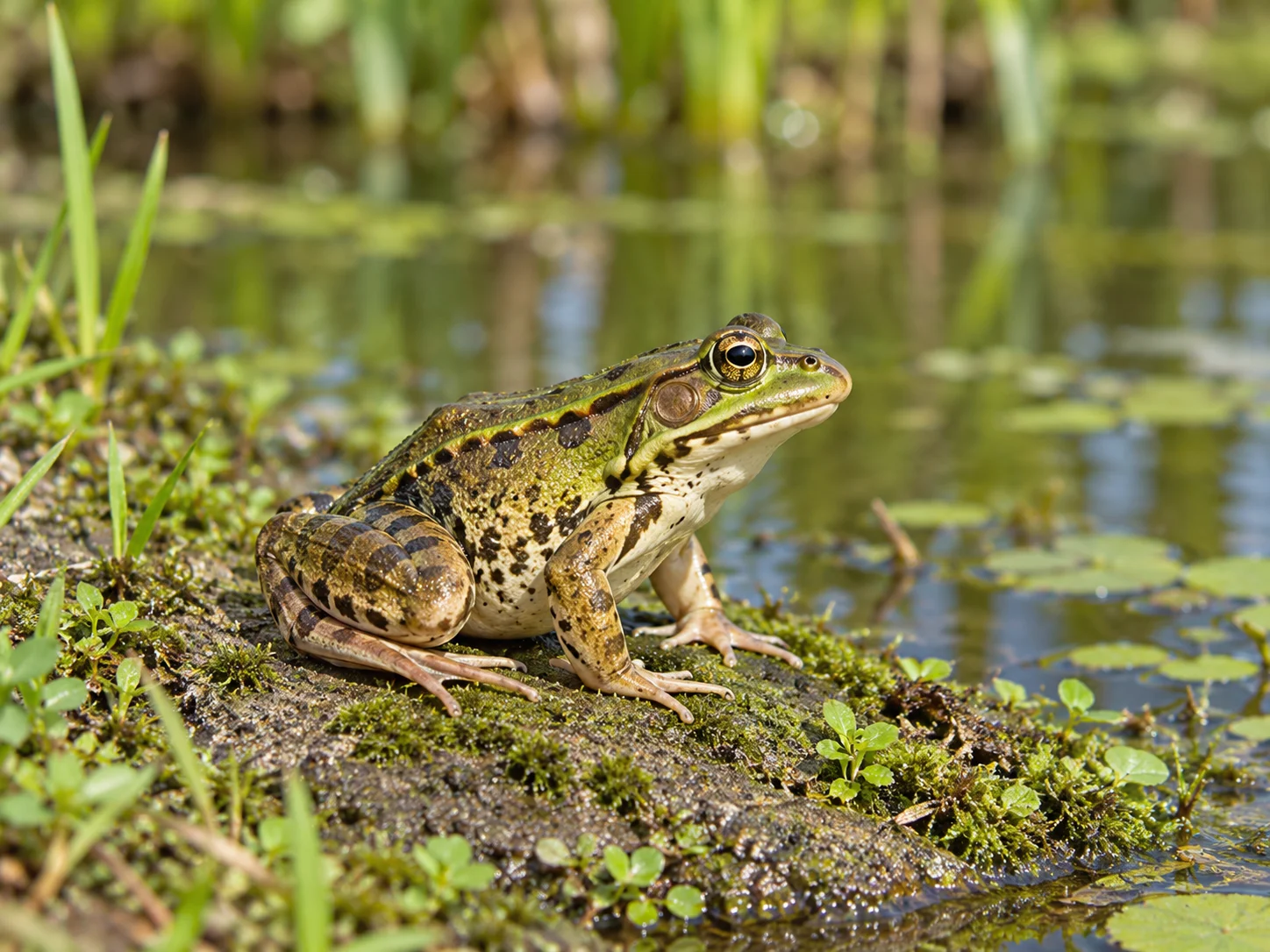
- Skin. Permeable, so frogs absorb water and some oxygen straight through it. They can breathe through their skin while underwater, which is how many hibernate at the bottom of ponds all winter.
- Eyes. Bulging and set high for seeing in almost every direction at once, and they sink inward to help swallow.
- Tongue. Attached at the front of the mouth rather than the back, so it flips out forward. Frog saliva switches between runny and sticky in an instant to grab prey.
- Legs. Long and powerful in leaping species; some frogs jump over 20 times their own body length.
- Ears. A visible circular eardrum, the tympanum, on each side of the head behind the eye.
That permeable skin is a gift and a curse. It lets a frog drink and breathe through its body, and it also lets pollution straight in, which is why frogs are so sensitive to a damaged environment.
Habitat and Range
Frogs live on every continent except Antarctica, in rainforest, grassland, desert, mountain and city pond alike.
Most need water or damp conditions, at least to breed, but some have escaped that. Desert frogs burrow down and wait out years of drought inside a cocoon of shed skin, emerging only when rain finally arrives.
The wood frog of North America goes further and freezes solid. Up to two thirds of the water in its body turns to ice, its heart stops, it stops breathing, and in spring it thaws out and hops away. Sugars in its blood act as antifreeze and stop its cells being destroyed.
Diet and Feeding
Adult frogs are carnivores, eating insects, spiders, worms, slugs and snails. Larger species take fish, mice, small birds and other frogs.
Most hunt by movement. A frog may ignore a dead insect placed in front of it entirely, because its visual system is tuned to things that move.
The tongue strike is among the fastest actions in nature, faster than a human can blink, and the saliva performs a trick: thin on impact so it spreads over the prey, then suddenly thick and sticky to hold it.
Tadpoles are different animals entirely. Most are vegetarian, scraping algae off rocks with rows of tiny teeth.
Behavior and Lifestyle
Most frogs are active at night, when it is cooler and damper and there is less risk of drying out.
Calling is what frogs are known for, and it is almost always males. Each species has its own call, and a female can pick her own kind out of a chorus of several species calling at once. The vocal sac inflates like a balloon to amplify the sound, and some frog choruses can be heard a mile away.
Defense varies wildly. Some frogs are camouflaged, some play dead, some inflate themselves to look too big to swallow, and some advertise that they are poisonous with brilliant colors.
Poison dart frogs are the famous example. The golden poison frog carries enough toxin to kill several people, and it is bright yellow precisely so predators learn to leave it alone. Fascinatingly, they do not make the poison themselves: it comes from the insects they eat, and captive-bred dart frogs raised on fruit flies are completely harmless.
Reproduction and Life Cycle
Most frogs lay eggs in water, often hundreds or thousands at a time, in a jelly mass called spawn.
Then comes metamorphosis, one of the most dramatic transformations in nature. A tadpole hatches with a tail and gills, swims and eats algae, then grows back legs, then front legs, absorbs its own tail, swaps gills for lungs and rebuilds its gut from a plant-eating one to a meat-eating one. It becomes a different animal.
Not all frogs do it this way, and the variations are extraordinary. Some carry eggs on their backs. The male midwife toad wraps the eggs around his legs and carries them. Poison dart frogs carry tadpoles up trees one at a time and leave each in a pool of water inside a plant, then return to feed them unfertilized eggs. A few frogs skip the tadpole stage entirely and hatch as tiny froglets.
Frogs live 2 to 10 years in the wild, and some toads reach 30 or more.
Predators and Threats
Almost everything eats frogs: snakes, birds, fish, otters, raccoons, large spiders, dragonfly larvae and other frogs. Tadpoles are eaten in enormous numbers.
Human pressures are severe: wetlands drained, pollution soaking straight through permeable skin, pesticides, roads cutting across migration routes to breeding ponds, and collection for food and the pet trade.
The worst threat is a disease. A fungus called chytrid attacks frog skin, and since frogs breathe and drink through their skin, infection kills them. It has spread worldwide, driven many species to extinction, and is considered one of the most destructive wildlife diseases ever recorded.
Conservation Status
There is no single status for frogs, but the overall picture is alarming.
Amphibians are the most threatened group of vertebrates on Earth. Roughly 40 percent of amphibian species are at risk of extinction, a far higher proportion than mammals or birds, and many have disappeared within living memory.
Some losses are already final. The golden toad of Costa Rica was discovered in 1966 and last seen in 1989. The gastric-brooding frog of Australia, which swallowed its eggs and raised tadpoles in its stomach, was found in the 1970s and gone by the 1980s.
Conservationists run captive breeding programs as insurance, and some species now exist only in those.
Role in the Ecosystem
Frogs sit in the middle of the food web and hold it together. They eat vast quantities of insects, including mosquitoes and crop pests, and they feed an enormous range of predators in turn.
Tadpoles do a separate job, grazing algae and keeping ponds from choking.
They are also one of the best environmental warning systems we have. Because they live in water and on land and absorb everything through their skin, frogs register pollution and habitat damage long before most animals show any effect. A pond losing its frogs is a pond in trouble.
Their chemistry has been medically useful too. Compounds from frog skin have been developed into painkillers and antibiotics, and some species carry substances still being studied, which is part of what makes each extinction a loss we cannot measure.