Meet the Pigeon
In October 1918, in the Argonne forest in France, around 550 American soldiers were trapped behind German lines and being shelled by their own artillery, which did not know where they were.
Two pigeons were sent with the message and were shot down. A third, Cher Ami, was hit in the chest, blinded in one eye and lost most of a leg, with the message capsule hanging from the tendons. She flew 25 miles and delivered it.
The shelling stopped. Around 194 men walked out. The bird that did it was the same species that people shoo off park benches.
Scientific Name and Classification
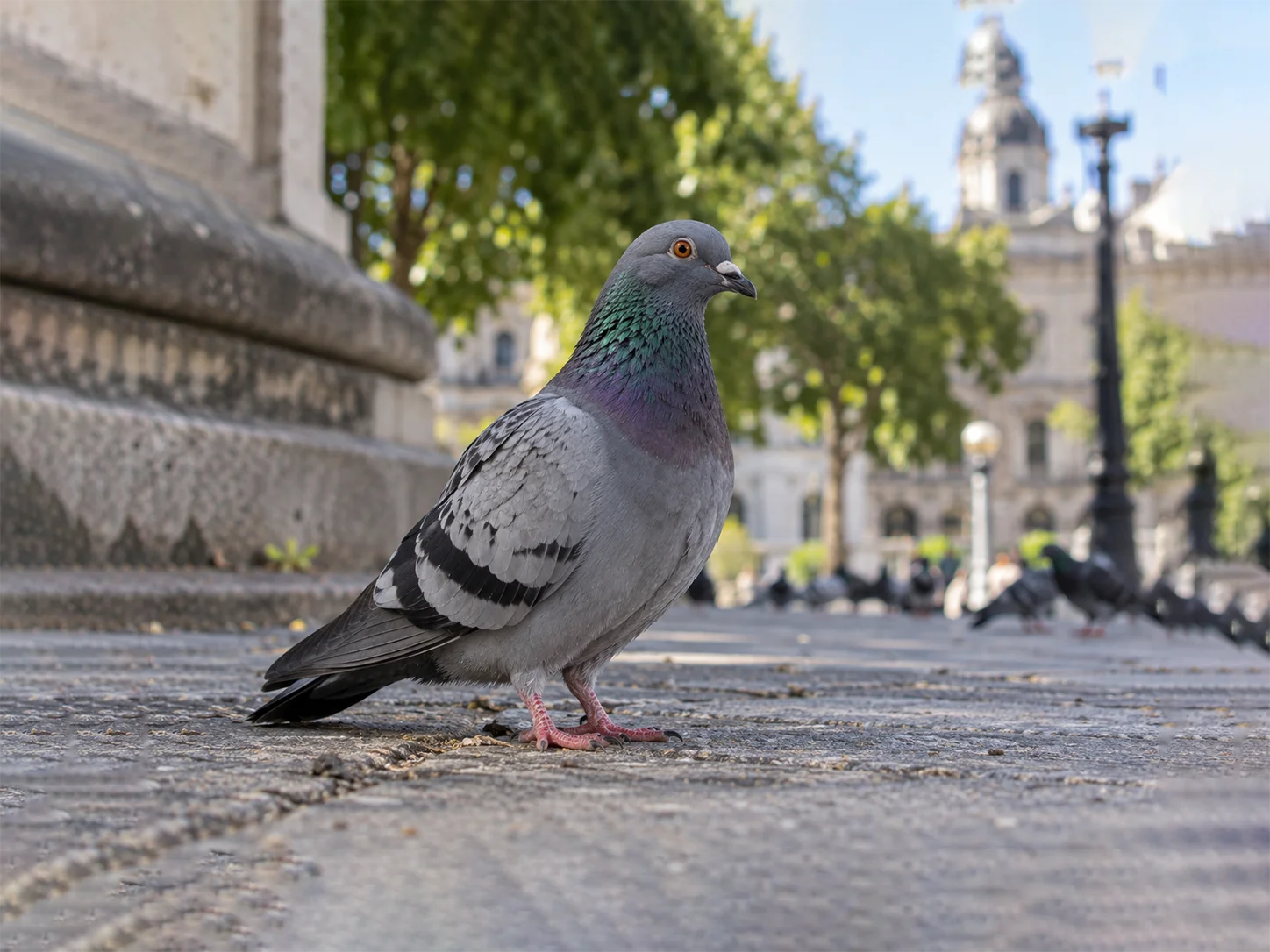
Pigeons and doves make up the family Columbidae, with about 350 species. The bird in cities worldwide is the rock dove, Columba livia, in its feral form.
- Kingdom: Animalia
- Phylum: Chordata
- Class: Aves
- Order: Columbiformes
- Family: Columbidae
There is no biological difference between a pigeon and a dove. The two words are used interchangeably, with larger species more often called pigeons and smaller ones doves, purely by convention. The bird released at weddings as a white dove is a domestic rock dove, which is a pigeon.
The family’s most famous member is gone. The dodo was a giant flightless pigeon from Mauritius, and its closest living relative is the Nicobar pigeon.
How a Pigeon Finds Its Way Home
Release a homing pigeon hundreds of miles from its loft, somewhere it has never been, and it will come back. Races of 500 miles in a day are routine.
How it does this has been studied for over a century and is still not fully settled, which is a good illustration of how a familiar animal can remain genuinely unexplained. What is reasonably clear is that pigeons use several systems at once:
- The sun. They use it as a compass, corrected against an internal clock for the time of day.
- Magnetism. Pigeons detect the Earth’s magnetic field. Where the sensor is remains disputed, with iron-containing cells in the beak and magnetically sensitive neurons in the inner ear both proposed.
- Smell. Experiments with blocked nostrils go badly wrong, suggesting the birds build a map of airborne odors carried on prevailing winds.
- Infrasound. They hear sound far below our range, and may navigate partly by the low rumble of distant terrain.
- Landmarks. Close to home they switch to following familiar roads and features, and pigeons have been tracked taking motorway routes rather than straight lines.
Humans used this for about 3,000 years. Pigeons carried the results of the ancient Olympics, Caesar’s dispatches, and news of Waterloo; Reuters started as a pigeon service carrying stock prices between Aachen and Brussels; and in both world wars they carried messages radio could not. Thirty-two pigeons have received the Dickin Medal for animal gallantry.
Appearance and Anatomy
A city pigeon is 12 to 15 inches long with a 24 to 28 inch wingspan, and weighs 9 to 14 ounces (250 to 400 g).
Across the family the range is far wider, from the diamond dove at little over an ounce to the crowned pigeons of New Guinea, turkey-sized birds with lace crests.
- Neck. The green and purple sheen is structural color, not pigment, shifting as the bird turns.
- Eyes. Excellent vision, including ultraviolet. Pigeons see colors we do not.
- Hearing. Extends into infrasound, below anything we can hear.
- Crop. Produces crop milk, a nutritious secretion fed to the young, which almost no other bird does.
The variety of plumage in city flocks, from pale gray to nearly black to patchy white, is leftover domestication. These are escaped and feral descendants of thousands of years of selective breeding.
Habitat and Range
Feral pigeons live on every continent except Antarctica, in almost every city on earth.
Their success in cities is not an accident. The wild rock dove nests on cliff ledges in sea caves, and a building is a cliff with better ledges. They were pre-adapted to us before we built anything.
Wild members of the family live almost everywhere else: rainforest, desert, mangrove and remote islands, with New Guinea and Southeast Asia holding the greatest variety, including the fruit doves, which are among the most brightly colored birds anywhere.
Diet and Feeding
Pigeons are mostly seed and grain eaters, and in cities effectively omnivorous scavengers, taking bread, scraps and whatever else is dropped.
Wild species eat seeds, fruit and buds, and the fruit doves and imperial pigeons are specialist fruit eaters that swallow fruit whole.
They drink in a way almost no other bird does. Most birds scoop water and tip their heads back; a pigeon puts its bill in and sucks, like a straw.
Desert species can go further. Some sandgrouse-like doves fly 30 miles or more to water, and a few pigeons can drink slightly brackish water that would kill most birds.
Behavior and Lifestyle
Pigeons are social, flocking and largely monogamous, with pairs often staying together for life.
They are also considerably smarter than their reputation. In laboratory work pigeons have learned to recognize themselves in a mirror, to distinguish paintings by Monet from paintings by Picasso and generalise to unseen works, to sort images by category, and to grade medical images with accuracy comparable to trained people. A great deal of what is known about how animals learn comes from experiments with pigeons.
The head-bobbing walk is not a bob. The pigeon thrusts its head forward and then holds it perfectly still while the body catches up, so the eyes get a steady image. Filmed in slow motion, the head barely moves at all.
The males’ bowing and cooing display, tail dragging and turning in circles, is courtship, and it is performed with great persistence and very little success.
Reproduction and Life Cycle
Pigeons breed year-round where food allows, and can raise several broods a year, which is much of why cities fill up with them.
The nest is a flimsy platform of twigs on a ledge, and two white eggs is the near-invariable clutch. Both parents incubate, the male by day and the female at night, for 17 to 19 days.
Both parents then feed the squabs on crop milk, a cheesy secretion sloughed from the crop lining. Only pigeons, flamingos and a few penguin relatives produce anything like it, and it means pigeon parents do not need insects to raise young, which is a large part of their urban success.
Squabs fledge at four to six weeks, and this is why you rarely see a baby pigeon: by the time one leaves the ledge it is nearly adult-sized.
City pigeons live three to five years. Protected racing birds can reach 15 or more.
Predators and Threats
Peregrine falcons, sparrowhawks, owls, cats, rats and gulls all take pigeons. Peregrines have moved into cities largely because of them, nesting on skyscrapers and hunting the flocks below.
Feral pigeons are not threatened. Wild members of the family often are, and the family has a terrible extinction record, because fruit-eating island pigeons were easy to hunt and vulnerable to introduced rats and cats.
The passenger pigeon is the case everyone should know. It was possibly the most numerous bird on earth, in flocks of hundreds of millions that darkened the sky for hours. Commercial hunting and forest clearance destroyed it in a few decades, and the last one, Martha, died in Cincinnati Zoo on 1 September 1914.
That is the lesson worth carrying: abundance is not safety.
Conservation Status
The rock dove is Least Concern and one of the most successful birds alive. Across the family the picture is much worse: a substantial share of the 350 species are threatened, and around a dozen have gone extinct in recent centuries.
Mauritius shows both ends of it. The dodo was lost within a century of European arrival, but the pink pigeon on the same island was brought back from around ten birds in the 1990s to several hundred by captive breeding and release, and it remains one of the better conservation successes anywhere.
Feral pigeons are a nuisance in many cities, and the effective responses are unglamorous: stop feeding them, block nesting ledges, and manage waste. Culling does not work, because the survivors breed faster into the space.
Role in the Ecosystem
Fruit-eating pigeons are among the most important seed dispersers in tropical forests, and some large tree species have fruit so big that pigeons are nearly the only birds that can swallow them whole and carry the seeds away. Losing those pigeons means losing the trees’ ability to spread.
In cities, pigeons are the base of an urban food chain that supports peregrines and other raptors in places they would otherwise never live.
Their contribution to science is out of all proportion to their reputation. Much of what we understand about learning, about visual categorization and about animal navigation was worked out with pigeons, and they carried human messages for three millennia before that.
Which makes the ordinary park pigeon an odd case: an animal we have used, bred, decorated, raced, sent to war and decorated for bravery, and then decided to find contemptible.