Meet the Spider
Spider silk is stronger than steel of the same thickness and tougher than Kevlar, meaning it absorbs more energy before breaking. It is produced at room temperature, from water and protein, by an animal the size of a thumbnail.
We still cannot make it properly. Decades of effort have gone into spider silk, including engineered goats, bacteria and silkworms producing spider proteins, and the results are useful but not equal to the original. The problem is not the protein; it is the spinning. A spider pulls liquid silk through a duct that changes its acidity and water content as it goes, and the molecules lock into shape under tension as they emerge.
There are about 52,000 described spider species, and almost every one of them does this.
Scientific Name and Classification
Spiders are the order Araneae, with over 52,000 species in more than 130 families, so there is no single scientific name. The common garden orb-weaver of Europe is Araneus diadematus, and the black widow is Latrodectus mactans.
- Kingdom: Animalia
- Phylum: Arthropoda
- Class: Arachnida
- Order: Araneae
- Families: Araneidae, Salticidae, Theridiidae, Lycosidae, Theraphosidae and many more
Spiders are not insects. The difference is not a technicality, and the checks are simple: a spider has eight legs, an insect has six; a spider has two body sections, an insect three; a spider has no antennae and no wings; and a spider has simple eyes, usually eight of them, rather than compound eyes.
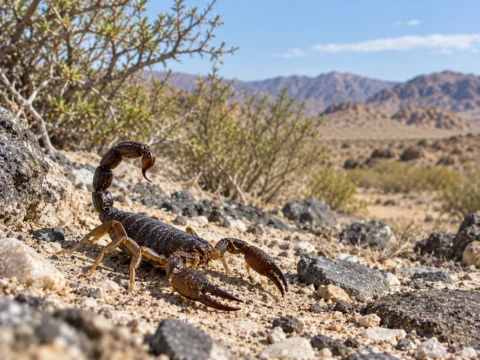
They are arachnids, so their relatives are scorpions, ticks, mites and harvestmen. Harvestmen, with their tiny single body section, are not spiders either.
How Spiders Make and Use Silk
A spider is not a one-silk animal. Most species produce several different kinds from separate glands, and a single orb web uses at least four.
- Dragline silk for the frame and for the safety line a spider trails behind it. This is the famously strong one.
- Capture spiral silk, which is stretchy and coated in sticky droplets, and can extend several times its length without snapping.
- Attachment discs to glue the web to surfaces.
- Egg sac silk, tough and weatherproof.
- Wrapping silk for subduing prey.
The web is also a sense organ rather than just a trap. A spider sitting at the hub reads vibrations through the radial threads, and from them it can judge the size and position of what has landed and whether it is prey, a rival, a mate drumming a courtship rhythm, or a leaf.
Not all spiders build webs, and this surprises people. Jumping spiders stalk and pounce, wolf spiders run their prey down, crab spiders sit camouflaged in flowers and ambush, and trapdoor spiders wait in a burrow behind a hinged lid. Roughly half of all spider species do not build a capture web at all.
Some use silk to travel. Spiderlings release a few threads and are carried away on air currents, a behavior called ballooning, and they have been collected thousands of feet up and hundreds of miles out to sea. Research suggests they are riding atmospheric electric fields as well as wind, which is why ballooning works on still days.
Appearance and Anatomy
Spiders range from the Samoan moss spider at a quarter of a millimeter, smaller than a pinhead, to the goliath birdeater of South America with a leg span of nearly 12 inches and a weight of about 6 ounces.
- Two body parts. The cephalothorax, carrying legs, eyes and fangs, and the abdomen, holding the silk glands.
- Fangs. Called chelicerae. Almost all spiders have venom, delivered through them.
- Legs. Eight, and they work hydraulically. A spider has muscles to flex its legs but extends them by pumping body fluid, which is why a dead spider curls up: the pressure is gone.
- Eyes. Usually eight simple eyes in arrangements that identify the family. Jumping spiders have excellent vision, comparable to a pigeon’s in acuity and far better than any other invertebrate of their size.
- Book lungs. Stacked plate-like breathing organs, in some species alongside tracheal tubes.
They cannot chew. A spider injects digestive fluid into its prey and drinks the liquefied contents, leaving an empty husk.
Habitat and Range
Spiders live on every continent except Antarctica, and in almost every land habitat: forest, desert, grassland, mountains, caves, marshes, and in very large numbers inside houses.
They have been found at 22,000 feet on Everest, living on insects blown up the mountain, and one species, the diving bell spider, lives underwater in a bubble of air it holds in a silk chamber and replenishes from the surface.
Their density is the detail that tends to stop people. Surveys of grassland have found hundreds of spiders per square meter, and a frequently cited estimate puts the world’s spiders at several hundred million tons of insects eaten per year, which is in the same range as the total weight of meat and fish people consume annually.
The house spiders in most homes are not visitors from the garden. Several species are effectively domestic, living their whole lives indoors.
Diet and Feeding
Spiders are carnivores, eating mainly insects and other spiders, with the larger species taking lizards, frogs, fish, small birds and bats.
There is one known exception, and it is a good one: Bagheera kiplingi, a jumping spider from Central America, lives mainly on the protein-rich nodules produced by acacia plants, making it the only substantially vegetarian spider known.
Many are specialists. Portia jumping spiders hunt other spiders by walking onto their webs and plucking the threads to imitate a trapped insect, varying the rhythm until they find one that works, and they will try different patterns on an unfamiliar species until something gets a response. That is trial-and-error problem solving in an animal with a brain the size of a grain of salt.
Spiders can go remarkably long without eating, some for months, by lowering their metabolism.
Behavior and Lifestyle
Most spiders are solitary and will attack each other on sight, but there are exceptions worth knowing about. A few dozen species are genuinely social, and Anelosimus eximius builds communal webs holding thousands of individuals that hunt cooperatively and share prey.
Courtship is elaborate and often risky for the male, since a female may treat him as food. Males signal carefully: plucking the web in a species-specific rhythm, drumming on leaves, waving patterned legs, and in peacock spiders performing a dance with an iridescent fan raised over the back.
Sexual cannibalism is real but less universal than its reputation. It happens in some species, is rare in most, and in a few the male has adaptations to survive it or to improve his odds, including giving the female a gift of wrapped prey.
Jumping spiders have shown genuinely surprising abilities in the laboratory, including planned detour routes to reach prey they can see but cannot reach directly, and something resembling a sleep state with twitching limbs and moving retinas.
Reproduction and Life Cycle
Males transfer sperm using the pedipalps, the two short appendages at the front, which they load beforehand and insert during mating. No other animal group reproduces quite this way.
Females lay anywhere from a few eggs to over 2,000, wrapped in a silk sac, which may be hidden, guarded, or carried. Wolf spiders carry the sac attached to the abdomen and then carry the hatched spiderlings on their back for weeks.
Parental care varies from none to considerable, and some species feed their young regurgitated food, while in a few the mother is eaten by her own offspring at the end.
Spiderlings molt repeatedly, five to ten times for most species, and because the exoskeleton cannot stretch, each molt is a vulnerable interval.
Most spiders live a year or less. Tarantulas are the exception: females of some species live 20 to 30 years, and a trapdoor spider in Western Australia known as Number 16 was monitored from 1974 until 2016, dying at 43, the oldest spider ever recorded.
Predators and Threats
Birds, lizards, frogs, centipedes, ants, other spiders and specialized wasps eat them, and spider wasps paralyze a spider and lay an egg on it so the larva eats it alive.
Human threats are habitat loss, pesticides, and deliberate killing, which is worth addressing because the fear is so disproportionate to the risk.
Of 52,000 species, around 25 to 30 have venom medically significant to humans, and deaths are very rare. Australia has recorded no confirmed death from a funnel-web spider since antivenom became available in 1981. Most reported spider bites are not spider bites at all: studies of patients presenting with suspected bites have found the great majority to be bacterial infections, often MRSA, which matters because it means people are treated for the wrong thing.
Spiders also cannot bite through most human skin easily, have no interest in us, and the common story about swallowing spiders in your sleep has no evidence behind it whatsoever.
Conservation Status
Almost no spiders have been assessed. Of 52,000 described species only a few hundred appear on the IUCN Red List, and new species are described constantly, so nobody knows how spiders are doing overall.
Those assessed as threatened are mostly cave species or others confined to a single small site, where one quarry, fire or development can remove everything.
The Kauai cave wolf spider, which has no eyes at all, lives in a few lava tubes in Hawaii and is Endangered. The great raft spider in Britain nearly vanished with its fenland and has been brought back by reintroduction.
The broad concern is the general decline in insect abundance, since a predator that eats insects cannot outlast its food supply.
Role in the Ecosystem
Spiders are the most important insect predators on land, and the scale is genuinely difficult to picture: they eat hundreds of millions of tons of insects a year, including mosquitoes, flies and crop pests, entirely for free.
They are also food, for a long list of birds and other animals, and in some ecosystems the main link between insects and vertebrates.
Their venom is increasingly valuable to medicine. Spider venoms are complex mixtures of peptides, each targeting a specific ion channel, and compounds from them are being developed as painkillers, as treatments to limit brain damage after stroke, and as targeted insecticides that spare bees.
And the silk remains one of the standing challenges in materials science. An animal with no laboratory, no heat and no toxic solvents makes a fiber we cannot match, out of water and protein, at the speed of a falling thread. The spider in the corner of the room is doing something that a great many well-funded chemists would like to understand.