Meet the Rooster
A rooster is an adult male chicken, Gallus gallus domesticus. In older British English he is called a cock, and a young male under a year old is a cockerel.
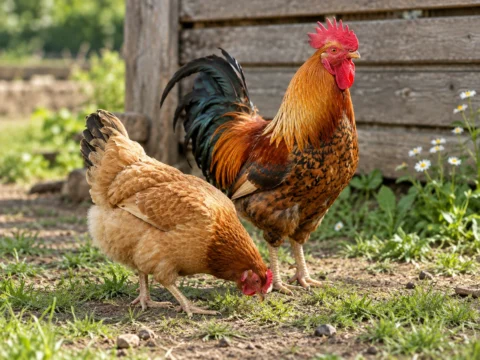
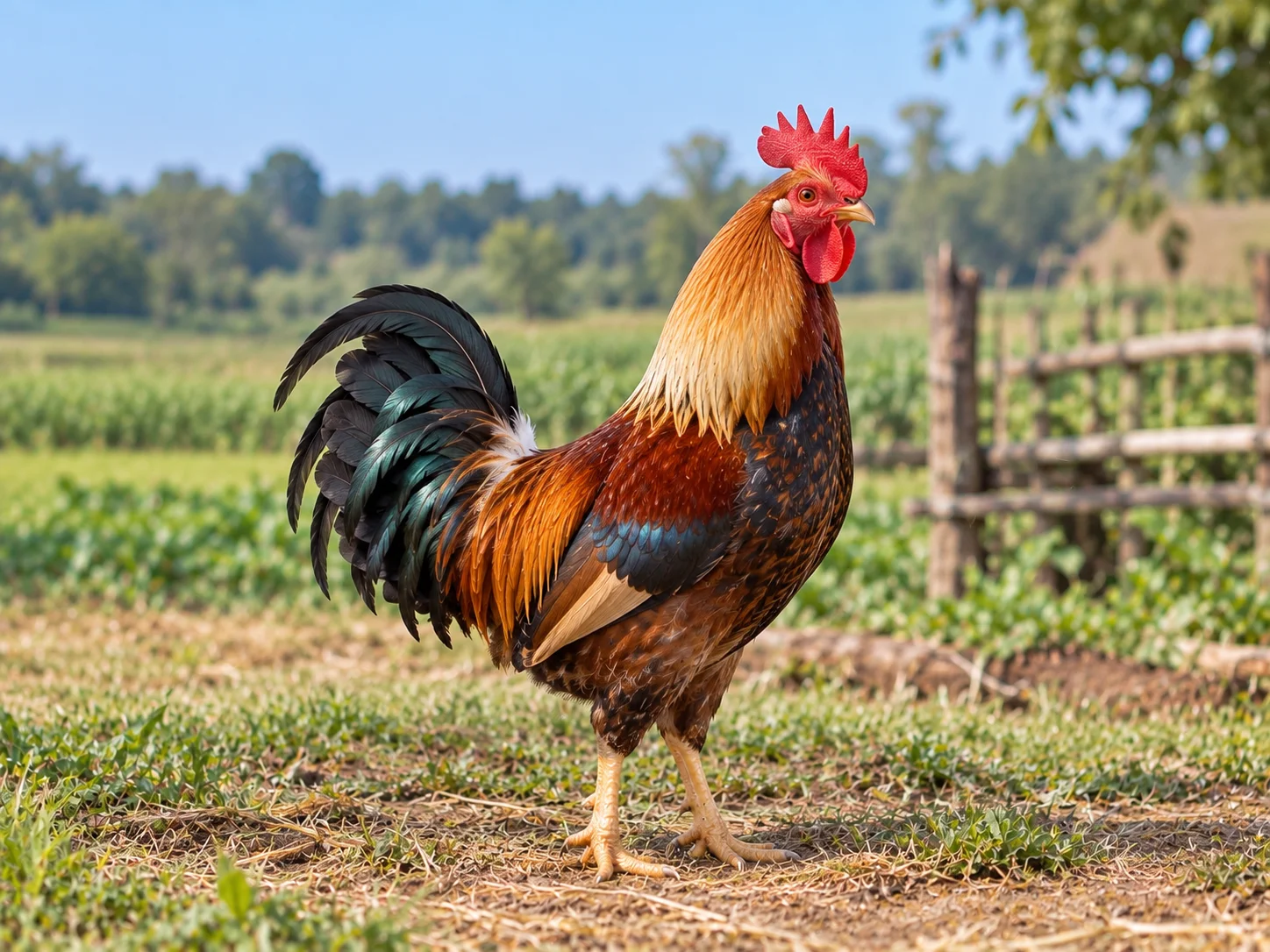
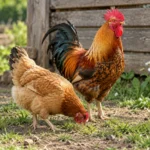
He is the showy one. Where a hen is built to disappear into the background, a rooster carries a tall red comb, long arching tail feathers, glossy neck hackles and sharp spurs on his legs.
And he crows. Loudly, repeatedly, and not only at sunrise, whatever the storybooks say.
Scientific Name and Classification
A rooster’s scientific name is Gallus gallus domesticus, the same as every chicken. “Rooster” describes sex and age, not a separate kind of bird.
- Kingdom: Animalia
- Phylum: Chordata
- Class: Aves
- Order: Galliformes
- Family: Phasianidae
- Genus: Gallus
- Species: Gallus gallus domesticus
The word rooster became common in American English partly to avoid the other meaning of “cock”. Both are correct, and “rooster” is what most people say today.
Do Roosters Only Crow at Sunrise?
No. Roosters crow all day long, and often at night too.
What is true is that they reliably crow around dawn, and the reason is genuinely interesting: a rooster has an internal body clock. Researchers kept roosters in constant dim light, with no sunrise to react to, and the birds still began crowing at roughly the same time each morning. They are not responding to the light. They are anticipating it.
Crowing through the day does other jobs. It announces territory to neighboring roosters, keeps the flock aware of where he is, and answers other roosters within earshot. Rank matters here too: in a group, the top rooster crows first and the others follow in order.
A crow can reach around 100 decibels close up, about as loud as a chainsaw. Roosters avoid deafening themselves with a neat trick: as the beak opens wide to crow, soft tissue partly closes the ear canal.
Appearance and Anatomy
Roosters stand roughly 1.5 to 2.5 feet tall and weigh 5 to 12 pounds depending on breed, noticeably larger than hens of the same breed.
- Comb and wattles. Much larger and redder than a hen’s. They shed heat, and their size and color signal health to hens.
- Hackles and saddle feathers. Long, pointed, often iridescent feathers on the neck and lower back. A hen’s are short and rounded.
- Sickle feathers. The long curved tail plumes that arch over his back. Hens do not have them.
- Spurs. Sharp bony projections on the backs of the legs, grown for fighting and capable of real damage.
Those four features together make a rooster easy to identify from a distance, long before he crows.
Habitat and Range
Roosters live wherever chickens are kept, on every continent except Antarctica.
A flock needs very few. One rooster can cover eight to twelve hens comfortably, and commercial egg farms keep none at all, since hens lay perfectly well without one. Many towns also ban roosters while allowing hens, purely because of the noise.
Like all chickens he will roost in a tree or on a high perch at night if he can, an instinct inherited from the forest-dwelling red junglefowl.
Diet and Feeding
Roosters are omnivores and eat what the rest of the flock eats: seeds, grain, greens, fruit, insects, worms, slugs and the occasional small animal.
He swallows grit deliberately so his gizzard can grind food, since chickens have no teeth.
Roosters do something hens do not. On finding good food, a rooster performs a display called tidbitting: he picks the morsel up, drops it, and calls with a rapid clucking until the hens come. He frequently does not eat it himself. Hens prefer roosters who tidbit often, so the behavior pays him back.
Behavior and Lifestyle
A rooster’s main job in a flock is watchman. He spends much of the day with his head up, scanning, while the hens feed with their heads down.
He has separate alarm calls for danger from above and danger on the ground, and the flock responds differently to each: freeze and look up for a hawk, run for cover from a fox. A good rooster will put himself between a predator and his hens, and roosters are regularly killed doing it.
Two roosters in one flock usually means conflict. They posture, raise their hackles, circle, and if neither backs down they fight with their spurs, sometimes seriously.
Roosters can be aggressive to people as well, particularly during the breeding season or when protecting chicks, and a rooster that attacks tends to go for legs and faces.
Reproduction and Life Cycle
A cockerel becomes fertile at around four to five months old, usually crowing for the first time some weeks earlier, often badly.
Courtship involves a sideways dance with one wing lowered and dragged along the ground, along with plenty of tidbitting.
His role ends there. Hens incubate the eggs and raise the chicks alone, though a rooster will defend them. Fertilized eggs hatch after about 21 days.
Roosters can live 8 to 10 years or more, though few get the chance.
Predators and Threats
Foxes, hawks, owls, raccoons, dogs and snakes all take chickens, and a rooster is more exposed than the hens because he stands in the open keeping watch.
He has real weapons in his spurs and will use them, but against a fox or a large hawk he is badly outmatched.
Disease, especially avian influenza, affects roosters as it does all poultry. Cockfighting remains a threat in some countries and is illegal in most.
Conservation Status
Chickens are domestic birds and are not assessed by the IUCN.
Roosters do face one specific issue. Because egg production needs only hens, male chicks from laying breeds have no commercial value, and enormous numbers are killed shortly after hatching. Several countries have now banned the practice, and new technology that identifies the sex of an embryo before hatching is being introduced to avoid it.
Role in the Ecosystem
Like all chickens, roosters eat insect pests, scratch and turn the soil, and fertilize the ground as they go.
Within a flock his role is protective rather than productive. A free-ranging flock with a rooster loses fewer birds to predators, because something is always watching while the others eat.
Culturally he has done well for himself. The rooster is a national emblem of France, one of the twelve animals of the Chinese zodiac, and a symbol of vigilance and the dawn in a great many traditions, for the simple reason that he reliably announces the morning.