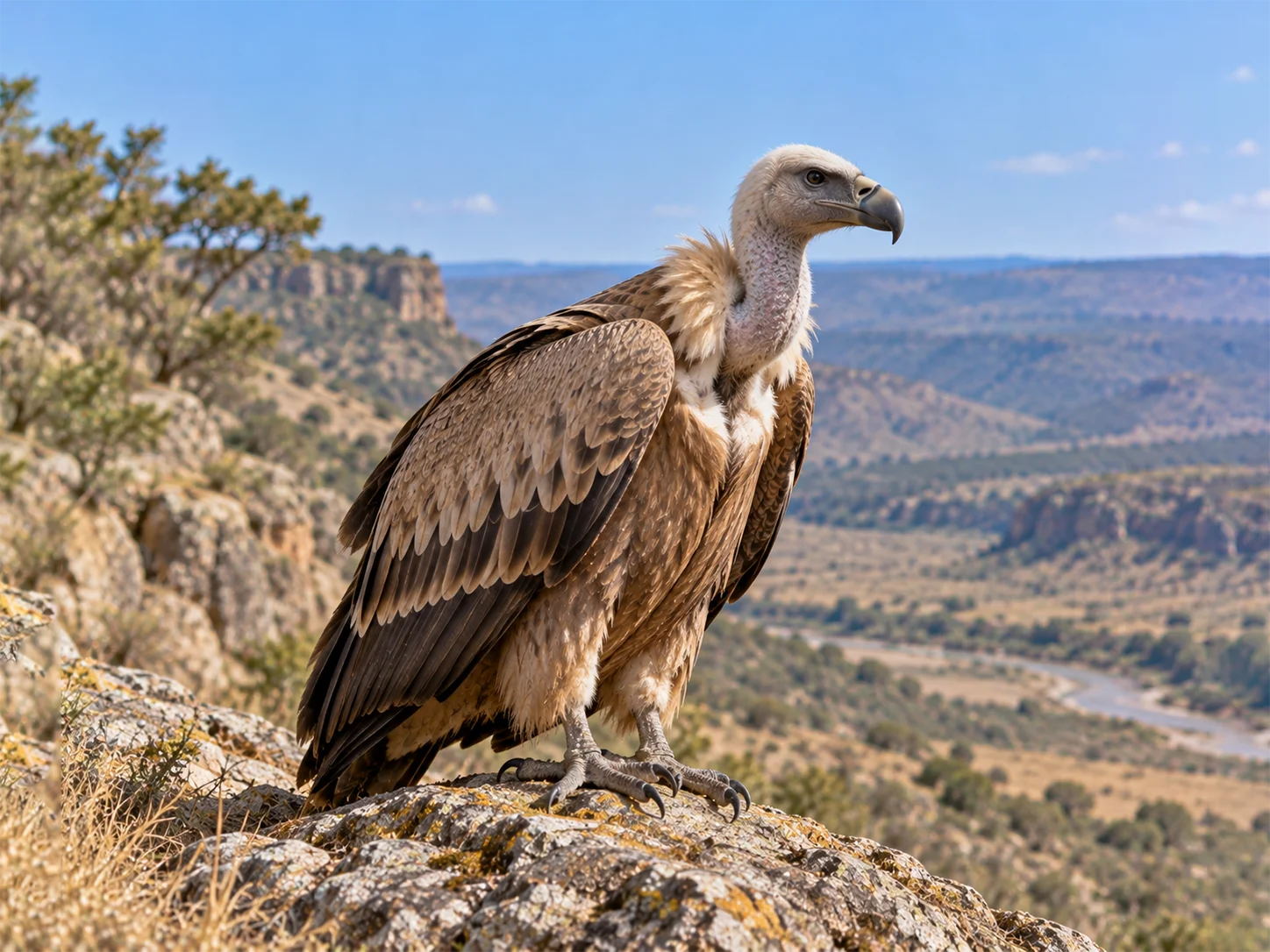
Meet the Vulture
A vulture can eat meat crawling with anthrax, botulism and cholera, and walk away fine. Its stomach acid is strong enough to dissolve bone and kills almost everything that goes into it.
That is not a disgusting detail. It is a public health service. Vultures destroy diseases that would otherwise spread from rotting carcasses into other animals and into people.
When India lost almost all of its vultures, the consequences were measured in human deaths, and it is one of the clearest demonstrations ever recorded of what a single group of animals was quietly doing for everyone else.
Scientific Name and Classification
Vultures have no single scientific name, and the reason is genuinely interesting: there are two completely separate groups of them.
- Old World vultures (family Accipitridae), in Europe, Asia and Africa. These are relatives of eagles and hawks.
- New World vultures (family Cathartidae), in the Americas, including the condors. These are not closely related to eagles at all.
- Kingdom: Animalia
- Phylum: Chordata
- Class: Aves
- Families: Accipitridae and Cathartidae
The two groups look alike, behave alike and do the same job, but they arrived there independently. Bald heads, soaring flight, scavenging and the hooked beak all evolved twice.
There are real differences underneath. Most New World vultures have an excellent sense of smell and can find a carcass hidden under forest canopy; Old World vultures hunt almost entirely by sight.
Why Are Vultures Bald?
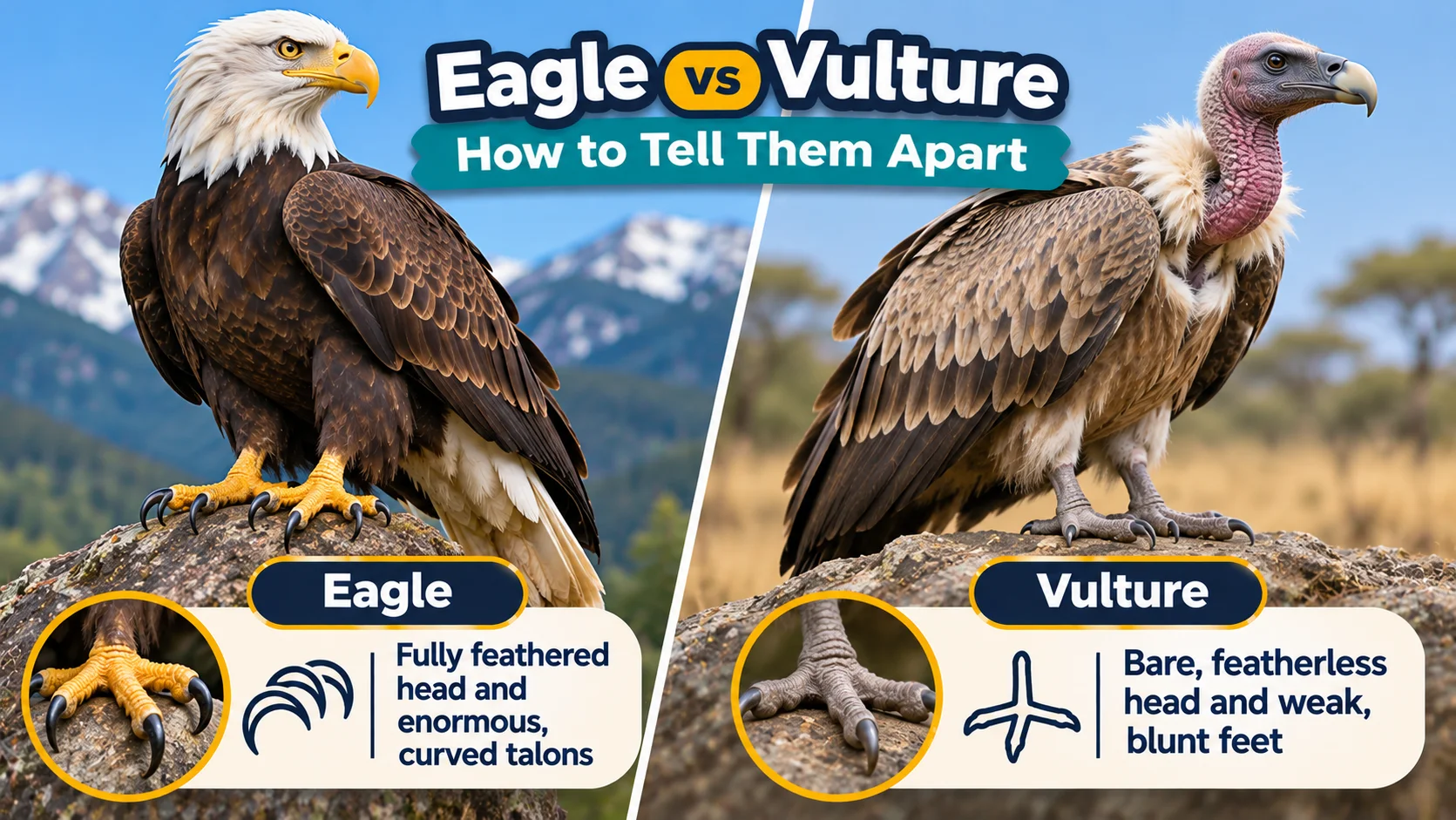
The usual answer is hygiene: a feathered head pushed inside a carcass would become clogged with blood and bacteria, and bare skin is easier to keep clean and is sterilized by sunlight.
That is part of it, and there is a second reason that is probably just as important: temperature control.
A vulture spends hours soaring in hot air and then stands on open ground at a carcass. Bare skin on the head and neck works as a radiator, and the bird adjusts it by posture: it stretches the neck out to shed heat and hunches it down into the body feathers to keep warm. Research on this found the neck posture tracks temperature closely.
Vultures also do something else that horrifies people and is entirely practical. They urinate down their own legs, which cools them by evaporation and kills bacteria picked up from standing in a carcass.
Appearance and Anatomy
Vultures range from about 2 pounds to the Andean condor at 33 pounds with a 10-foot wingspan, one of the largest flying birds alive.
- Stomach acid. Extraordinarily strong, far more corrosive than ours, destroying anthrax, botulism, cholera and rabies in the gut.
- Head and neck. Bare or sparsely downed, for hygiene and heat.
- Wings. Enormous and broad, built for soaring on rising air. A vulture can stay up for hours barely flapping.
- Beak. Hooked for tearing, though many vultures cannot open a tough hide and must wait for a larger animal to break it first.
- Feet. Relatively weak and flat, for walking rather than gripping, because a scavenger does not need to catch anything.
The bearded vulture is the specialist. It eats bone, dropping large ones onto rocks from height to shatter them, and its diet is roughly 70 to 90 percent bone.
Habitat and Range
Vultures live on every continent except Antarctica and Australia, in savanna, desert, mountain, grassland and forest.
They need open sky and rising warm air more than any particular ground, because soaring is how they cover the enormous distances required to find scattered carcasses. A vulture may search hundreds of square miles in a day.
They also need cliffs or tall trees to nest and roost on, and they gather at communal roosts of dozens or hundreds of birds.
Diet and Feeding
Vultures are carnivores and almost entirely scavengers, eating animals that are already dead.
Finding the food is the hard part, and vultures watch each other to do it. A bird dropping out of the sky is a signal, and others converge from miles around, so a carcass can go from empty to covered in vultures within minutes.
Different species specialize at the carcass itself. Large ones tear open the hide, medium ones eat muscle and organs, small ones pick scraps from the bones, and the bearded vulture takes the bones themselves. A full set of species strips a carcass almost completely.
They can eat a fifth of their body weight at once, then go days without food, which suits a food supply that arrives unpredictably.
Behavior and Lifestyle
Vultures are social, feeding and roosting in groups with a clear order of precedence at a carcass.
They are patient. Much of a vulture’s day is spent perched waiting for the air to warm enough to soar, then circling for hours.
They spread their wings in the sun in a posture called horaltic, which warms them, dries the feathers and may help kill bacteria.
Their defense is unpleasant and effective: a threatened vulture vomits, which lightens it for a fast takeoff and discourages whatever is approaching.
They are also more intelligent than their reputation. Egyptian vultures use stones as tools, picking them up and throwing them at ostrich eggs to break the shell.
Reproduction and Life Cycle
Vultures breed slowly, which is central to why they are now in so much trouble.
Most lay a single egg, occasionally two, on a cliff ledge, in a cave or in a large tree nest. Incubation runs about 50 to 60 days, shared by both parents.
Chicks develop slowly and stay dependent for months. Condors may raise one chick only every other year, and do not breed at all until six to eight years old.
Many vultures pair for life, and vultures are long-lived birds, commonly reaching 20 to 30 years and sometimes 50.
Predators and Threats
Adult vultures have few natural predators, though eagles and large carnivores take young birds and eggs.
Poisoning is the overwhelming threat, and it happens in several ways. Farmers poison carcasses to kill predators, and vultures arriving in numbers die by the hundred from a single bait. Poachers poison carcasses deliberately, because circling vultures reveal a kill to rangers. Lead from ammunition in shot animals poisons them slowly.
The worst case was a veterinary drug. Diclofenac, given to cattle in South Asia, causes fatal kidney failure in vultures that eat the carcass, and it wiped out over 95 percent of several Indian vulture species in roughly a decade.
Conservation Status
Vultures are among the most threatened groups of birds in the world. More than half of all species are at risk, and several Asian and African vultures are Critically Endangered.
The Indian collapse is the headline case. Three vulture species fell by well over 95 percent after diclofenac came into use, in one of the fastest declines of any bird ever recorded. The drug has since been banned for veterinary use and numbers are slowly stabilizing.
The California condor is the counter-example. Down to 22 birds in 1987, every one was taken into captivity and bred, and there are now several hundred, with many flying wild again. Lead poisoning remains their biggest obstacle.
Role in the Ecosystem
Vultures are nature’s sanitation system, and India showed exactly what happens without them.
When the vultures died, cattle carcasses they would have stripped in hours were left to rot. Feral dog numbers rose sharply on the extra food, rats multiplied, and rabies cases in people increased. Research has linked the vulture collapse to a very large number of additional human deaths over the following years, a cost running into billions of dollars.
That is the clearest measurement anyone has of what a scavenger is worth.
Vultures also do the job better than mammal scavengers, because their stomach acid destroys the pathogens rather than passing them on. A dog eating an anthrax carcass can spread anthrax; a vulture ends it.
They return nutrients to the soil, and for a bird most people find ugly, they are probably among the most directly useful animals in the world.