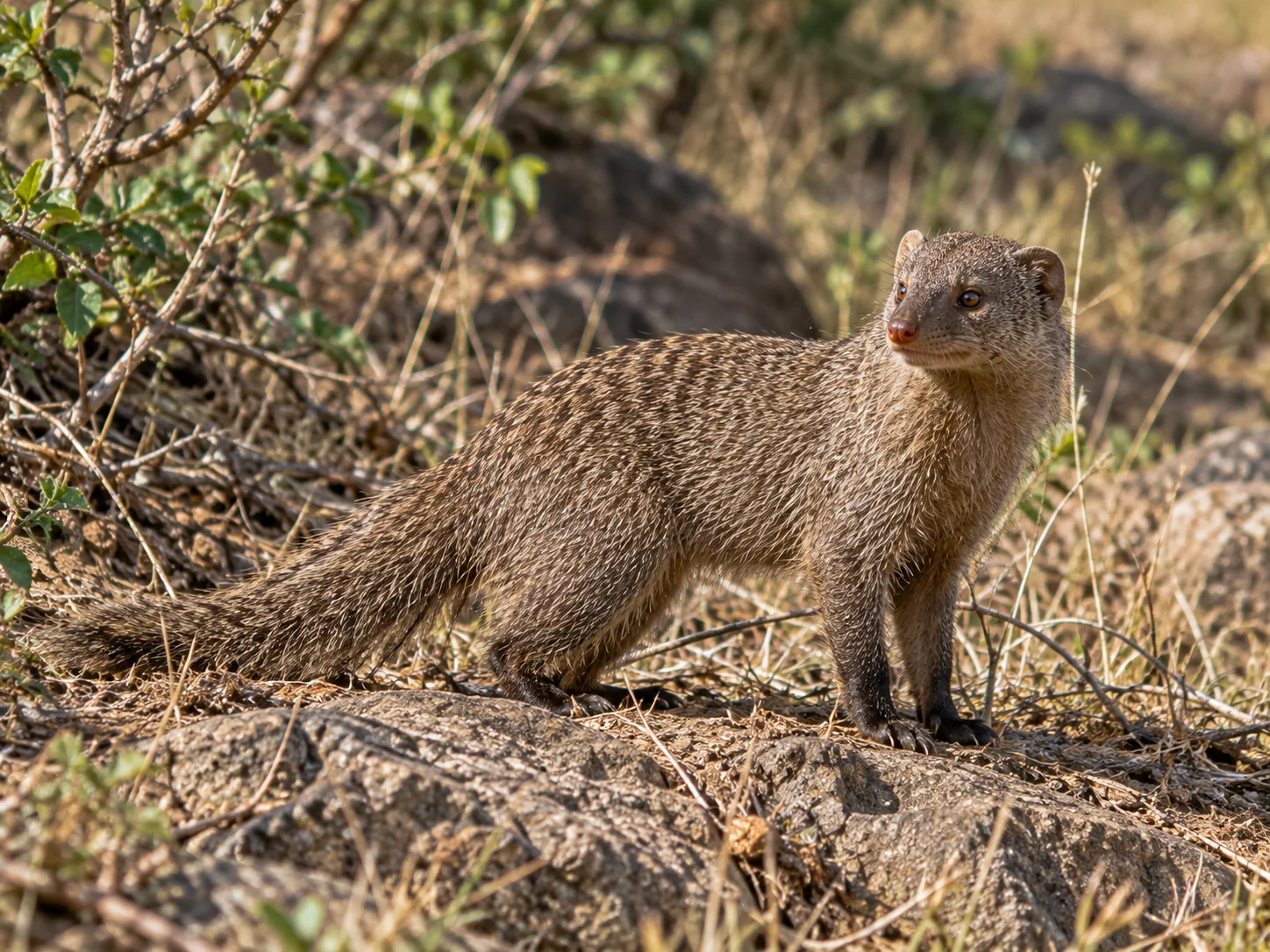
Meet the Mongoose
The story everyone knows is that the mongoose is immune to snake venom. It is not true, and the real explanation is more interesting.
A mongoose has partial resistance, and it comes from a specific molecular quirk. Cobra venom works by jamming the acetylcholine receptor, the switch that lets nerves tell muscles to move. In mongooses, that receptor is shaped slightly differently, so the venom binds to it poorly. The same mutation has turned up independently in honey badgers, hedgehogs and pigs, which is a striking case of several species arriving at the same answer.
But resistance only buys margin. A mongoose that takes a full bite from a large cobra can still die, and it wins its fights mainly by not getting bitten: speed, a thick coat, erect fur that makes it look bigger, and the patience to wait for the snake to tire.
Scientific Name and Classification
Mongooses are the family Herpestidae, with around 34 species, so there is no single scientific name. The Indian gray mongoose is Urva edwardsii, and the dwarf mongoose is Helogale parvula.
- Kingdom: Animalia
- Phylum: Chordata
- Class: Mammalia
- Order: Carnivora
- Family: Herpestidae
Mongooses are not weasels, though they look like them. Their closest relatives are civets, genets and, more distantly, hyenas and cats, which puts them in the cat-like branch of the carnivores rather than the dog-like one. The resemblance to a weasel is convergence, not kinship.
The meerkat is a mongoose, which surprises most people. It is Suricata suricatta, within Herpestidae, and it is simply the most famous member of the family.
The plural is mongooses, not mongeese. The word comes from a south Indian language, probably Marathi or Telugu, and has nothing to do with geese.
Mongooses Teach Their Young
Teaching is rare in animals. For it to count, an adult has to change its own behavior, at a cost, specifically to help a youngster learn something it could not work out alone. Very few species have been shown to do it, and the meerkat is one of the clearest cases on record.
Adult meerkats train pups to handle scorpions, and they do it in graded steps:
- First, they bring the pup a dead scorpion.
- Then, a live one with the sting removed.
- Then, a live intact scorpion, with an adult standing by to intervene if the pup fumbles it.
The adults adjust the difficulty according to the pup’s age, judged largely by the begging call it makes, and researchers demonstrated the mechanism by playing recordings of older pups’ calls to younger ones, after which the adults started bringing harder prey.
This is also how wild predators learn to deal with cane toads elsewhere, and conservation programs have borrowed the idea deliberately.
Appearance and Anatomy
Mongooses range from the dwarf mongoose at 8 inches and 7 ounces to the white-tailed mongoose at over 4 feet including the tail and 11 pounds (5 kg).
- Body. Long and low, with short legs and a tapering bushy tail, built for getting into burrows and crevices.
- Claws. Non-retractable and strong, for digging.
- Coat. Coarse and dense, which a striking snake struggles to penetrate, and which the mongoose can erect to look substantially larger.
- Eyes. Horizontal pupils, giving a wide sharp view along the ground, and good enough vision to track a fast strike.
- Anal scent glands. Well developed, used heavily for marking and for group identity.
Most are grizzled gray or brown, and several species have banded coats, like the banded mongoose of southern Africa.
Habitat and Range
Mongooses are native to Africa, southern Asia and parts of southern Europe, in savanna, grassland, scrub, forest, desert and farmland, and several species do well around villages and towns.
Africa holds the most species. The Egyptian mongoose reaches Spain and Portugal, the only mongoose native to Europe, and the Indian gray mongoose is common across the subcontinent.
They are also one of the world’s most damaging introduced animals, which is covered below, and introduced populations now exist in Hawaii, the Caribbean, Fiji, Okinawa and elsewhere.
Most species shelter in burrows, which they dig themselves or take over from other animals, and termite mounds are a favorite.
Diet and Feeding
Mongooses are carnivores in the main, though several take fruit and are effectively omnivorous.
Insects are the staple for most species, along with scorpions, spiders, worms, crabs, lizards, snakes, rodents, birds and eggs. Snakes are a much smaller part of the diet than the legend suggests; a mongoose is primarily an insect eater that is capable of killing a snake when it has to.
They handle eggs and hard-shelled prey in a way worth watching: a mongoose will stand up and hurl an egg or snail backwards between its legs against a rock until it breaks, and some species have a favorite anvil stone they use repeatedly.
They are also resistant enough to scorpion venom to eat scorpions routinely, biting off the sting first.
Behavior and Lifestyle
The mongoose family splits neatly in two, and the split is one of the more interesting things about it. Roughly half the species are solitary, and the other half are intensely social, living in groups of up to 50.
Social mongooses run cooperative societies that look oddly familiar. Meerkats and dwarf mongooses post sentinels that stand upright and watch while the rest forage, and the sentinel gives different alarm calls for a hawk, a jackal and a snake, each producing a different response from the group. They have babysitters, adults who stay behind at the burrow with pups while the group forages, going without food themselves for the day.
Dwarf mongooses also form a working partnership with hornbills. The birds follow foraging mongooses to catch insects the mammals flush out, and in return they watch for raptors and call a warning, and the mongooses will wait in the morning for the hornbills to arrive before setting off.
Within groups there is a dominant breeding pair, and subordinate females that breed may have their pups killed, which is the harsh side of a cooperative society.
Reproduction and Life Cycle
Gestation runs 42 to 105 days depending on species, and litters are two to four pups, born blind in a burrow.
In social species the whole group raises them. Pups are guarded, carried, groomed and fed by adults other than their mother, and babysitting duty rotates.
Banded mongooses do something unusual: all the breeding females in a group give birth on the same day, often within hours of each other, which means no pup can be identified as belonging to a particular mother and none can be singled out and killed. Synchronising birth is a defense against infanticide.
Pups emerge from the burrow at about four weeks and begin following the group, learning what to eat and how to handle it, and in meerkats each pup attaches itself to a particular adult who feeds and teaches it.
Mongooses live 6 to 10 years in the wild and up to 20 in captivity.
Predators and Threats
Eagles, hawks, jackals, caracals, leopards, large snakes and domestic dogs take mongooses, and raptors are the main danger to the small social species, which is exactly why they post sentinels and look upward so often.
In India, mongooses are killed in large numbers for their hair, which is used to make paintbrushes, and this remains a serious illegal trade despite the species being protected under the Wildlife Protection Act. Tens of thousands of animals are estimated to be killed for brushes, with the hair often smuggled and sold internationally.
They are also caught for staged snake-versus-mongoose fights, which is illegal and still happens, and persecuted as poultry pests.
Conservation Status
Most mongoose species are listed as Least Concern, and several are abundant. A few with small ranges, such as Liberian and Jackson’s mongooses, are threatened by forest loss.
The more significant conservation story runs the other way, and it is one of the classic cautionary tales in ecology.
In the 1870s and 1880s, small Indian mongooses were introduced to Hawaii, Jamaica, Puerto Rico, Fiji and other islands to control rats in sugar cane. The plan failed on a basic point of biology that nobody checked: rats are mostly nocturnal and mongooses hunt by day, so they largely ignored each other.
What the mongooses did eat was everything else. Ground-nesting birds, sea turtle eggs, lizards and amphibians that had evolved with no mammalian predators at all. They are implicated in the extinction or near-extinction of numerous island species, including Hawaiian birds and Caribbean reptiles, and in the Hawaiian petrel and nene goose becoming endangered. They also spread rabies in Puerto Rico.
The small Indian mongoose is now on the list of the world’s 100 worst invasive species, and eradicating it from an island is extremely difficult and expensive.
Role in the Ecosystem
Where they belong, mongooses are valuable insect and rodent predators, and in African savanna the social species turn over enormous quantities of invertebrates.
Their digging aerates soil and creates burrows that other animals use, and their partnership with hornbills is one of the better-documented cases of mutual benefit between a mammal and a bird.
Scientifically they have been extraordinarily useful. Meerkats and banded mongooses are among the most studied wild mammals on earth, and long-running projects in the Kalahari and Uganda have shaped what biologists understand about cooperative breeding, sentinel behavior, teaching and the costs of living in a group.
And the mongoose carries two lessons that pull in opposite directions. It is not immune to venom, which is a reminder to check a good story. And it was moved around the world on the strength of an assumption nobody tested, which is a reminder that checking matters: a day-hunting predator was shipped to a dozen islands to kill a night-active rodent, and the birds paid for it.