Meet the Aardvark
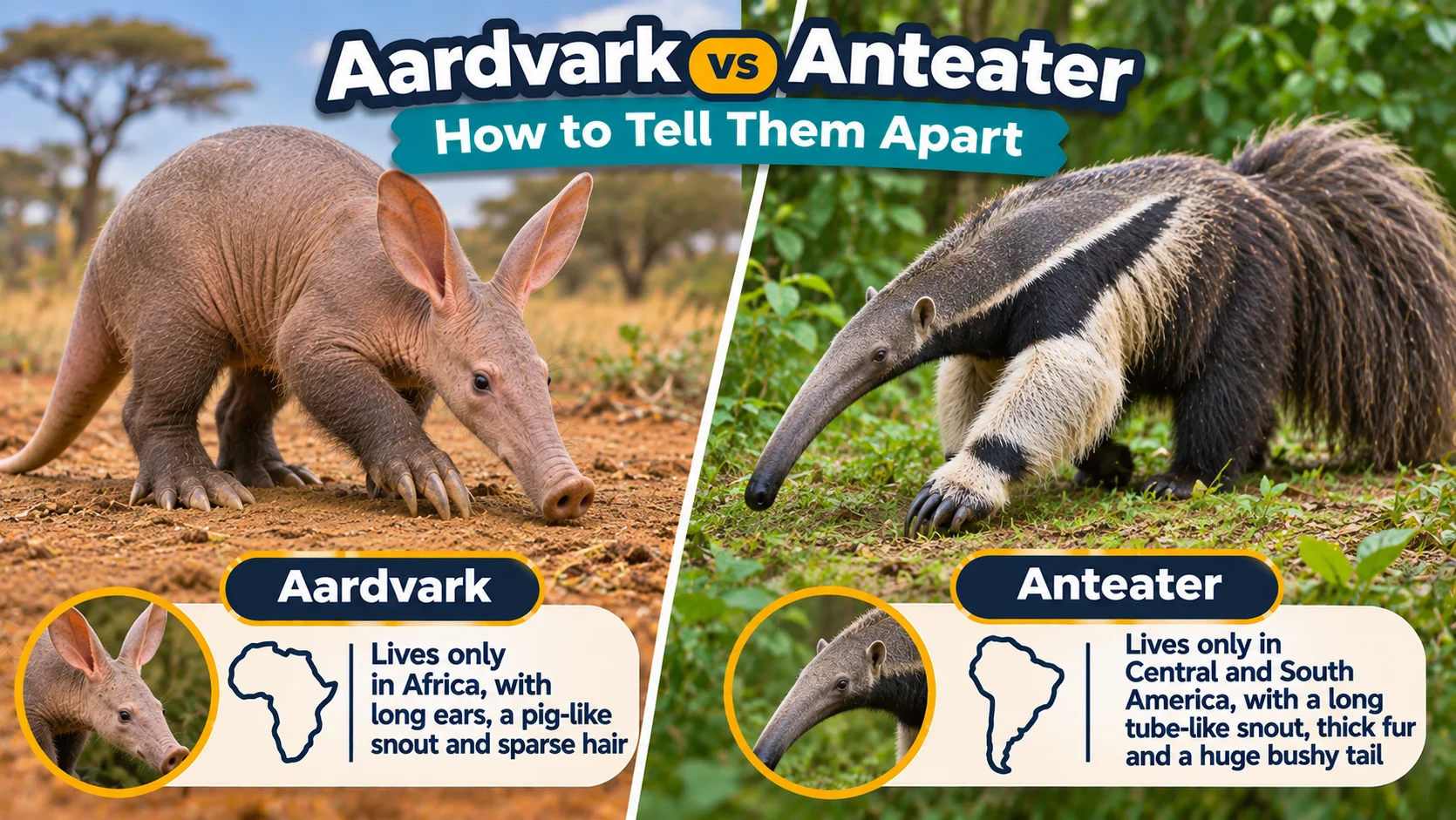
The aardvark looks like an animal built from spare parts. It has the snout of a pig, the ears of a rabbit, a tail like a kangaroo’s, and claws shaped like garden trowels. It is not closely related to any of those animals. In fact, the aardvark is the only living member of an entire order of mammals, which makes it one of the loneliest branches on the whole mammal family tree.
Its name comes from Afrikaans and means “earth pig,” which tells you how it spends its nights. An aardvark digs almost constantly, and those burrows turn out to matter far beyond the animal itself. When an aardvark moves out, warthogs, porcupines, hyenas, jackals, pangolins, lizards and birds move in.
Hardly anyone sees one. Aardvarks come out after dark, travel alone, and vanish underground at the first hint of danger. Safari guides in southern Africa can work for years without a single sighting.
Scientific Name and Classification
The aardvark’s scientific name is Orycteropus afer. The German naturalist Peter Simon Pallas described the species in 1766. Orycteropus comes from Greek and means “burrowing foot.” Afer means “of Africa.” Together they translate roughly to “the digging foot from Africa.”
The everyday name is Afrikaans. Aarde means earth and vark means pig. Older English books often call the animal an antbear instead.
- Kingdom: Animalia
- Phylum: Chordata
- Class: Mammalia
- Order: Tubulidentata
- Family: Orycteropodidae
- Genus: Orycteropus
- Species: Orycteropus afer
The order name Tubulidentata means “tube-toothed,” and it points to something genuinely odd about aardvark teeth. They have no enamel and no roots, and they keep growing throughout the animal’s life. Each tooth is a bundle of hundreds of thin tubes packed tightly together. No other mammal has teeth built this way.
Every other species in the order Tubulidentata is extinct. The aardvark is the last one left.
Appearance and Anatomy
An adult aardvark measures about 3.4 to 4.3 feet (105 to 130 cm) from nose to rump, with a heavy tail adding another 18 to 28 inches (45 to 70 cm). Measured nose to tail tip, a big one reaches roughly 7.3 feet (2.2 m). Most weigh between 110 and 180 pounds (50 to 80 kg), though some reference works record animals as light as 88 pounds (40 kg).
The skin is thick and grayish-pink, covered in sparse bristly hair rather than proper fur. The legs often look darker than the body, stained by the soil the animal spends its nights in.
Almost every part of an aardvark is shaped by two jobs: digging, and eating insects.
- Claws. The front feet have four toes tipped with flattened, spade-like claws. The back feet keep all five toes. The front claws can tear open a termite mound that a person would struggle to break with a hammer.
- Snout. Long, flexible and tube-shaped, packed with more scent-detecting tissue than almost any other mammal carries.
- Nostrils. They seal shut on command, keeping soil and angry insects out while the animal digs.
- Tongue. Up to 12 inches (30 cm) long, narrow, and coated in sticky saliva.
- Ears. Tall and rabbit-like, with sharp hearing. They fold flat against the head during digging.
- Tail. Thick and muscular where it meets the body, used as a prop when the animal sits back on its hind legs.
Habitat and Range
Aardvarks live across most of sub-Saharan Africa, from Senegal in the west to Ethiopia in the east and south as far as the Cape. That is an enormous range covering dozens of countries, including Kenya, Tanzania, Zambia, Mozambique, Botswana, Namibia and South Africa.
They turn up in savanna, grassland, open woodland and scrub, and have been recorded at elevations above 10,000 feet (3,200 m). The two places they avoid are true desert and hard rocky ground, for the same reason in both cases: an aardvark that cannot dig cannot hide.
Soil matters more to an aardvark than vegetation does. They favor loose, sandy ground that is easy to excavate, and they tend to settle near good supplies of termite mounds and ant nests.
Diet and Feeding
Aardvarks are insectivores, and they are unusually specialized even by that standard. Ants and termites make up nearly the whole diet. Beetle larvae turn up occasionally, and that is about the extent of the variety.
A foraging aardvark walks in a slow zigzag with its snout close to the ground, sweeping for the scent of a nest. Once it finds one, it braces on its hind legs and tail and rips the mound open with its front claws. Then the tongue goes to work, flicking in and out and pulling insects back by the hundred. Biologists call aardvarks “scratch diggers” for this style of feeding.
A single aardvark can eat tens of thousands of insects in one night, and may cover several miles doing it. The prey supplies water as well as food, which is why aardvarks manage in places where open water is scarce.
There is one strange exception to the insect-only rule. Aardvarks eat a fruit called the aardvark cucumber (Cucumis humifructus), which grows entirely underground. The animal digs it up for the moisture, then scatters the seeds in its dung. The plant depends on the aardvark to reproduce, making this one of the few known partnerships of its kind.
Behavior and Lifestyle
Aardvarks are nocturnal and solitary. They emerge after sunset, forage through the night, and are usually back underground before the heat of the morning builds. Adults meet mainly to mate, and otherwise keep to themselves.
Digging shapes everything they do. An aardvark will scrape a shallow hole for a day’s rest, open smaller holes while chasing insects, and maintain a larger home burrow that can run up to 46 feet (14 m) with several entrances and chambers. Those home burrows hold a steady temperature and humidity whatever the weather does above ground, which is exactly what makes them so valuable to other animals later on.
An alarmed aardvark heads for the nearest burrow. If there is no burrow within reach, it digs one, and it digs astonishingly fast. Cornered with no way down, it rolls onto its back and strikes upward with all four sets of claws, which is enough to make most predators reconsider.
Eyesight is poor and colorblind. Hearing and smell do almost all the work.
Reproduction and Life Cycle
Because aardvarks are so hard to observe, much of what happens between a wild male and female remains unknown. Pairs come together briefly to mate and then separate.
Gestation runs about seven months and almost always produces a single cub. Twins happen, but rarely. The newborn weighs around 4 pounds (2 kg) and arrives pink, nearly hairless and wrinkled, with its eyes already open.
For the first two weeks the cub stays in the burrow. After that it begins following its mother on night foraging trips, learning where the termite mounds are. It is weaned at roughly three months, starts digging burrows of its own at around six months, and is usually independent soon after.
Aardvark milk is unusually high in protein, which is what you would expect from a mother living entirely on insects.
Zoo aardvarks have lived to about 23 years. Lifespan in the wild is not well documented, and is thought to be considerably shorter, somewhere near ten years.
Predators and Threats
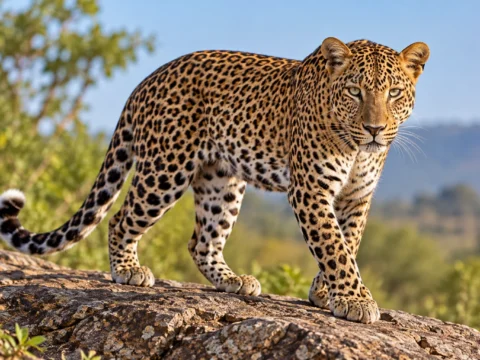
Lions, leopards, hyenas, African wild dogs and large pythons all take aardvarks when they get the chance. Cubs are far more vulnerable than adults, and most predation happens above ground at night.
Human pressures are the bigger long-term problem:
- Habitat loss. Farming and settlement keep expanding into aardvark country.
- Hunting for meat. Aardvarks are taken for bushmeat in parts of the Democratic Republic of the Congo, Kenya, Mozambique and Zambia.
- Conflict with farmers. Burrows in fields and pasture get aardvarks killed as pests.
- Pesticides. Chemicals used on crops reduce the ant and termite populations the animal depends on entirely.
- Climate change. Research from Oregon State University found that drying landscapes isolate aardvark populations and leave them exposed to heat and long droughts, with the Horn of Africa among the areas at greatest risk.
The climate threat is harder to see than a snare or a plow, but it strikes at the food supply, and an animal this specialized has nothing to switch to.
Conservation Status
Globally, the IUCN Red List classifies the aardvark as Least Concern, based on an assessment completed in 2016. The species covers a huge range and is not considered at risk of extinction overall. It is not listed under CITES.
That reassuring label hides a real difficulty. Nobody knows how many aardvarks there are. They are nocturnal, solitary and underground for most of the day, so no reliable population estimate exists and no trend can be measured. Conservation groups have asked for standardized monitoring precisely because the data gap is so wide.
There is already one warning sign. In the 2025 Regional Mammal Red List for South Africa, Lesotho and Eswatini, compiled by the Endangered Wildlife Trust and the South African National Biodiversity Institute, the aardvark was moved up from Least Concern to Near Threatened. That change applies to southern Africa rather than the whole species, and the assessors linked it to climate pressure on the animal’s insect prey and on habitat quality.
Zoos in North America and Europe run managed breeding programs for aardvarks, which keeps a healthy backup population and gives researchers a chance to study an animal that is almost impossible to watch in the wild.
Role in the Ecosystem
If you had to justify the aardvark’s existence to a skeptic, you would start with its burrows. Scientists call the aardvark an ecosystem engineer, meaning an animal that physically reshapes the place it lives in ways that other species depend on.
An abandoned aardvark burrow does not stay empty for long. Studies have recorded at least 27 other vertebrate species using them. Warthogs, porcupines, hyenas, jackals, pangolins, mongooses, bats, owls, lizards and snakes all move in, and some modify the entrance to suit themselves. African wild dogs, one of the continent’s most endangered carnivores, raise their pups in dens that often began as aardvark diggings.
What makes the burrows so valuable is the climate inside them. Temperature and humidity stay steady while the surface swings between blistering afternoons and cold nights. In dry country that stability can decide whether an animal survives a heat wave, a drought or a grass fire. The burrows also work as nurseries, giving young animals a defensible place to grow up.
The digging helps in quieter ways too. Turning over soil aerates it and mixes in nutrients, so plants grow better around old burrow sites, which feeds the herbivores, which feeds everything above them. And by eating termites in enormous numbers, aardvarks hold down insects that damage crops and buildings.
Remove the aardvark and you do not lose one animal. You lose the housing supply for dozens.
Subspecies
Aardvark subspecies are genuinely unsettled, and it is worth being straight about that rather than presenting a tidy list.
Over the years naturalists described as many as eighteen subspecies. Specialists now treat most of those as doubtful, because the descriptions rested on very few specimens and the features used to tell them apart vary continuously across the animal’s range. Many are likely to be duplicates of one another under different names.
Modern references usually recognize three:
- Orycteropus afer afer, the southern aardvark
- Orycteropus afer adametzi, the western aardvark
- Orycteropus afer wertheri, the eastern aardvark
Even those boundaries are fuzzy. Conservation specialists have recommended a genetic study to sort the question out properly, which has not yet been done across the full range.