Meet the Agama Lizard
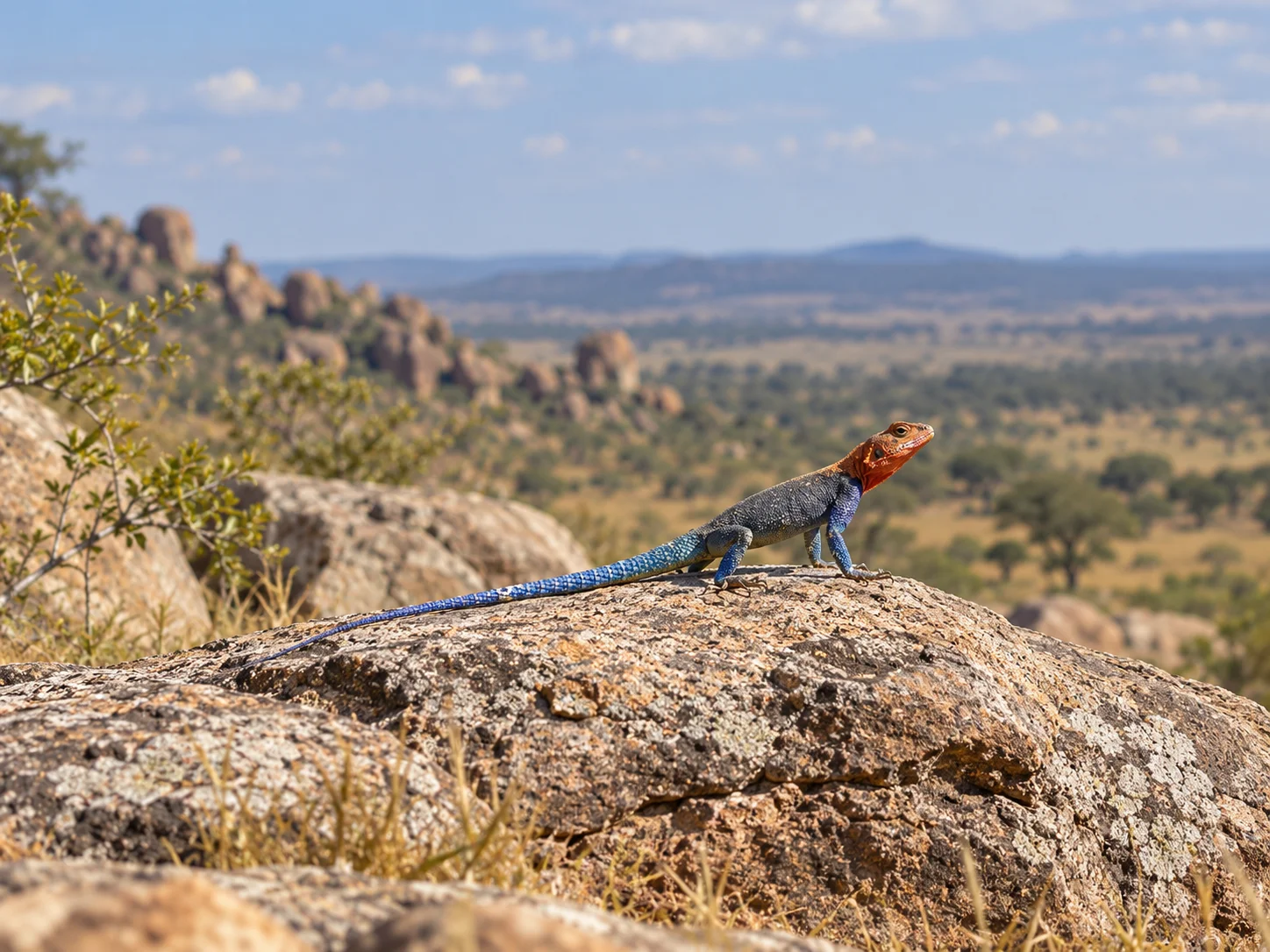
A dominant male common agama has a brilliant orange or red head on a deep blue body. He is impossible to miss, which is exactly the point.
Those colors are a status report. Only the top male in an area wears them, and he can switch them off: challenge him, frighten him, or wait until nightfall, and the brilliance drains away to drab brown within minutes.
Agamas are among the most familiar lizards of sub-Saharan Africa, basking on rocks, walls and rooftops, bobbing their heads at each other all day long.
Scientific Name and Classification
The common agama’s scientific name is Agama agama. It is also called the red-headed rock agama or rainbow agama.
- Kingdom: Animalia
- Phylum: Chordata
- Class: Reptilia
- Order: Squamata
- Family: Agamidae
- Genus: Agama
- Species: Agama agama
The genus Agama holds around 40 African species, and the family Agamidae is much larger again, including the bearded dragons of Australia and the flying dragons of Southeast Asia.
Worth knowing: the name Agama agama has been applied loosely for a long time, and recent genetic work has split what people once called one species into several. The agamas living wild in Florida, long assumed to be Agama agama, turned out on DNA testing to be a different species, Agama picticauda.
Why Do Agama Lizards Change Color?
Because color is how they talk to each other.
In a group of agamas one male is dominant, and only he wears the full display: orange or red head, blue body, often a banded tail. Subordinate males stay brown and inconspicuous, because advertising would get them attacked.
The colors come and go. A dominant male fades to drab when he is cold, at night, when he is frightened, and when he loses a fight. A male who wins a territory colors up within days.
Females are a plain olive-brown year round, with some orange on the sides when carrying eggs.
Alongside the color comes the head-bobbing. Agamas bob, do push-ups and flatten their bodies sideways to look larger, and a confident male performs this at any rival who comes near. Actual fighting, with tail-lashing and biting, is a last resort.
Appearance and Anatomy
Common agamas measure 5 to 12 inches in total length, tail included, and weigh only a few ounces. Males are noticeably larger than females.
- Head. Large and broad in males, carrying the bright breeding color.
- Tail. Long, often more than half the total length, used for balance. Unlike many lizards, agamas cannot regrow a lost tail properly.
- Claws. Strong and curved for gripping rock, bark and brickwork.
- Scales. Rough and keeled, giving a slightly spiny look.
- Eyes. Moved independently, with good color vision, which matters for an animal that signals with color.
They are fast over short distances and will sprint for cover at the first sign of movement.
Habitat and Range
Common agamas live across sub-Saharan Africa, in countries from Senegal and Mauritania in the west across to Kenya and Tanzania.
They like warm, dry, open ground with hard surfaces to bask on and crevices to hide in: rocky outcrops, savanna, scrub and the edges of forest.
They have done extremely well out of people. Walls, buildings, bridges and rubble piles are ideal agama habitat, so they are often commonest in villages and towns, basking on rooftops in full view.
Agamas have also been carried abroad by the pet trade and now live wild in southern Florida, where they have spread widely.
Diet and Feeding
Agamas are mainly insect eaters, taking ants, termites, beetles, grasshoppers and flies, and they will also eat small lizards, eggs, flowers, fruit and seeds, which makes them omnivores in practice.
Ants and termites are the staple, and an agama sitting beside a termite trail can eat a very large number in a sitting.
They hunt by sight and ambush, sitting still in a sunny spot, watching, then dashing out. Their sticky tongues catch small prey, and the teeth are fused to the jaw rather than set in sockets.
They get most of their water from food, which suits dry country.
Behavior and Lifestyle
Agamas are active by day and live in small groups, usually one dominant male with several females and some subordinate males.
The day follows the sun. They emerge to bask, warming up before they can hunt properly, feed through the morning, shelter in a crevice through the hottest hours, then feed again in the afternoon.
The dominant male spends much of his time on a high perch, in full color, watching. Those are the lizards people notice on walls.
In towns, where good basking spots are scarce, fights between males are more frequent than in open country, simply because there is more worth fighting over.
Reproduction and Life Cycle
Agama lizards usually breed after the rains. A female digs a shallow hole in damp sandy soil, lays a clutch of around five to seven eggs, covers them and leaves.
The nest temperature then decides the sex of the hatchlings, and in agamas it is unusually precise: eggs held near 29 degrees Celsius produce males, while eggs at 26 to 27 degrees produce females. A couple of degrees decides the entire clutch.
Eggs hatch after roughly two to three months, and the young are independent from the moment they emerge. There is no parental care at all.
Agamas typically live around 8 to 15 years, with the longest lives in captivity.
Difference Between Agama and Bearded Dragon
They are relatives, both in the family Agamidae, and they are often confused by people choosing a pet lizard.
| Common agama | Bearded dragon | |
|---|---|---|
| Where from | Sub-Saharan Africa | Australia |
| Color | Dominant males orange-headed and blue | Tan, brown or orange; no blue |
| Throat | Plain | Spiny beard that puffs out and blackens |
| Temperament | Nervous and fast; dislikes handling | Calm and tolerant of people |
| As a pet | Rarely suitable | One of the most popular pet lizards |
The short version: if it is bright blue with an orange head, it is an agama; if it has a spiny throat it can puff out like a beard, it is a bearded dragon.
Predators and Threats
Snakes, birds of prey, mongooses, monitor lizards, monkeys and domestic cats all eat agamas. Being brightly colored and sitting in the open is risky, which is part of why only the dominant male does it.
Their defenses are speed, wariness and a crevice nearby. They notice movement quickly and bolt.
They are not under serious human pressure. Agamas adapt well to settlements and are widespread and common, though collection for the pet trade takes animals in some areas and many die in transport.
Conservation Status
The common agama is widespread and abundant across sub-Saharan Africa and is not considered at risk. If anything it has benefited from human settlement, since buildings make excellent agama habitat.
The complication is taxonomic rather than ecological. Because Agama agama has recently been split into several species, some populations once counted as part of one very common species may turn out to be narrower-ranging species that need assessing on their own.
In Florida, where they are introduced rather than native, the concern runs the other way: a non-native lizard eating native insects and competing with native lizards.
Role in the Ecosystem
Agamas eat enormous numbers of insects, particularly ants and termites, which makes them useful around homes and gardens.
They are also prey, feeding snakes, birds of prey and small carnivores, so they sit in the middle of the food chain and move energy from insects up to larger animals.
Because they thrive alongside people, they are one of the few wild animals many African children see every day, which makes them a good introduction to how wildlife actually works.