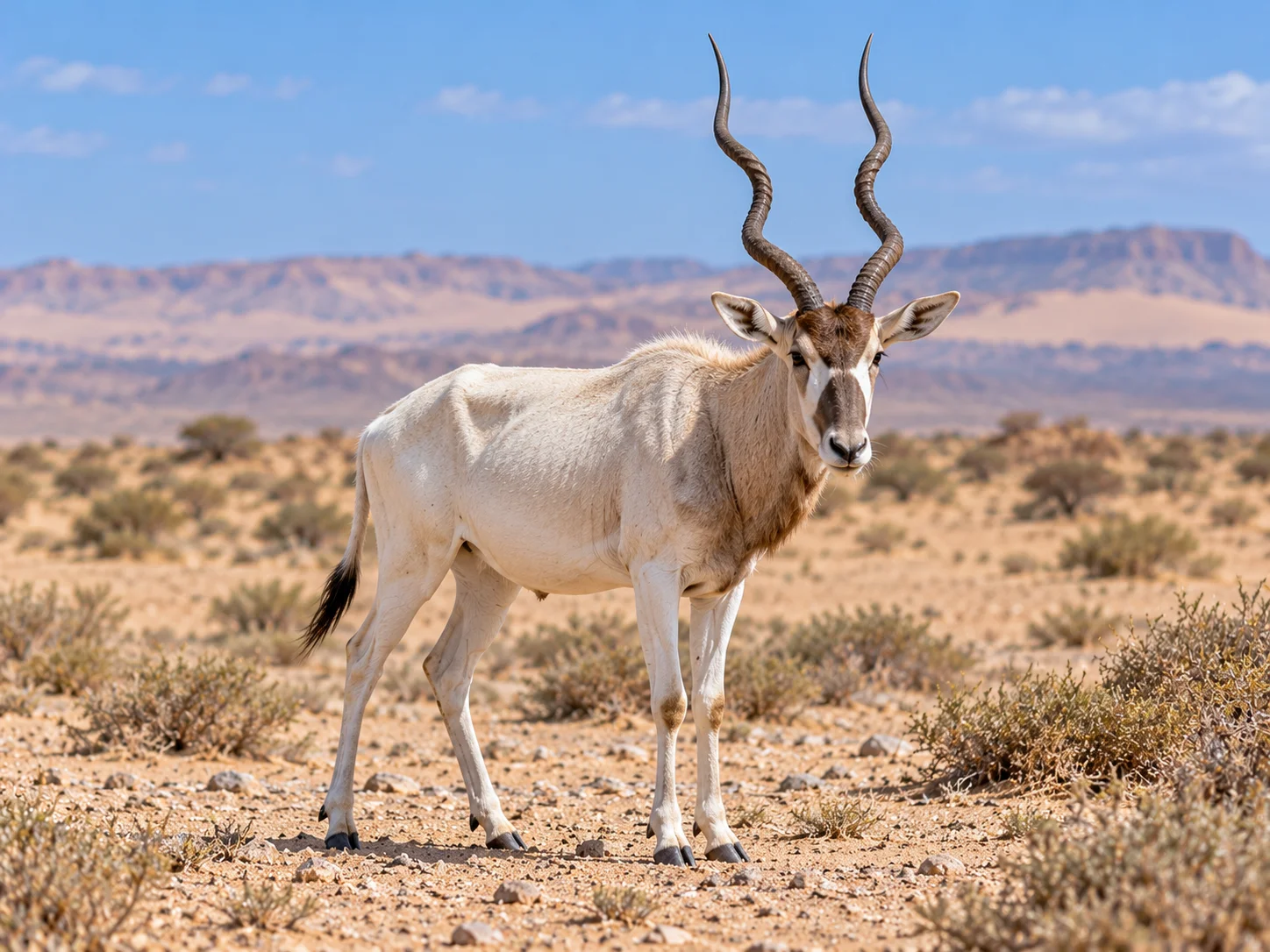
Meet the Addax
The addax is an antelope that may never drink water in its entire life.
It lives in the deep Sahara, in some of the driest country on the planet, and gets all the moisture it needs from desert plants. It is one of the most completely desert-adapted large mammals that has ever existed.
It is also almost gone. Fewer than 100 addax are thought to survive in the wild, which makes this one of the most endangered large animals on Earth, and almost nobody has heard of it.
Scientific Name and Classification
The addax’s scientific name is Addax nasomaculatus. The species name means “spotted nose”, for the white patch across its face.
- Kingdom: Animalia
- Phylum: Chordata
- Class: Mammalia
- Order: Artiodactyla
- Family: Bovidae
- Genus: Addax
- Species: Addax nasomaculatus
It is the only living species in its genus. Being in the family Bovidae makes it a relative of cattle, goats and sheep, all horned animals that chew the cud.
Its other common name is the screwhorn antelope, for the long spiral horns both sexes carry.
How Does the Addax Survive Without Water?
Through a set of adaptations that together let it live where almost nothing else large can.
- Water from food. Desert grasses and shrubs hold moisture, especially at night when they absorb dew from the air. An addax feeds largely after dark, when its food is at its wettest.
- Extremely efficient kidneys. Its urine is highly concentrated, so very little water is lost.
- Dry droppings. Water is reabsorbed in the gut before waste leaves the body.
- A coat that changes. White or sandy in summer to reflect heat, turning grayish-brown and thicker in winter for cold desert nights.
- Tolerating heat. Like camels, an addax lets its body temperature rise through the day rather than sweating to hold it down, then sheds the heat at night.
- Wide splayed hooves. Broad and flat, so it walks on soft sand instead of sinking in.
Addax also rest through the hottest hours in depressions they dig in the sand beside rocks or shrubs, where the ground is cooler and there is some shade.
Appearance and Anatomy
Addax stand about 3 to 3.8 feet at the shoulder, measure 5 to 5.6 feet in body length, and weigh 130 to 275 pounds.
- Horns. Long, thin and twisted in two or three spirals, reaching up to about 3 feet. Both males and females have them.
- Coat. Pale and changing with the season, with a white face patch and a dark tuft of hair on the forehead.
- Hooves. Broad and splayed for sand, with soft soles.
- Build. Stocky and short-legged compared with other antelope, which makes it slow. It is built for endurance in heat rather than for speed.
That slowness matters. An addax cannot outrun a vehicle, and that single fact explains much of what has happened to the species.
Habitat and Range
The addax lives in the Sahara Desert of North Africa, in sandy and stony desert, dunes and dry scrub.
It once ranged across the whole of North Africa, from Western Sahara and Mauritania east to Egypt and Sudan.
Today the only confirmed wild population is a tiny group in the Termit Massif region of Niger. Everywhere else it has been wiped out.
Addax follow rainfall, moving to wherever sparse desert plants have been triggered into growth, which means they wander over very large areas.
Diet and Feeding
Addax are herbivores, eating desert grasses, small shrubs, herbs and the leaves of whatever woody plants the desert offers.
They are particularly dependent on tough desert grasses that grow after rain and stay edible long after drying out.
Feeding happens mostly at night and in the cool hours around dawn, which is both a way of avoiding heat and a way of eating plants while they hold the most moisture.
They are ruminants and chew the cud, which extracts as much as possible from very poor forage.
Behavior and Lifestyle
Addax once formed herds of hundreds, but surviving groups are tiny, usually fewer than twenty animals, led by an older female.
They are active at night, at dawn and at dusk, and rest through the middle of the day.
They appear to sense rainfall at a distance and travel toward it, which is how a slow animal makes a living in a landscape where food appears unpredictably and briefly.
They are calm and not especially wary, which served them well against natural predators and very badly against armed people in trucks.
Reproduction and Life Cycle
An addax pregnancy lasts about 8.5 months and produces a single calf.
Births are timed to follow rains, when there is most food, and calves can stand and follow the herd within hours.
Calves nurse for around six months. Females can breed from about two years old and may produce a calf a year in good conditions.
Addax live about 19 years in the wild and up to 25 in captivity.
Predators and Threats
Natural predators were lions, leopards, cheetahs, hyenas and caracals, and most of those have themselves disappeared from the Sahara.
What has actually destroyed the addax is hunting from vehicles. A slow desert antelope that does not flee far is trivially easy to shoot from a moving truck, and organized hunting across open desert removed whole herds.
Oil exploration in Niger has brought roads, traffic and people into the last stronghold, along with disturbance of the few remaining animals.
Drought, competition with livestock for grazing, and regional conflict have all added to the pressure.
Conservation Status
The addax is Critically Endangered, and among the most endangered mammals in the world.
Fewer than 100 are believed to survive in the wild, and some surveys have found only a handful. The species is effectively extinct across almost its entire historic range.
There is one genuine reason for hope. Several thousand addax live in zoos, breeding programs and private reserves, particularly in the United States and the Middle East, and that captive population is healthy.
Reintroductions have been attempted in Tunisia, Morocco and Chad, with animals released into fenced protected areas. The hard part is not breeding addax. It is finding anywhere safe to put them.
Role in the Ecosystem
The addax was the main large grazer of the Sahara, and its grazing and droppings shaped how desert plants grew and spread across enormous areas.
It carried seeds in its coat and dung across distances almost nothing else covered, linking isolated patches of desert vegetation.
It also fed the Sahara’s large predators, and the collapse of desert antelope is part of why those predators have gone too.
Its loss is a quiet one. The Sahara looks much the same without addax, but a desert that has lost its largest grazer is a system with a piece missing.