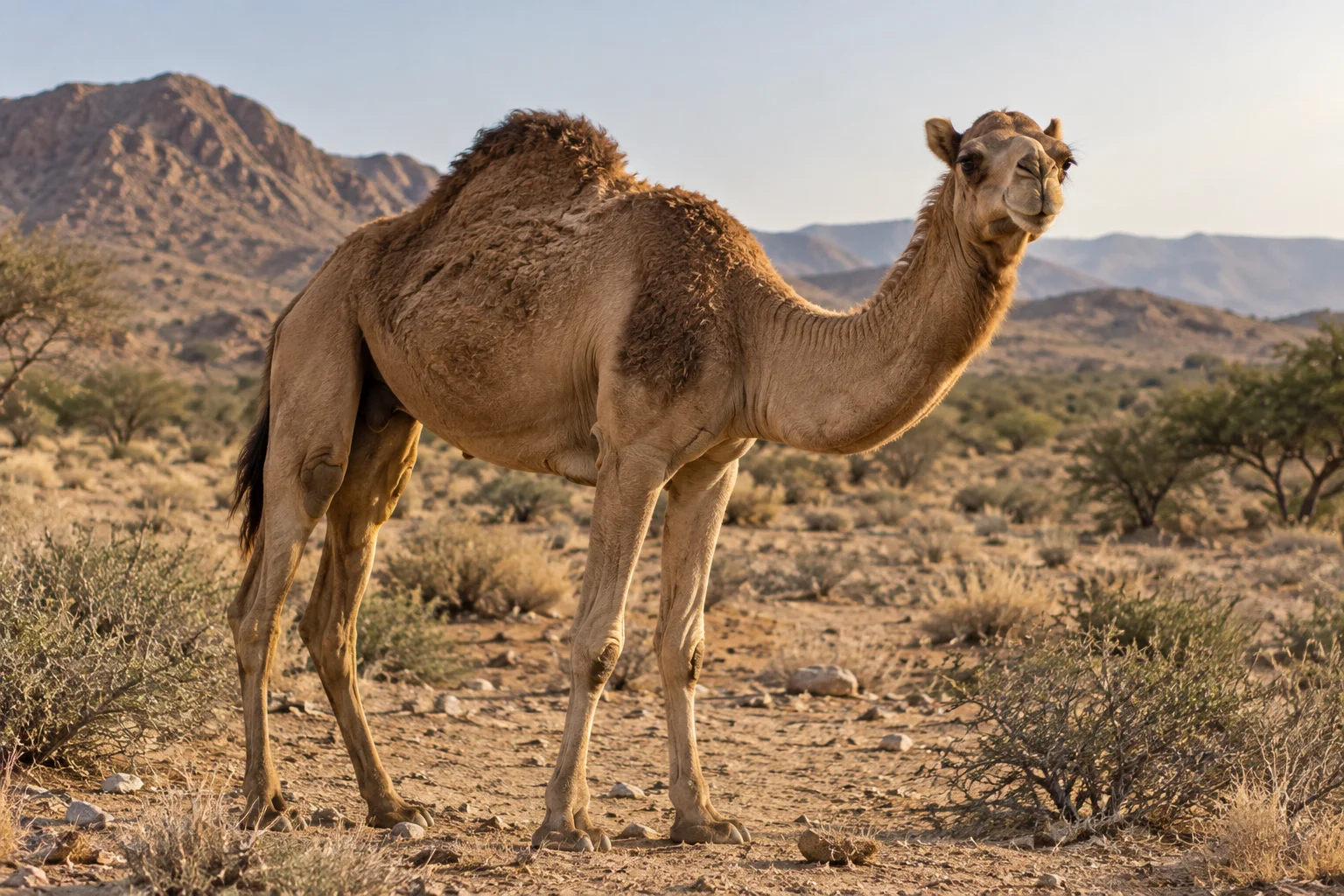
Meet the Camel
Let us deal with the famous bit immediately: a camel’s hump does not hold water. It is a mound of fat.
That fat is a food store, not a canteen, and keeping it piled on the back rather than spread around the body is itself an adaptation. A layer of fat all over would act like a winter coat; concentrated in a hump, it lets the rest of the body shed heat.
Camels survive the desert through a whole stack of adaptations, several of which are stranger than the hump. They have oval red blood cells, a nose that recovers water from their own breath, and the ability to lose a quarter of their body weight to dehydration and walk it off.
Scientific Name and Classification
There are three living species of camel, all in the genus Camelus.
- Dromedary (Camelus dromedarius), one hump. About 94 percent of all camels.
- Bactrian camel (Camelus bactrianus), two humps, domesticated, in Central Asia.
- Wild Bactrian camel (Camelus ferus), a separate wild species, not the ancestor of the domestic Bactrian, with fewer than about 1,000 animals left.
- Kingdom: Animalia
- Phylum: Chordata
- Class: Mammalia
- Order: Artiodactyla
- Family: Camelidae
- Genus: Camelus
The family Camelidae also includes the South American camelids: llamas, alpacas, guanacos and vicunas. All of them are humpless, and all are relatives.
Oddly, camels evolved in North America and spread out from there before dying out on the continent entirely.
Difference Between Dromedary and Bactrian Camels
There is a memory trick for this, and it works perfectly. Turn the first letter on its side: D has one hump, B has two.
| Dromedary | Bactrian | |
|---|---|---|
| Humps | One | Two |
| Where | North Africa, Middle East, India, Australia | Central Asia |
| Climate | Hot desert | Cold desert and mountains |
| Coat | Short | Thick and shaggy in winter, shed in summer |
| Build | Taller, leggier | Shorter, stockier, heavier |
| Share of camels | About 94% | About 6% |
How Do Camels Survive Without Water?
Not by storing it in the hump. Camels manage it by losing very little water and by tolerating dehydration that would kill almost anything else.
- They tolerate dehydration. A camel can lose about 25 to 30 percent of its body weight in water and keep working. Losing 15 percent would kill a person.
- Oval red blood cells. Camels are the only mammals whose red cells are oval rather than round. They keep flowing when the blood thickens from dehydration, and they stretch without bursting when the animal refills.
- They drink enormously, fast. A thirsty camel can take in 30 gallons or more in a few minutes, straight into the bloodstream.
- Their body temperature floats. A camel lets its temperature rise through the day instead of sweating to hold it steady, then dumps the heat at night. Not sweating saves a great deal of water.
- Their nose recovers water. Exhaled air passes through cool nasal passages and much of its moisture condenses out and is reabsorbed.
- Efficient kidneys and gut. Camel urine is thick and syrupy, and their droppings come out dry enough to burn.
A dromedary can go about 10 days without drinking even in serious heat, and far longer in cooler weather.
Appearance and Anatomy
Camels stand 6 to 7 feet at the shoulder, about 7 feet at the hump, and weigh 660 to 2,200 pounds. Bactrians are the heavier of the two.
- Eyes. Two rows of long lashes and a third clear eyelid that wipes sand away without blocking sight.
- Nostrils. Close completely in a sandstorm.
- Feet. Two broad toes on a wide leathery pad that spreads under the animal’s weight, so a camel walks on sand rather than sinking into it.
- Lips. Split and tough, letting a camel eat thorns that would injure most animals.
- Knees and chest. Thick leathery pads where the body touches hot ground when kneeling.
- Humps. Fat, up to about 80 pounds of it, which shrinks and flops over when the animal is underfed.
Habitat and Range
Dromedaries live across North Africa, the Middle East and into India, in hot deserts and dry scrub. Bactrians live in the cold deserts and steppe of Central Asia, where winters drop to minus 40.
Almost all camels alive are domestic. The only truly wild ones are the wild Bactrians of the Gobi, in remote parts of China and Mongolia.
There is one strange exception. Camels brought to Australia in the 1800s for desert transport were released when motor vehicles arrived, and their descendants now number in the hundreds of thousands. Australia has the largest wild-living camel population on Earth, and treats them as a pest.
Diet and Feeding
Camels are herbivores and remarkably unfussy ones. They eat grass, leaves, shrubs, dry stalks and thorny plants that other grazers avoid entirely.
Those split, leathery lips let them strip a thorn bush without damage, and they will also take salty plants most animals cannot stomach.
Camels chew the cud like cattle, but with a three-chambered stomach rather than four, and the two groups evolved the habit separately.
When food runs short the hump is the reserve. The fat is broken down for energy, the hump shrinks and sags, and it rebuilds once feeding improves.
Behavior and Lifestyle
Camels live in herds led by a dominant male, with females and young. Surplus males form their own bachelor groups.
They have a reputation for bad temper, which is partly fair. Camels bite, kick in any direction, and spit, though the spitting is really regurgitated stomach contents used as a warning, and it is usually aimed at other camels.
Walking is done with both legs on the same side moving together, a gait called pacing, which gives the rolling motion that earned camels the nickname ships of the desert and makes riders seasick.
They are strong rather than fast: a loaded camel carries 300 to 600 pounds and covers 25 miles a day, though in short bursts one can reach 40 miles an hour.
Camels also have long memories and are said to remember mistreatment for years. Handlers take that seriously.
Reproduction and Life Cycle
Camels carry their young for 12 to 14 months, among the longest pregnancies of any land mammal, and give birth to a single calf.
A newborn weighs 80 to 100 pounds, can walk within hours, and is born without humps. They develop as the calf starts eating solid food and laying down fat.
Calves nurse for a year or more and stay with the mother for several years. Camels are fully grown at about seven.
They live 40 to 50 years, which is a long working life, and camel milk is a staple food across much of their range.
Predators and Threats
Wolves are the main predator of wild Bactrians, and leopards and tigers historically took camels in parts of Asia. An adult camel is large and kicks hard, so calves are the usual target.
For wild Bactrians the pressures are hunting, competition with domestic livestock for scarce water, mining in the Gobi, and interbreeding with domestic camels, which dilutes what remains of the wild species.
Domestic camels face the problems of any livestock: drought, disease and shrinking grazing land.
Conservation Status
The two domestic camel species, the dromedary and the Bactrian, are farm animals and are not assessed by the IUCN. There are tens of millions of them, mostly dromedaries, and they are in no danger.
The wild Bactrian camel is a different story entirely. It is Critically Endangered, with fewer than about 1,000 animals surviving in the Gobi Desert, which makes it one of the most endangered large mammals in the world.
It was long assumed to be domestic camels gone feral. Genetic work showed otherwise: it is a separate species with three more chromosome pairs than the domestic Bactrian, and it survived in the Gobi on its own terms, including drinking salt water that domestic camels refuse.
Role in the Ecosystem
In their own deserts, camels browse tough shrubs that few other animals can use, spread seeds in their dung, and move nutrients across country that supports very little life.
Their effect on people has been larger still. Camels made trade across the Sahara and the Silk Road possible, carrying goods and ideas across barriers nothing else could cross, and whole cities grew up around routes that existed only because camels could walk them.
Where they do not belong, the picture reverses. Australia’s feral camels damage waterholes and native vegetation in arid country that evolved without any large hoofed animal, and they are culled in large numbers.