Meet the Affenpinscher
The Affenpinscher weighs about as much as a large cat and behaves as though it weighs forty pounds.
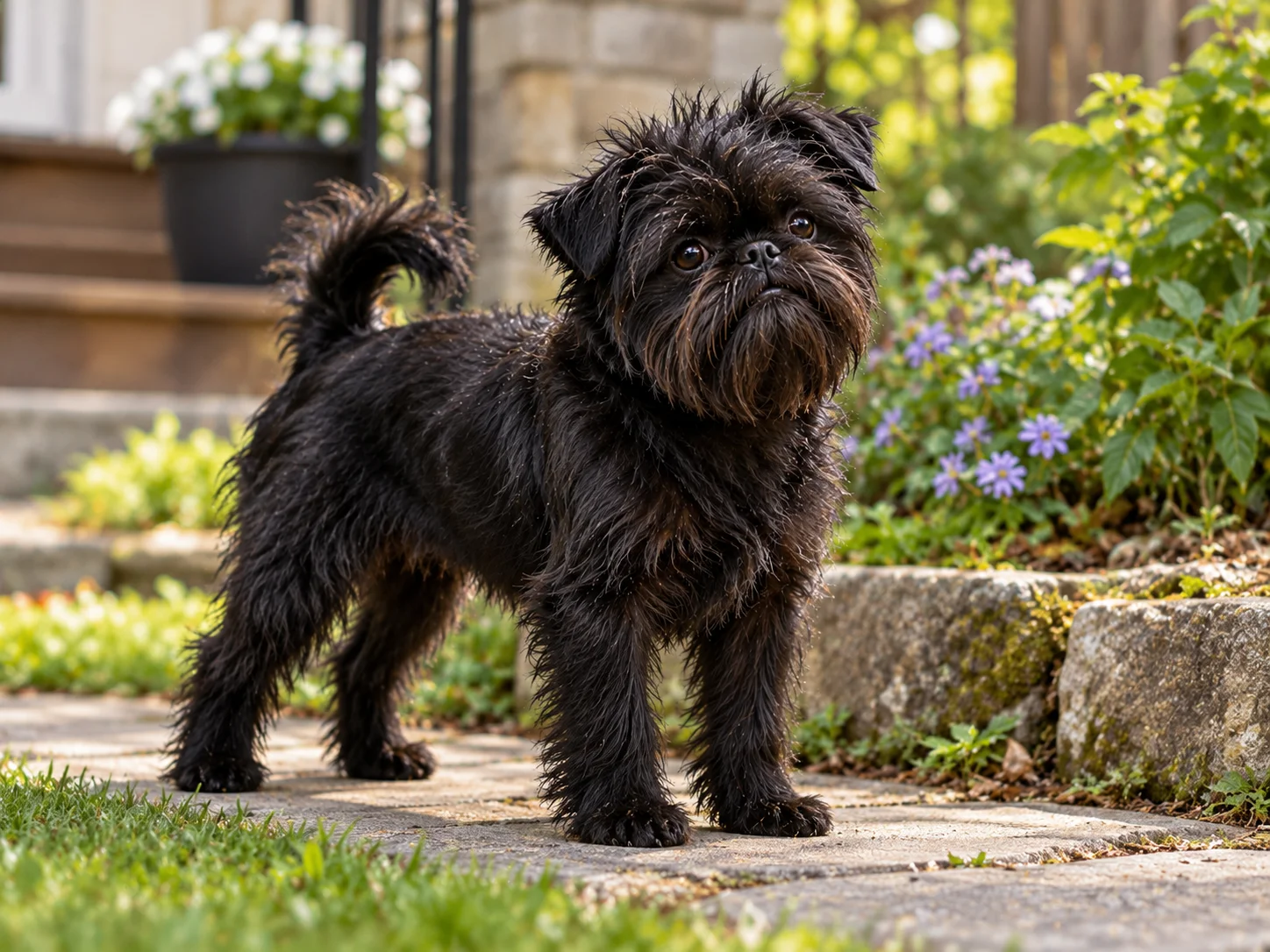
Its name is German for “monkey terrier”, after a face that genuinely does look more like a small primate than a dog: round dark eyes, a pushed-in muzzle, and a shaggy beard and eyebrows sticking out in all directions.
It was never bred to be a lap dog. This is a working rat-catcher that happens to be tiny, and the attitude that came with that job is still very much there.
Scientific Name and Classification
The Affenpinscher is a breed of domestic dog, Canis familiaris, not a separate species. Every dog breed shares the same scientific name.
- Kingdom: Animalia
- Phylum: Chordata
- Class: Mammalia
- Order: Carnivora
- Family: Canidae
- Species: Canis familiaris
Kennel clubs file it in the toy group, which is where dogs under about 12 pounds usually go. That placement is a little misleading, because the Affenpinscher is a terrier in everything but paperwork.
It is also an ancestor of other breeds. The Brussels Griffon and, by most accounts, the Miniature Schnauzer both have Affenpinscher behind them.
Why Is It Called an Affenpinscher?
Because of the face. In German, Affe means monkey or ape and Pinscher means terrier, so the name translates almost exactly as “monkey terrier”.
Nobody involved was being unkind. The resemblance is real: the eyes sit forward and round, the muzzle is short, and the facial hair grows outward in a way that frames the whole head.
Other countries settled on names about its personality instead. In France it has long been called the diablotin moustachu, the moustached little devil, which tells you most of what you need to know about owning one.
The breed is old. Small rough-coated monkey-faced dogs of this type appear in European paintings from the fifteenth and sixteenth centuries, and the Affenpinscher as a recognizable breed dates back at least to the seventeenth century, which makes it one of the oldest toy breeds in existence.
Origin and History
The Affenpinscher comes from Germany, and it started out larger than it is now.
Early Affenpinschers were working dogs kept in kitchens, stables, shops and farms to kill rats and mice. They were valued for being small enough to get into corners, bold enough to take on a cornered rat, and loud enough to raise an alarm.
Over time breeders selected smaller animals, and the Affenpinscher moved indoors, from the stable to the parlor. The job changed; the temperament did not.
It remains an uncommon breed. Registration numbers are low in most countries, so it is a dog most people have never met, though it had a moment of fame when an Affenpinscher called Banana Joe won Best in Show at Westminster in 2013.
Appearance and Anatomy
Affenpinschers stand 9 to 12 inches at the shoulder and weigh 7 to 10 pounds, with a square, sturdy build rather than a delicate one.
- Coat. Harsh, dense and wiry, about an inch long, with a shaggy mane around the head, neck and shoulders. Usually black, sometimes gray, silver, red or tan.
- Face. The breed’s signature. Prominent round dark eyes, a short blunt muzzle, a jutting lower jaw, and a beard and eyebrows that grow outward.
- Muzzle. Short, which makes the Affenpinscher mildly brachycephalic, with the breathing and heat consequences that brings.
- Ears. Small, set high, and either upright or dropped.
- Tail. Carried high. Docking was traditional and is now banned or discouraged in many countries, so most have a natural tail.
The expression is the point of the dog. Breed standards describe it as mischievous, and that is an accurate description of both the face and the animal behind it.
Temperament and Behavior
Confident, curious, stubborn and funny, with no apparent awareness of its own size.
- Fearless. An Affenpinscher will challenge a dog many times its weight, which is the main thing an owner has to manage.
- Loyal and attached. They bond strongly to their household and often follow one person around.
- Comic. The breed has a reputation as the clown of the toy group, and owners describe them as deliberately entertaining.
- Alert. They bark at anything unfamiliar. As a watchdog that is an asset; in a flat with thin walls it is not.
- Stubborn. Terrier independence means training needs patience and short, interesting sessions rather than repetition.
They keep a working dog’s prey drive, so small pets are a poor match, and a hamster or a pet rat is simply not compatible with an animal bred to kill rats.
They need less exercise than their energy suggests, and a couple of short walks plus indoor play suits them. Mental work matters more than distance.
Diet and Feeding
Affenpinschers are omnivores, like all dogs, and eat a normal complete dog food.
Portions are small, and that is exactly where the risk lies. On a 9-pound dog, a few extra treats a day are a large proportion of its intake, and small breeds put on weight quickly without anyone noticing.
A short muzzle can make eating messier and slower, and some do better with a shallow dish.
The usual dog warnings apply and matter more at this size: chocolate, grapes and raisins, onions and garlic, and the sweetener xylitol are all toxic, and a dangerous dose for a 9-pound dog is very small indeed.
Grooming and Care
The wiry coat sheds very little, which people like, but it is not low-maintenance.
It needs brushing a couple of times a week to stop the mane matting, and the traditional method of tidying it is hand-stripping, pulling out dead hairs rather than clipping. Clipping a harsh coat softens the texture permanently, so show dogs are always stripped.
The beard needs wiping after meals, and the facial folds and eyes need checking.
Heat is a genuine care issue. A short-muzzled dog cools itself less efficiently by panting, so Affenpinschers should not be exercised hard in hot weather and never left in a warm car.
Health and Life Span
Affenpinschers live 12 to 15 years, which is typical for a small breed and considerably longer than a giant one.
The conditions to be aware of are mostly the consequences of being small and short-faced: breathing difficulty and heat intolerance from the short muzzle, patellar luxation where the kneecap slips, hip problems, dental crowding in a small jaw, and heart valve disease in later life.
Litters are small, typically one to three puppies, which is part of why the breed stays uncommon.
A responsible breeder screens for knee, hip, heart and eye problems. Asking to see those results is the single most useful thing a buyer can do.
Is an Affenpinscher Right for Your Family?
Honest answer: often not, and it is better to know why in advance.
It suits adults and older children, people who want a small dog with a real personality rather than an ornament, flat-dwellers who can tolerate barking, and anyone who finds a stubborn dog funny rather than frustrating.
It suits less well homes with toddlers, because an Affenpinscher will not put up with being grabbed and is small enough to be hurt by accident; homes with hamsters, rats or small birds; owners who want an easy first dog; and anyone expecting a quiet one.
They are also rare, so finding a well-bred puppy usually means a waiting list rather than a shop.
The Affenpinscher’s Place Among Dogs
The Affenpinscher is a good illustration of what breeding actually did to dogs. Here is an animal descended from wolves, shaped by people into something under 10 pounds with a monkey’s face, for the specific job of killing rats in a German kitchen.
It also shows that temperament outlasts purpose. Nobody has kept an Affenpinscher as a working ratter for a very long time, and it still behaves like one: bold, noisy, quick to investigate, and entirely willing to pick a fight it cannot win.
And as an ancestor of the Brussels Griffon and the Miniature Schnauzer, this uncommon little dog sits behind breeds far more familiar than itself.