Meet the Zebu
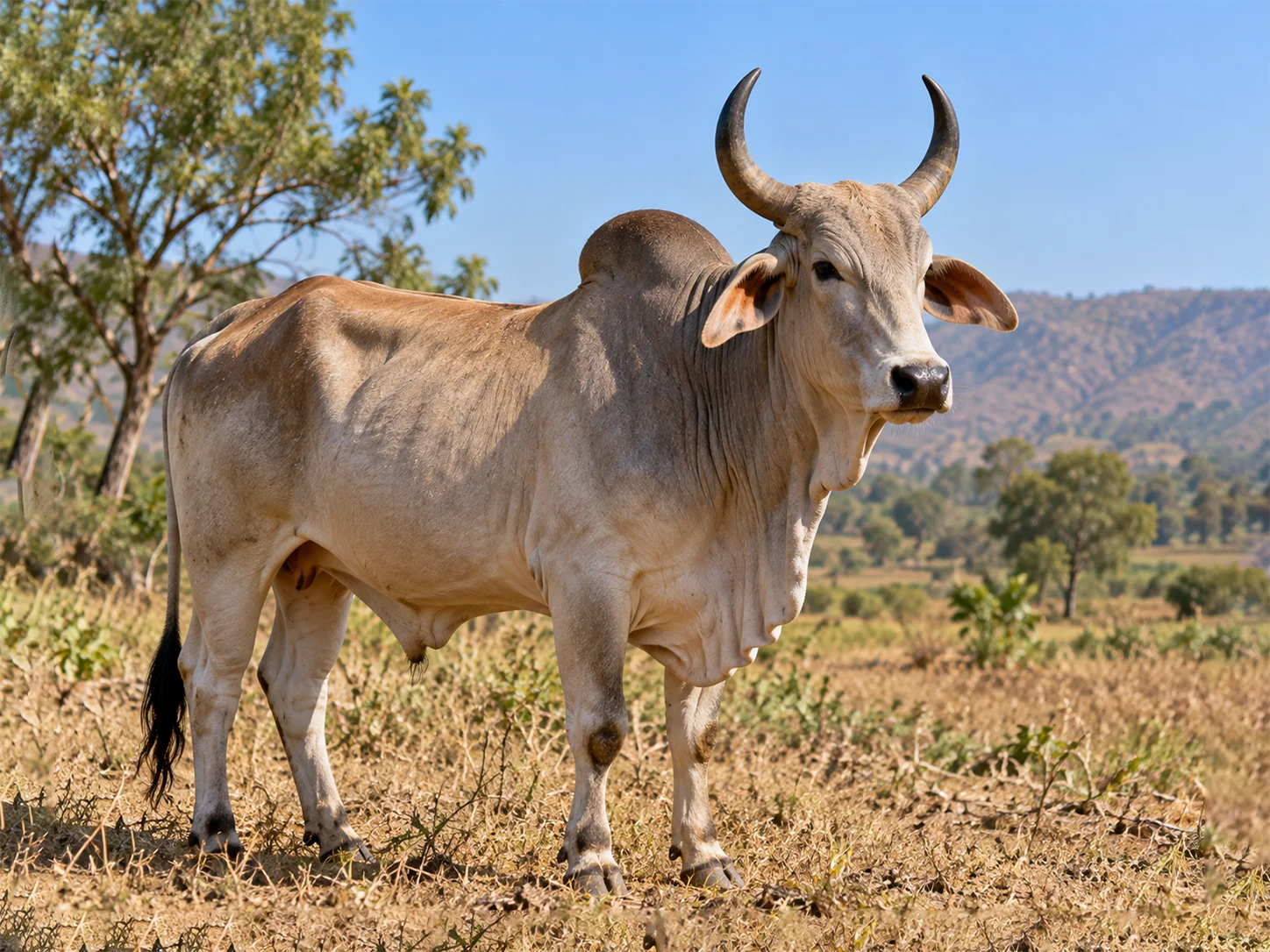
A zebu is a cow built for heat. It carries a fatty hump over its shoulders, a loose fold of skin at the throat, and often a pair of drooping ears, and all three of those features are there to help it shed warmth and get through dry country.
Zebu were domesticated in South Asia somewhere around 6,000 to 7,000 years ago. Since then they have spread across the hottest farmland on the planet, and today they are the backbone of beef production in Brazil and of cattle keeping across much of Africa and India.
In Madagascar, zebu outnumber people.
Scientific Name and Classification
The zebu is Bos indicus, named by Linnaeus in 1758, and also called indicine or humped cattle.
- Kingdom: Animalia
- Phylum: Chordata
- Class: Mammalia
- Order: Artiodactyla
- Family: Bovidae
- Species: Bos indicus, or Bos taurus indicus
Whether that should be a species at all is genuinely unsettled. It has been treated as a full species, including in reviews in 1999 and 2011, and as a subspecies of Bos taurus in work from 2004 and 2005. The American Society of Mammalogists currently files it under Bos taurus, which makes it a kind of cattle rather than a separate animal.
The practical answer is that zebu and the humpless European cattle most people picture interbreed freely, and a great many of the world’s herds are now some mixture of the two.
Appearance and Size
Size depends entirely on the breed, and there are around 75 of them. A Brahman cow stands roughly 50 to 57 inches (128 to 145 cm) at the shoulder, and large bulls pass 1,760 pounds (800 kg).
- A fatty hump over the shoulders, larger in bulls
- A big dewlap, the loose hanging fold of skin under the neck
- Ears that often droop rather than stand
- Loose skin overall, which gives more surface area for losing heat
- Coats in gray, white, red, black and combinations, varying by breed
At the other end of the scale are the miniature breeds, such as Nadudana, which are small enough to be kept as pets.
Where the Zebu Came From
The zebu descends from the Indian aurochs, and was domesticated about 6,000 to 7,000 years ago at Mehrgarh, in what is now Pakistan.
The wild ancestor did not survive the relationship. The Indian aurochs died out during the Indus Valley Civilization, probably through a combination of losing its habitat to herding and interbreeding with the domestic animals that had come from it. The most recent remains are about 3,800 years old.
From South Asia the humped cattle traveled:
- Egypt, around 4,000 years ago
- Sub-Saharan Africa, after about 700 AD
- The Horn of Africa, around 1000 AD
- Brazil, in the early twentieth century
That last arrival mattered enormously. From the 1960s the Nelore breed became Brazil’s main beef animal, and more than 80 percent of the country’s beef cattle are now purebred or hybrid stock of Ongole descent.
Why a Zebu Copes with Heat
Zebu are adapted to hot tropical savanna and steppe climates, with a notably higher tolerance of drought, heat and direct sun than European cattle.
Their reputation for toughness is not unlimited, though, and the exception is worth knowing. A zebu lacks trypanotolerance, the resistance to trypanosome infection that some African cattle breeds have, which leaves it open to nagana, the cattle form of sleeping sickness. Against parasites more broadly it is considered resilient, and the Brahman is specifically credited with good resistance to parasites and insects.
So a zebu is the animal you want in heat and dust, and not necessarily the animal you want where tsetse flies are.
Diet and Feeding
A zebu is a ruminant grazer, living on grass and other rough plant material and fermenting it in a four-chambered stomach, the same system used by a cow, a yak or a water buffalo.
The relevant difference is not what a zebu eats but how poor the grazing can be before it stops coping. That tolerance for thin, dry, seasonal pasture is the whole economic point of the animal.
Breeding and Life Cycle
A zebu cow usually has her first calf at about 29 months, and gestation averages 285 days, so a little over nine months.
Milk yield is low, which is the zebu’s main agricultural weakness, and it is also the thing crossbreeding fixes. Cross a zebu with European dairy stock and milk output rises, which is exactly why so much of the world’s cattle population is now a blend.
Two famous results of that blending are the Brahman, bred in the United States from 1885 out of Gir, Guzera and Nelore stock, and the Sanga cattle of Africa, such as the Afrikaner, Ankole and Boran. The Brahman went on to be reported in 55 countries with a world population estimated above 1.8 million, and by 1987 Queensland alone held more than a million of them.
Zebu and People
Few animals do as many jobs. A zebu may be a draft animal, a riding animal, a beef animal and a dairy animal, and it supplies hides, horn, and dung used both as fertilizer and as fuel.
It also carries a great deal of cultural weight. Zebu are venerated in Hinduism; in the Vedic religion they were a symbol of plenty, and from the middle of the first millennium the eating of beef came to be disfavored. In Tamil Nadu zebu bulls are used in jallikattu. In Madagascar they feature in the tolon’omby courtship ritual.
And in 1999, researchers at Texas A&M cloned one.
Conservation Status
The zebu is a domestic animal, so the IUCN does not assess it. There is no Red List category for a species that exists because people keep it.
Its wild ancestor is a different story, and a finished one. The Indian aurochs is gone, and the last of it died out roughly 3,800 years ago.
What is worth watching instead is breed diversity. Those 75 breeds, split roughly evenly between African and Indian ones, represent thousands of years of local adaptation to particular heat, particular diseases and particular grass. When herds everywhere get crossed toward whichever breed produces most, some of that is lost, and it is the kind of loss that is very hard to notice until a climate shifts and you want it back.