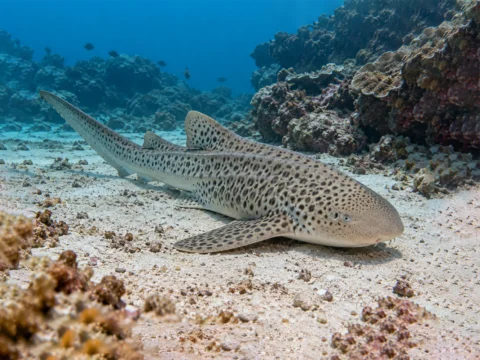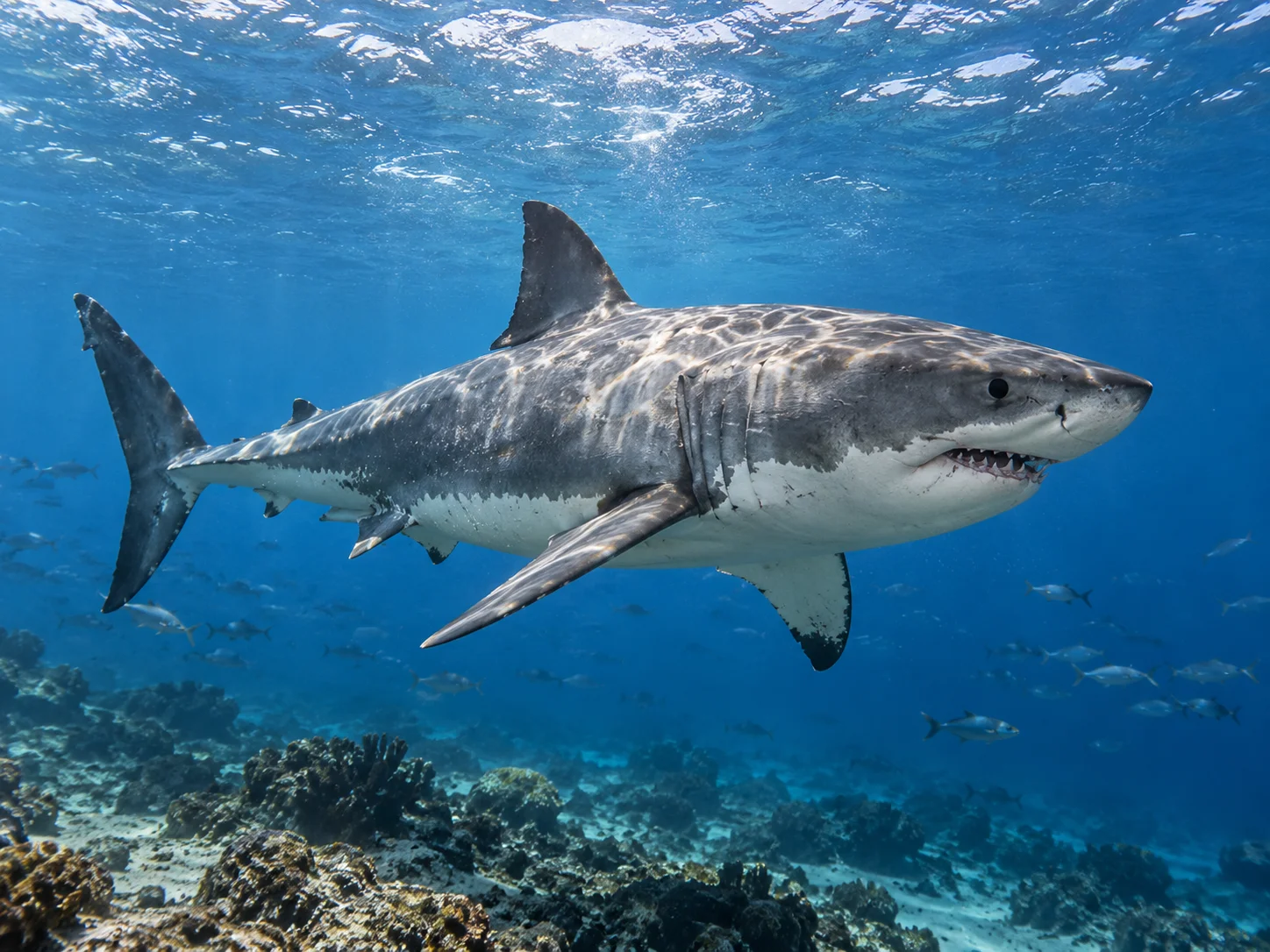

Meet the Shark
Sharks have been in the oceans for more than 400 million years. They were swimming before trees existed, before dinosaurs appeared, and they have survived every mass extinction since.
There are over 500 species, and almost none of them match the picture most people carry. The largest, the whale shark, is a gentle filter feeder the size of a bus. The smallest fits in your hand. Most are under 3 feet long and entirely harmless.
Sharks kill around 5 to 10 people a year worldwide. People kill somewhere around 80 to 100 million sharks a year.
Scientific Name and Classification
Sharks are a large group rather than one species, so they have no single two-word name. They form the superorder Selachimorpha, with over 500 species.
- Kingdom: Animalia
- Phylum: Chordata
- Class: Chondrichthyes (cartilaginous fish)
- Superorder: Selachimorpha
The class name is the important part. Sharks are cartilaginous fish: their skeletons are made of cartilage, the flexible material in your ears and nose, not bone. That makes them lighter and more flexible than bony fish, which matters for an animal with no swim bladder to keep it afloat.
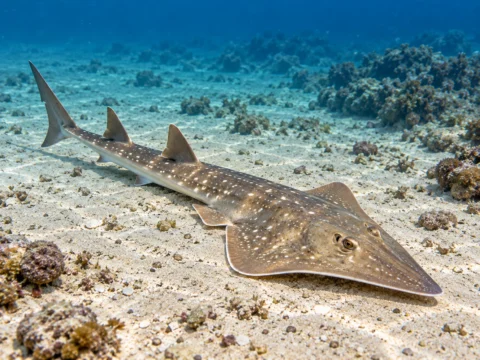
Their closest relatives are rays and skates, which are essentially flattened sharks.
Types of Shark and Their Characteristics
| Shark | Length | Notable for |
|---|---|---|
| Whale shark | Up to 40 ft | The largest fish alive; eats plankton |
| Basking shark | Up to 36 ft | Second largest; also a filter feeder |
| Great white | Up to 20 ft | The largest predatory fish |
| Tiger shark | Up to 16 ft | Eats almost anything |
| Hammerhead | Up to 20 ft | Wide head packed with sensors |
| Greenland shark | Up to 24 ft | May live over 400 years |
| Dwarf lanternshark | About 8 in | Fits in a human hand, and glows |
The Greenland shark deserves a second look. One individual was estimated at roughly 400 years old, making it the longest-lived vertebrate known. It does not even begin breeding until around 150.
Appearance and Anatomy
Sharks range from about 8 inches to 40 feet, and from a few ounces to over 40,000 pounds for a whale shark.
- Skeleton. Cartilage, not bone. Lighter and more flexible, and it is why shark fossils are usually just teeth.
- Teeth. Set in rows and replaced constantly. A shark may lose and regrow tens of thousands over a lifetime.
- Skin. Covered in tiny tooth-like scales called denticles. Shark skin feels like sandpaper one way and smooth the other, and the structure reduces drag so well that swimsuit designers copied it.
- No swim bladder. Sharks stay up using a huge oil-rich liver and by swimming. Many sink if they stop.
- Ampullae of Lorenzini. Jelly-filled pores on the snout that detect the faint electrical fields given off by living muscle. A shark can find a fish buried in sand by its heartbeat.
- Lateral line. A row of sensors along the flank that feels vibration and movement in the water.
Smell is excellent but not magical. Sharks can detect blood at very low concentrations, though the common claim about one drop in an Olympic pool is an exaggeration.
Habitat and Range
Sharks live in every ocean on Earth, from warm shallow reefs to polar water and down into the deep sea.
Some stay in one small area their whole lives. Others cross oceans: great whites have been tracked from South Africa to Australia and back, over 12,000 miles.
A few live in fresh water. Bull sharks swim far up rivers, and have been recorded thousands of miles up the Amazon and the Mississippi.
Diet and Feeding
Most sharks are carnivores, but what they eat varies enormously.
The biggest sharks eat the smallest food. Whale sharks and basking sharks swim with their mouths open, straining plankton and tiny fish out of the water, and take nothing larger.
Most other sharks hunt fish, squid and crustaceans. Larger predators take seals, turtles and rays. Tiger sharks eat almost anything, and have been found with license plates and tin cans inside them.
One shark even eats plants: the bonnethead takes in large amounts of seagrass and digests it, making it the only known omnivorous shark.
Sharks eat far less than people assume. A great white can go weeks between substantial meals.
Are Sharks Dangerous to People?
Far less than their reputation suggests.
There are roughly 70 to 100 unprovoked shark bites worldwide each year, and around 5 to 10 are fatal. More people are killed annually by cows, dogs, bees and falling coconuts.
Of over 500 shark species, only a handful are involved in serious incidents at all, mainly great white, tiger and bull sharks. Most bites appear to be investigation or mistaken identity rather than predation: a shark bites once and leaves, which is not how an animal hunting food behaves.
Sensible precautions are to avoid swimming at dawn and dusk, stay out of murky water, avoid areas where people are fishing, and not wear shiny jewelry that flashes like fish scales.
The comparison worth remembering: sharks kill around 5 to 10 people a year, and people kill tens of millions of sharks.
Behavior and Lifestyle
Most sharks are solitary, though hammerheads gather in schools of hundreds and some species hunt cooperatively.
Breathing shapes their lives. Sharks push water over their gills, and some species can pump it while still, resting on the bottom. Others, including great whites and makos, must keep swimming to breathe, so they never fully stop moving, even asleep.
Most sharks are cold-blooded, but a few, including great whites and makos, keep their muscles and eyes warmer than the surrounding sea, which lets them hunt faster in cold water.
They are also better learners than their reputation allows, solving problems, remembering feeding locations and recognizing individual divers.
Reproduction and Life Cycle
Sharks reproduce in three different ways, which is unusual for one group of animals. Some lay eggs in tough cases known as mermaid’s purses. Most give birth to live young. A few grow eggs that hatch inside the mother before she gives birth.
Pregnancies are long. Many run a year, and the frilled shark may carry young for three and a half years, the longest known of any vertebrate.
Litters are small, often under a dozen, and pups are entirely independent from birth with no parental care. In sand tiger sharks the strongest embryo eats its siblings in the womb.
This is the heart of the conservation problem. Sharks grow slowly, breed late and have few young, so a population that is overfished takes decades to recover, if it ever does.
Predators and Threats
Adult sharks have few natural predators besides larger sharks and orcas, which have learned to kill great whites and eat their livers.
The overwhelming threat is fishing. Tens of millions of sharks are caught each year, some targeted and many as bycatch in nets set for other fish.
Finning is the most wasteful part: fins are cut off for soup and the shark, often still alive, is thrown back to die. Many countries have banned the practice, though enforcement across open ocean is difficult.
Habitat loss matters too. Mangroves and reefs serve as nurseries for young sharks, and both are disappearing.
Conservation Status
There is no single status for sharks, with over 500 species involved, and the overall picture is poor.
Roughly a third of sharks and rays are threatened with extinction, and oceanic shark populations have fallen by around 70 percent since 1970. Several hammerhead species are Critically Endangered, and the whale shark is Endangered.
There is some progress. Shark sanctuaries now cover large areas of ocean, finning bans have spread, and in places like Palau and the Bahamas live sharks have become worth far more to tourism than dead ones are to fishing.
Role in the Ecosystem
Sharks are apex predators, and removing them unbalances everything underneath.
They take sick and weak animals, which keeps prey populations healthy. They also change behavior: where sharks patrol, turtles and grazing fish do not linger in one spot, so seagrass beds and reefs are not stripped bare. That effect on where prey dares to feed matters as much as the eating.
Where sharks have been fished out, the consequences cascade. Losing large sharks off the US east coast allowed rays to multiply, and the rays wiped out a centuries-old scallop fishery.
Healthy reefs tend to have sharks on them. It is one of the quickest ways to judge whether a reef is in good condition.