Meet the Terrapin
In the late 1800s, terrapin soup was one of the most expensive dishes in America. It was served at state dinners, on transatlantic liners and in the grandest hotels in New York and Baltimore, and a single large diamondback terrapin could fetch the equivalent of a week’s wages.
The fashion nearly finished them. Terrapins were taken out of the salt marshes of the eastern United States by the barrel, and populations collapsed along the whole coast.
What saved them was Prohibition. The classic recipe depended on sherry, sherry became illegal in 1920, the dish went out of fashion, and the terrapin was left alone long enough to recover. It is the only animal in this encyclopedia rescued by a drinks ban.
Scientific Name and Classification
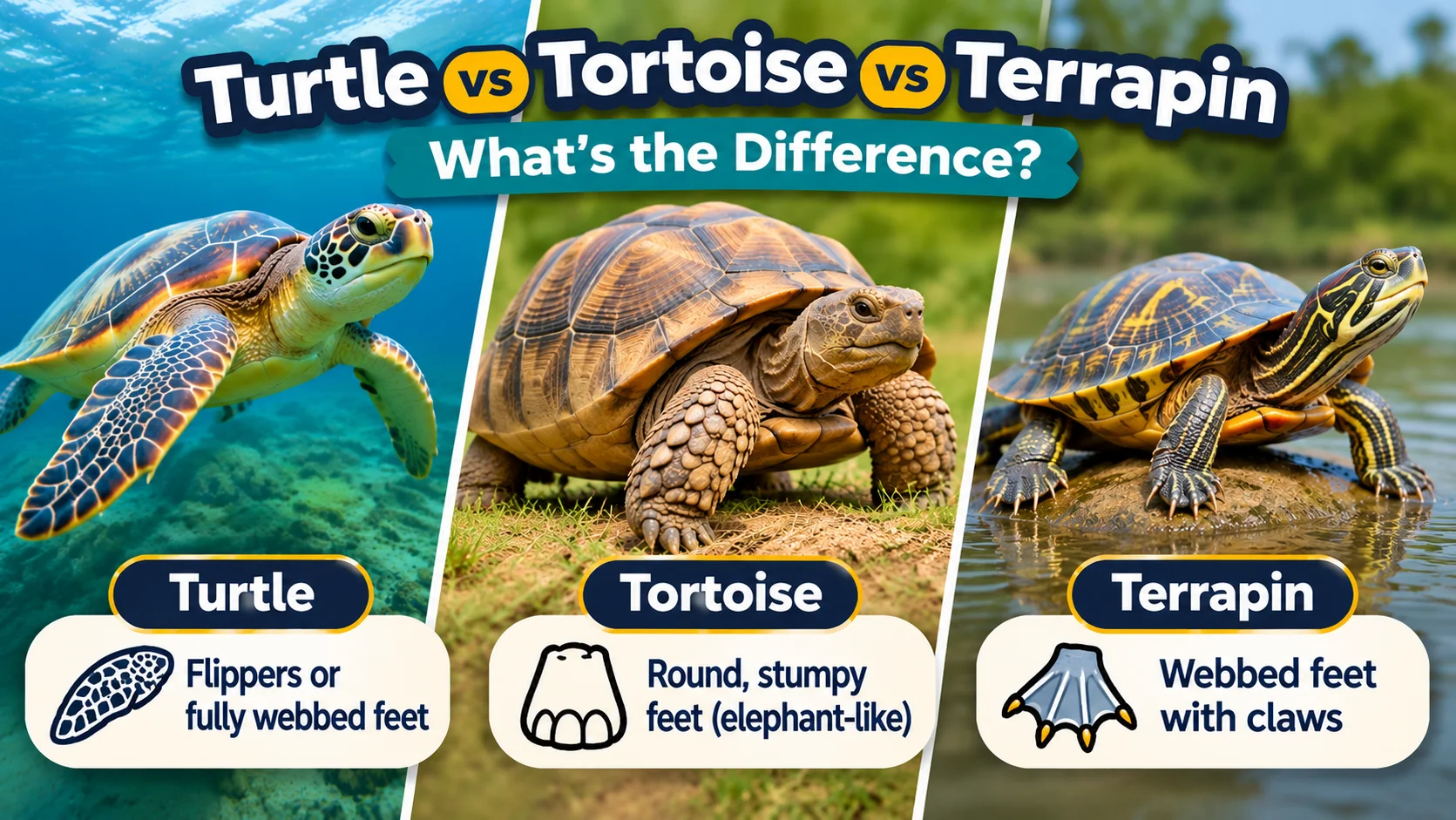
Terrapin is not a scientific grouping, and that is the first thing to get straight. It is a common name for small turtles of fresh and brackish water, and which animal it means depends on where you are standing.
- Kingdom: Animalia
- Phylum: Chordata
- Class: Reptilia
- Order: Testudines
- Families: Emydidae, Geoemydidae and others
In North America, the terrapin is one specific animal: the diamondback terrapin, Malaclemys terrapin, of the Atlantic and Gulf salt marshes. In Britain and much of the Commonwealth, terrapin means any small pond turtle, including the European pond turtle Emys orbicularis and the red-eared slider kept as a pet. In South Africa it means the freshwater turtles, as opposed to land tortoises.
The word itself comes from an Algonquian language, and it entered English from the people who had been eating them long before anyone put sherry in the pot.
Appearance and Anatomy
Terrapins are 4 to 11 inches in shell length and weigh 8 ounces to 3 pounds (240 g to 1.4 kg), with females of most species considerably larger than males.
The diamondback is named for the concentric diamond-shaped growth rings on its shell plates, and it has pale gray skin flecked with black spots that no two individuals share in the same pattern.
Its real distinction is physiological. The diamondback is the only turtle in the world that lives permanently in brackish water, and it manages salt in three ways: glands near the eyes excrete it, the skin is unusually impermeable, and the animal drinks the thin layer of fresh rainwater that sits briefly on the surface of the marsh after a shower, skimming it off the top with its mouth.
Like other turtles, the shell is fused ribs and vertebrae rather than armor worn over the body, and the animal cannot be separated from it.
Habitat and Range
Terrapins of one kind or another live in North America, Europe, Asia and Africa, in ponds, rivers, marshes, ditches and estuaries.
The diamondback occupies a narrow and specific band: the coastal salt marshes, tidal creeks and mangroves from Cape Cod down the Atlantic seaboard and around the Gulf of Mexico to Texas. It lives nowhere else, and nothing else lives quite where it lives.
That narrowness is the problem. Salt marsh is exactly the habitat that gets drained, bulkheaded, built on and cut through with boat channels, so the terrapin’s entire world is the strip of coast humans most want to develop.
European pond turtles have declined sharply across much of their range and are extinct in Britain as a native animal, though they were present there in warmer prehistoric periods.
Diet and Feeding
Terrapins are omnivores, and most shift their diet with age: young animals eat more animal food, adults take more plants.
Diamondbacks are specialists in hard-shelled prey, eating periwinkle snails, crabs, mussels, clams and marsh worms, and females have broader, heavier jaws than males precisely so they can crush larger shells.
That diet gives them an ecological job worth knowing about. Marsh periwinkles graze on cordgrass, and in large numbers they can strip a marsh bare, turning it to mud. Terrapins eat periwinkles, and research has linked healthy terrapin numbers to healthier cordgrass, which means a turtle is helping hold the marsh together.
Other terrapins eat insects, tadpoles, fish, carrion and water plants, and most will take anything they can catch or chew.
Behavior and Lifestyle
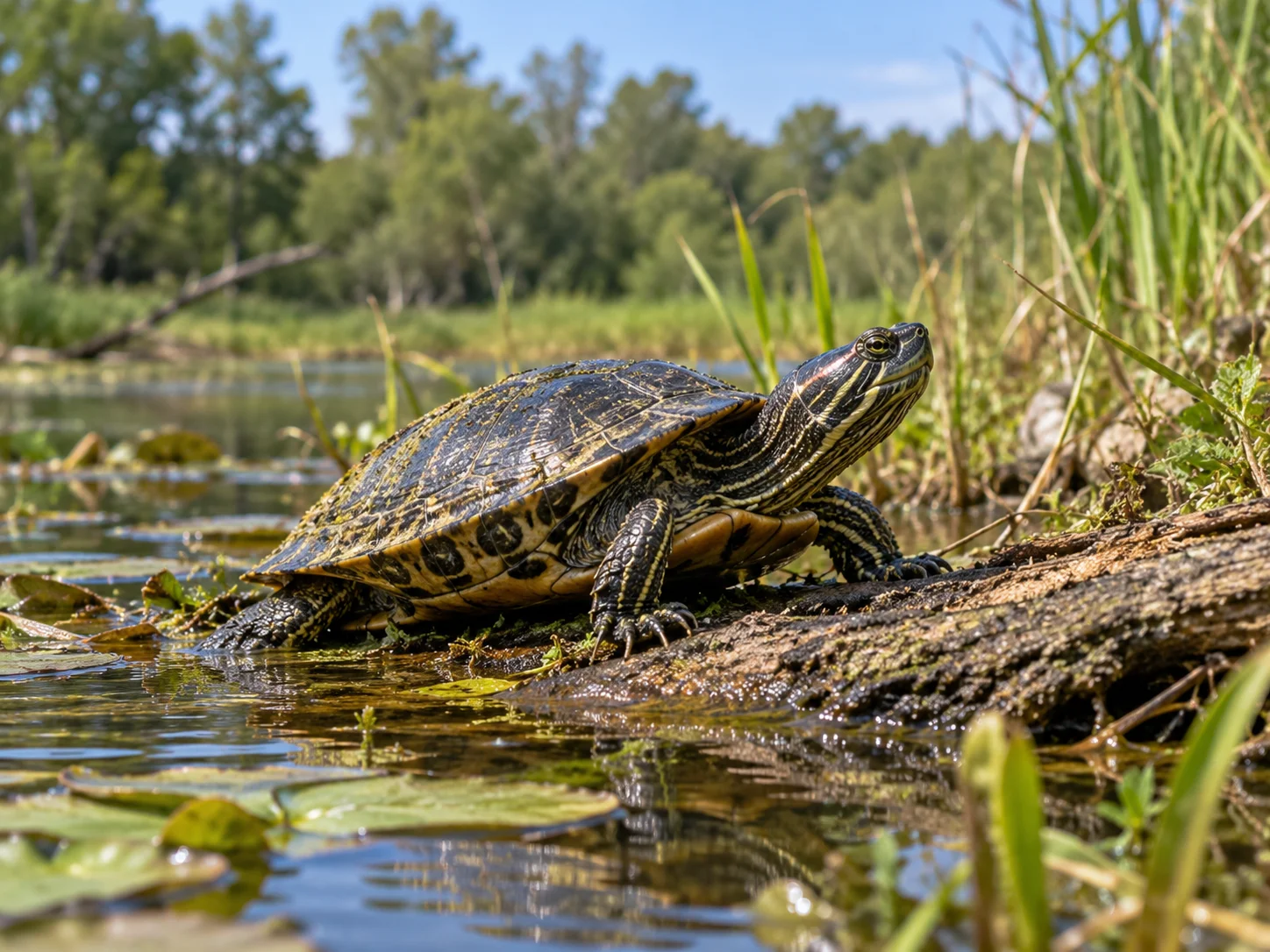
Terrapins are diurnal and spend much of the day alternating between water and a basking spot, because a reptile has to manage its temperature by moving.
Basking matters more than it looks. Sunlight lets them raise their body temperature to digest food and helps control the algae and parasites that otherwise build up on a wet shell, which is why a row of terrapins on a log is doing maintenance rather than relaxing.
In cold climates they overwinter in the mud at the bottom, and while buried they can take in a limited amount of oxygen through the skin and the lining of the throat and cloaca, so an animal with lungs can spend months underwater without breathing.
They are shy, slide off the log at the first sign of movement, and are far more often seen as a splash than as a turtle.
Reproduction and Life Cycle
Females come ashore in late spring and summer, dig a nest in sand or soft soil above the tideline, lay 4 to 22 eggs, cover them and leave.
Incubation takes 60 to 90 days, and nest temperature decides sex, with warmer nests producing females in terrapins. That makes a warming climate a direct and awkward problem, because it skews a whole generation.
Hatchlings are tiny, about an inch across, and almost everything eats them. Many overwinter in the nest and emerge the following spring.
They mature slowly, females at 6 to 8 years and males at 2 to 3, and live 25 to 40 years, with diamondbacks recorded past that in captivity. Slow maturity plus heavy hatchling losses means a population depends on adult females surviving for decades, which is precisely what drowning in crab traps prevents.
Predators and Threats
Raccoons, foxes, skunks, gulls, crows, herons, crabs and large fish take eggs and hatchlings, and raccoons in particular can destroy nearly every nest on a beach.
Four human threats dominate, and the first is the one most people have never heard of:
- Crab traps. Terrapins enter baited crab pots, cannot get out, and drown. A single lost or abandoned pot can kill dozens over time, and this is the largest single cause of diamondback deaths. The fix is cheap and proven: a small plastic insert in the trap entrance, a bycatch reduction device, that lets crabs in and keeps terrapins out.
- Roads. Females crossing coastal roads to reach nesting sand are killed in large numbers, and because the casualties are breeding females the damage is disproportionate.
- Habitat loss. Bulkheading and development remove the sandy nesting areas just above the marsh.
- Collection, historically for soup and now for the pet trade, particularly in Asia, where the demand for turtles of all kinds is severe.
Conservation Status
Because terrapin covers many species, the status depends entirely on which animal is meant.
The diamondback terrapin is listed as Vulnerable, and is protected to varying degrees by individual US states, with crab trap excluder devices now required in several.
The European pond turtle is Near Threatened and declining, with reintroduction projects running in several countries.
Many Asian terrapins are in far worse trouble, and freshwater turtles as a group are among the most threatened vertebrates on earth, driven by collection for food and medicine.
There is also an invasive-species twist. The red-eared slider, sold worldwide as a pet and released when it outgrows its tank, is now established on every continent except Antarctica and outcompetes native terrapins, including the European pond turtle. A terrapin is both one of the more threatened animals here and one of the more damaging invaders, depending on the species.
Role in the Ecosystem
Diamondback terrapins help keep salt marshes intact by eating the periwinkle snails that would otherwise overgraze cordgrass, and salt marsh is valuable out of all proportion to its appearance: it absorbs storm surge, filters runoff, nurseries fish and crabs, and stores carbon.
Other terrapins scavenge, eat aquatic vegetation and disperse seeds between water bodies, and all of them are food for a long list of predators at the egg and hatchling stage.
They are good indicators of water quality, because they are long-lived, stay in one area and accumulate pollutants.
And the terrapin offers an unusually clear example of how conservation actually works. The problem is specific, a turtle drowning in a crab pot. The solution is specific, a plastic insert costing very little. It does not require anyone to stop crabbing, it does not need a change of heart about nature, and where it has been made compulsory it works. Most conservation problems are nothing like this tractable, which is exactly why this one is worth pointing at.