Meet the Eel
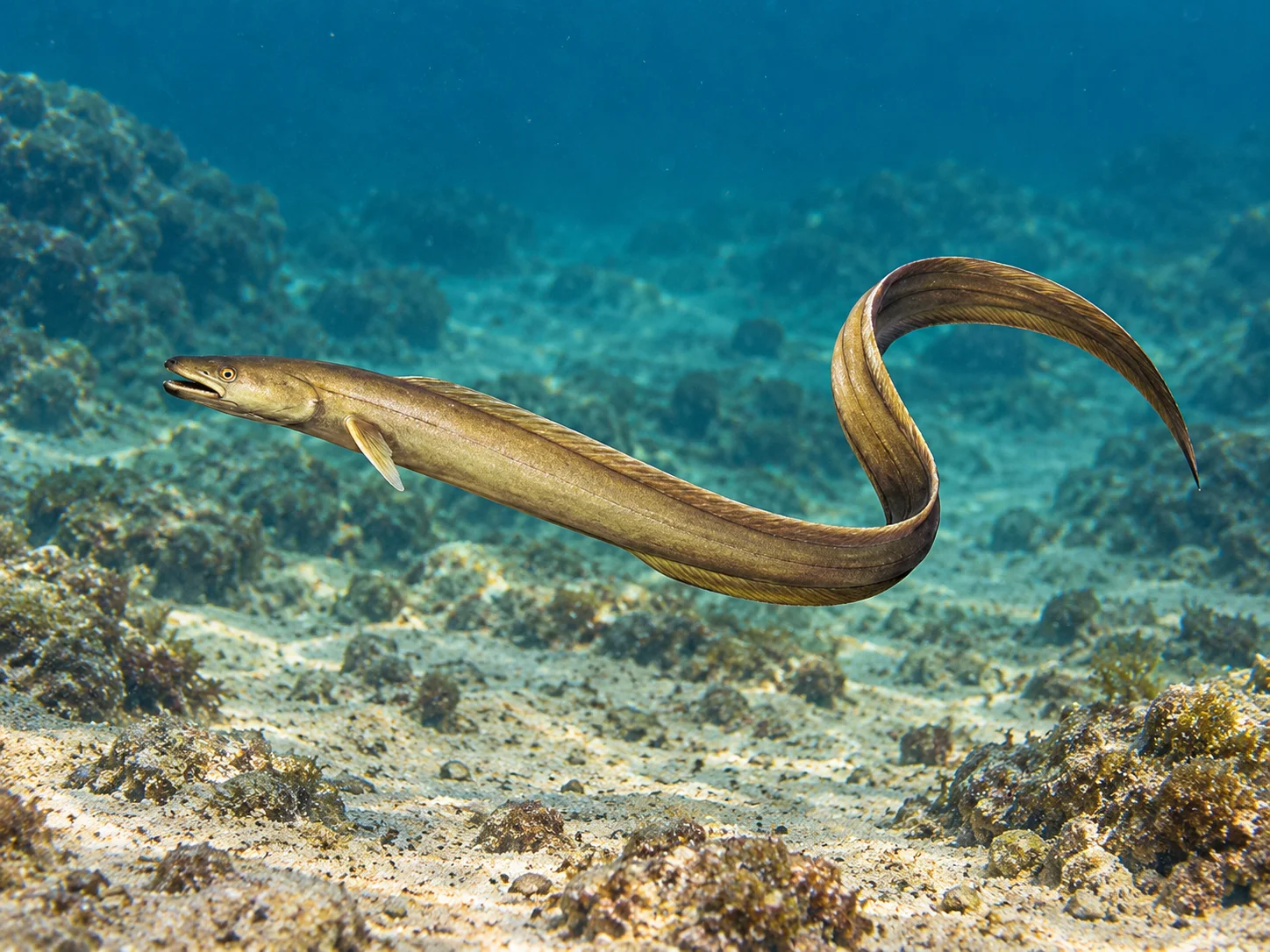
For more than two thousand years, nobody could work out where baby eels came from. People found eels in every river and pond in Europe, but never an eel egg, and never an eel carrying eggs. Eels are an order of long-bodied fish, the Anguilliformes, with around 800 species in rivers and oceans worldwide.
Aristotle decided they grew out of mud. Others thought they came from horsehair, or from dew. A young Sigmund Freud spent months dissecting eels trying to find their reproductive organs and failed.
The answer, found only in the twentieth century, turned out to be stranger than any of the guesses.
Scientific Name and Classification
Eels form the order Anguilliformes, with around 800 species, so there is no single two-word name.
- Kingdom: Animalia
- Phylum: Chordata
- Class: Actinopterygii (ray-finned fish)
- Order: Anguilliformes
The group includes freshwater eels, moray eels, conger eels, garden eels and snipe eels.
One famous animal is not in it at all. The electric eel is not an eel. It is a knifefish from South America, more closely related to catfish, and it simply happens to be long and thin. Real eels do not generate electricity.
The Mystery of Where Eels Come From
European and American eels spend most of their lives in rivers, lakes and ponds. Then, once, they go to sea to breed, and they do it in a way nobody expected.
They swim thousands of miles to the Sargasso Sea, a patch of still, weed-filled ocean in the middle of the North Atlantic. European eels travel around 3,000 miles to get there, crossing the entire ocean.
Their bodies change on the way. Their eyes enlarge for deep water, their gut dissolves because they will never eat again, and their reproductive organs finally develop, which is exactly why no one dissecting a river eel ever found any.
They spawn there and die. The young, transparent leaf-shaped larvae called leptocephali, drift back on ocean currents for a year or more, turn into see-through baby eels called glass eels, and enter the rivers their parents left.
Here is the remarkable part: no one has ever seen two European eels breed in the wild. Not once. The eggs and the act itself have never been observed, despite a century of looking. It remains one of the genuine open mysteries in zoology.
Appearance and Anatomy
Eels range from under 2 inches to the giant moray at 10 feet, and the slender giant moray reaches 13 feet. Weights run from a fraction of an ounce to over 60 pounds.
- Body. Long and snakelike, with the dorsal, tail and anal fins fused into one continuous fin running round the back end.
- No pelvic fins, and most have no pectoral fins either, which is what gives them that smooth serpentine swimming.
- Skin. Covered in a thick slime layer. Freshwater eels have tiny scales buried in the skin; many marine eels have none at all.
- Second jaws. Moray eels have a set of jaws in the throat that shoot forward to drag prey back, which inspired the creature design in the Alien films.
- Gills. Small, which is why morays sit with their mouths open. They are breathing, not threatening.
That slime matters more than it sounds. It lets a freshwater eel survive out of water for hours, and eels will cross wet grass at night to reach a different pond.
Habitat and Range
Eels live in oceans worldwide and in the fresh waters of Europe, the Americas, Africa, Asia and the Pacific.
Most species are marine. Moray eels live on coral reefs and rocky coasts, wedged into crevices with only the head showing. Garden eels anchor their tails in sand burrows and sway in the current like a field of grass, retreating instantly when anything approaches.
Freshwater eels are the travelers, moving between rivers and the open ocean, and they will climb. Young eels work their way up wet walls, weirs and dam faces to reach water upstream.
Diet and Feeding
Eels are carnivores, eating fish, crabs, shrimp, worms, insect larvae and squid.
Most hunt at night and rely heavily on smell, which is extremely good. An eel can track prey through dark or murky water where sight is useless.
Moray eels ambush from crevices, and their throat jaws solve a real problem: an animal that cannot create suction to swallow needs another way to move prey inward, so a second set of jaws reaches forward and pulls.
Some morays hunt cooperatively with groupers, which is rare between species. The grouper signals, the moray flushes prey out of a crevice, and whichever catches it eats it.
Behavior and Lifestyle
Most eels are solitary and secretive, hiding by day in burrows, crevices and mud and emerging after dark.
Freshwater eels are long-lived and patient. They can spend 10 to 20 years in a river before the migration, and some females have remained for over 50 years, waiting for conditions to trigger the journey.
They can swim backwards as easily as forwards, which is useful for an animal that spends its life in tunnels.
Morays look menacing with their constant gaping, but they are not aggressive. Almost every moray bite happens when a diver puts a hand into a hole.
Reproduction and Life Cycle
The freshwater eel life cycle runs through several completely different-looking stages.
- Leptocephalus. A flat, transparent, leaf-shaped larva that drifts on ocean currents for a year or more. They look so unlike eels that scientists classified them as a separate species for decades.
- Glass eel. A see-through miniature eel that arrives at the coast and enters rivers.
- Elver. A small pigmented eel moving upstream.
- Yellow eel. The long adult stage, lasting 10 to 20 years or more in fresh water.
- Silver eel. The final change: eyes enlarge, body silvers, gut dissolves, and the eel leaves for the sea to spawn once and die.
Eels decide their own sex late, and it depends on conditions. In crowded waters more become male; in sparse waters more become female.
Marine eels like morays have a more ordinary life, spawning repeatedly in open water.
Predators and Threats
Larger fish, sharks, herons, cormorants, otters and seals all eat eels, and glass eels are eaten in enormous numbers on their way upriver.
The pressures from people are severe. Dams and weirs block migration routes, so eels cannot reach the rivers they need or get back to sea. Wetlands have been drained, rivers polluted, and a parasite introduced from Asia damages the swim bladder that European eels need for the ocean crossing.
Overfishing is the biggest issue of all. Glass eels are caught in vast numbers for the food trade, and because eels cannot be bred in captivity, every farmed eel began as a wild-caught baby. That makes eel farming a drain on the wild population rather than a relief for it.
Conservation Status
There is no single status across 800 species, but the famous ones are in serious trouble.
The European eel is Critically Endangered. The number of glass eels arriving in European rivers has fallen by well over 90 percent since the 1980s, a collapse so steep it is hard to overstate.
The American eel and Japanese eel are also classed as threatened.
What makes this hard is the mystery. Protecting an animal whose breeding has never been witnessed, which spawns in the middle of an ocean nobody owns, is extremely difficult. Eel passes are now built around dams, and glass eel fishing is restricted, but recovery is slow.
Role in the Ecosystem
Eels are both predator and prey, and in many rivers they are among the largest predators present, controlling fish and invertebrate numbers.
They also move nutrients on a scale few animals match. An eel grows for decades in a river, then carries all that accumulated body mass thousands of miles out to the open ocean and dies there, transferring energy from fresh water to the deep sea. The larvae then carry it back the other way.
On reefs, moray eels control fish and crustacean populations and reach into crevices no other predator can.
Because they need rivers connected to the sea, eels are also a good indicator. A river still full of eels is a river still open to the ocean.