Meet the Isopod
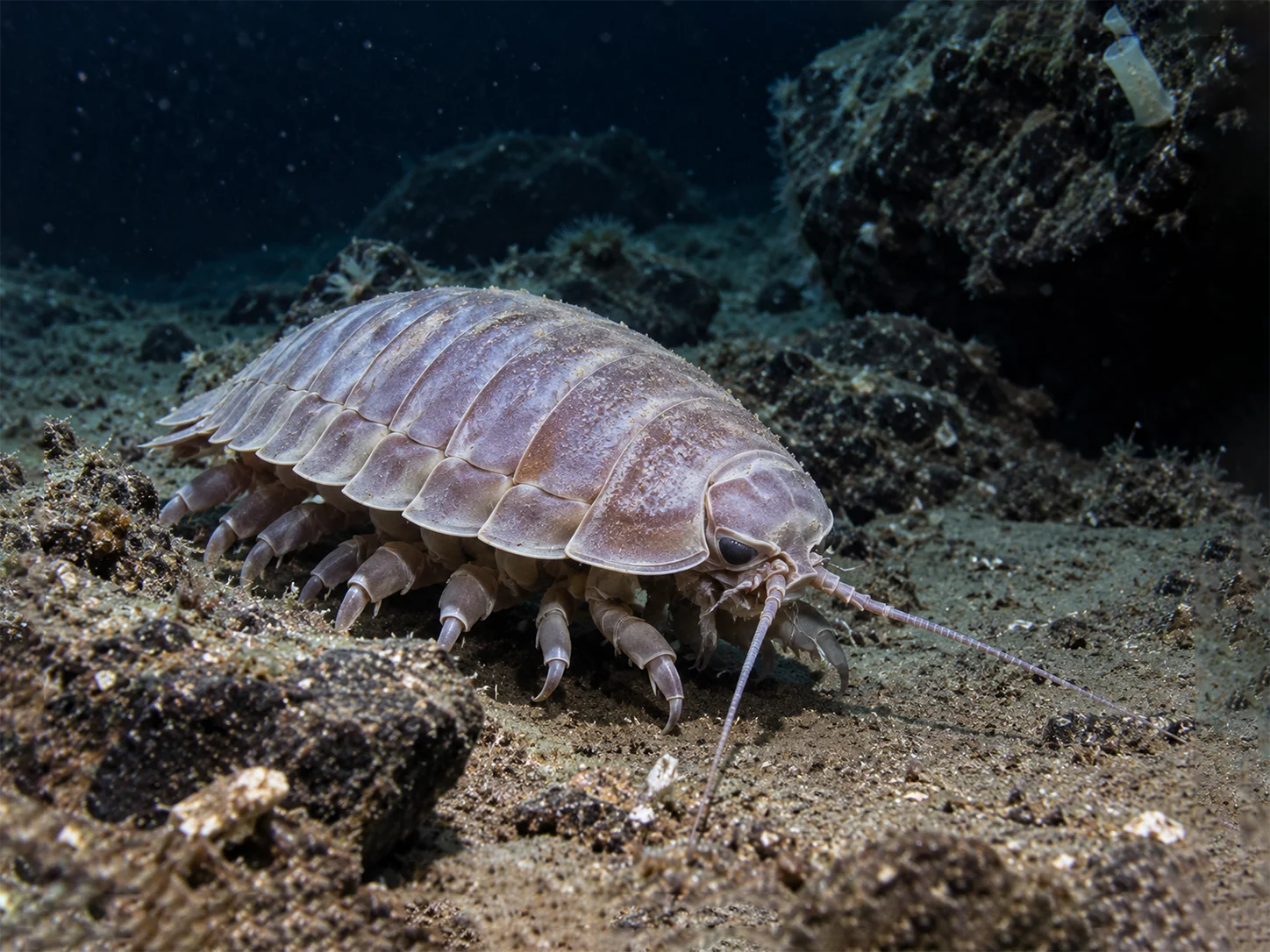
Turn over a flowerpot and the little gray armored things that scatter are isopods. So is a creature the size of a dinner plate that walks around on the floor of the deep ocean.
So is one that swims into a fish’s mouth, latches onto the base of its tongue, waits for the tongue to wither away, and then lives there as a replacement tongue for the rest of the fish’s life.
There are over 10,000 species of isopod, and the range between the smallest and the largest is the widest in any comparable group of animals. They are also, almost always, mistaken for insects.
Scientific Name and Classification
Isopods are an order, Isopoda, within the crustaceans. They are not insects.
- Kingdom: Animalia
- Phylum: Arthropoda
- Subphylum: Crustacea
- Class: Malacostraca
- Order: Isopoda
Malacostraca is the class that holds crabs, lobsters, shrimp and krill, so a woodlouse under a log is a closer relative of a crab than of any beetle. The quickest way to tell is to count legs: an insect has three pairs, a spider has four, and an isopod has seven.
The name means equal foot, because unlike a crab with its mismatched claws and legs, an isopod’s legs are all much the same.
With more than 10,000 species in wildly different situations, the order carries no single conservation status.
From a Grain of Sand to a Dinner Plate
The smallest isopods, in the family Microcerberidae, are 0.3 millimeters long, which is 0.012 of an inch. They live in the spaces between grains of sand.
The largest are the deep-sea giant isopods of the genus Bathynomus, which reach nearly 20 inches (50 cm). They look exactly like a woodlouse that has been scaled up past the point of comfort, which is essentially what they are.
That is a difference of more than a thousand times in length between the two ends of one order of animals.
Anatomy
- A flattened, segmented body in overlapping plates
- Seven thoracic segments, each carrying one pair of walking legs
- Two pairs of antennae and compound eyes set directly on the head
- Six abdominal segments, often partly fused into a rigid plate at the rear
- Five pairs of flap-like pleopods underneath
The pleopods are the interesting part. In water they serve as gills and help with swimming. On land they still handle gas exchange, and in some species the internal structures look remarkably like simple lungs.
Many isopods can roll into a tight ball, a trick called volvation. It shields the soft underside and cuts water loss, and it has evolved independently several times over, including among marine isopods that have no use for the second benefit at all.
Why Woodlice Live Under Things
Woodlice are isopods that moved onto land, and they are possibly the most successful terrestrial crustaceans in existence, found on every continent except Antarctica. Around 5,000 species of the 10,000 are terrestrial.
They never finished the job, though. An insect is sealed in a waxy cuticle that holds water in; a woodlouse is not, so it loses moisture by evaporation, particularly from its underside.
That single gap in the design explains everything about where you find them. Under a log, under a stone, in leaf litter, in the damp corner of a cellar. A woodlouse is a sea creature that got onto land without quite solving the water problem, and it has spent the time since staying out of the sun.
Habitat and Range
Of the 10,000-plus species, around 4,500 are marine, about 500 live in fresh water, and roughly 5,000 are land-dwelling woodlice.
Marine isopods are almost all bottom-dwellers, living on the seabed from the shoreline to the deep ocean, and some can swim short distances. Sea slaters live at the top of the shore and can run startlingly fast across rock.
Diet and Feeding
There is no single isopod diet. Across the order they are detritivores, grazers, carnivores, parasites and filter feeders.
Land species are mostly vegetarian, working through moss, bark, algae, fungi and decaying plant matter. The parasites and the filter feeders are all aquatic; no land isopod does either.
The Tongue-Eating Louse
Most parasitic isopods are external, clinging to fish or other crustaceans and feeding on blood. One of them does something considerably stranger.
Cymothoa exigua infests the spotted rose snapper in the Gulf of California. It enters through the gills, attaches to the base of the fish’s tongue, and feeds there. The tongue wastes away. The isopod then stays in its place, and the fish goes on using the parasite much as it used the tongue.
It is reported as the first known case of a parasite functionally replacing an organ of its host. The fish does not die of it, which is the detail that makes the whole thing worse.
Reproduction and Life Cycle
A female isopod carries her eggs with her. Flat overlapping plates under the thorax form a pouch called a marsupium, and up to several hundred eggs develop inside it.
What emerges is not a larva. Isopods hatch as mancae, which already look like small adults, complete except for the last pair of walking legs. There is no free-swimming stage at all.
Most crustaceans do the opposite, releasing tiny larvae that drift in open water and look nothing like the adult. Skipping that stage is a large part of how isopods managed to colonize land, because a drifting larva needs an ocean and a manca does not.
They also molt in two stages, shedding the back half of the shell and then the front, rather than all at once.
Role in the Ecosystem
Woodlice make soil. By chewing through dead leaves and wood they break plant material down mechanically and chemically, and they boost the microbial activity that does the rest. They are a major contributor to humification, the process that turns dead plants into earth.
In the sea, isopods do the same work on a different scale, clearing dead matter from the seabed alongside animals like the urchin, and feeding fish and other predators in turn.
It is worth noticing what that means. The animals under the flowerpot are not incidental to the garden. A world without isopods would be a world where dead leaves piled up and soil formed far more slowly, which is a surprising amount of consequence for something that curls into a ball when you look at it.