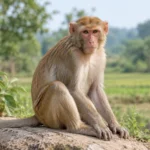
Meet the Mandrill
The mandrill is the largest monkey in the world and the most colorful mammal on Earth. A dominant male has a scarlet stripe down his nose, brilliant blue ridges either side of it, a yellow beard, and a rump in shades of red, blue and violet.
Those colors are a status display, and they are honest. The brighter the male, the higher his rank, and if he loses his position the colors fade.
Mandrills also form the largest gatherings of any primate. Groups of hundreds move through the rainforest together, and a supergroup of over 1,300 animals has been recorded.
Scientific Name and Classification
The mandrill’s scientific name is Mandrillus sphinx.
- Kingdom: Animalia
- Phylum: Chordata
- Class: Mammalia
- Order: Primates
- Family: Cercopithecidae
- Genus: Mandrillus
- Species: Mandrillus sphinx
Mandrills were long classified with baboons, and they look the part, but genetic work moved them into their own genus. Their closest relative is the drill, a similar but much plainer animal from the same part of Africa.
They are Old World monkeys, so despite the size and the stub of a tail, a mandrill is not an ape.
Why Is the Mandrill So Colorful?
Because in a dim forest full of monkeys, rank needs to be visible at a glance.
The colors come from blood vessels and pigment in bare skin, and they track testosterone. A dominant male is vivid; a subordinate is dull. When a male rises in rank his colors intensify within days, and when he falls they fade. Researchers can read a male’s position in the group from his face.
Females prefer the brightest males, so the display does two jobs at once: warning rivals and attracting mates.
The rump is part of the same system. Bright hindquarters are easy to follow through dense undergrowth, which helps keep an enormous group together when visibility is poor.
Females and young males are far less colorful, which is exactly what you would expect if the display is about male competition.
Appearance and Anatomy
Mandrills show one of the largest size differences between the sexes of any mammal. Males measure 30 to 37 inches in the body and weigh 42 to 110 pounds. Females are roughly half that, at 22 to 26 inches and 22 to 33 pounds.
- Face. Bare skin over bony ridges, scarlet along the nose and blue on the ridges in dominant males.
- Canine teeth. Up to 2.5 inches long in males. A yawning mandrill displaying them is issuing a warning, not showing tiredness.
- Tail. A short stub, unusual among monkeys.
- Cheek pouches. Like other Old World monkeys, mandrills can stuff food into pouches inside the cheeks and carry it away.
- Build. Heavy and powerful, spending most of the time on the ground.
Despite all that, a mandrill climbs well and sleeps in trees every night.
Habitat and Range
Mandrills live in a small part of west-central Africa: southern Cameroon, Gabon, Equatorial Guinea and the Republic of Congo.
They occupy dense tropical rainforest, along with forest edges and sometimes nearby farmland.
Their range is bounded by rivers, which mandrills do not cross, and that neatly separates them from the drill to the north.
A large group needs a great deal of forest. Home ranges can exceed 20 square miles, which is why habitat fragmentation hits them hard.
Diet and Feeding
Mandrills are omnivores, eating fruit, seeds, nuts, leaves, bark, fungi, insects, snails, eggs, lizards and occasionally small mammals.
Fruit is the staple, and much of the rest comes from turning over the forest floor: mandrills move leaf litter and rotten logs aside with their hands, looking for insects underneath.
Those long canines are not for hunting. They are weapons for display and fighting between males, and a mandrill is overwhelmingly a plant eater.
Cheek pouches let an animal grab food quickly in a crowd and move off to eat it somewhere less competitive, which matters in a group of hundreds.
Behavior and Lifestyle
Mandrill society is built around females. The core group, called a horde, is made up of related females and their young, and it is stable. Adult males mostly live alone and join the horde when females are ready to breed.
Hordes are enormous by primate standards. Several hundred animals is normal, and the record stands at over 1,300 moving together, the largest gathering of non-human primates ever recorded.
They are active by day, foraging on the ground and climbing into trees to sleep.
Communication is varied: grunts, crows and screams, plus facial expressions. Baring the teeth in what looks like a grin is friendly in mandrills, the opposite of what it would mean from a dog.
They groom each other constantly, which maintains relationships in a group far too large for every animal to know every other one well.
Reproduction and Life Cycle
Pregnancy lasts about 175 days and produces a single infant, usually born in the dry season when fruit is plentiful.
Newborns have pink skin and black fur, and cling to their mother’s belly before riding on her back.
Related females help care for infants, and a young mandrill grows up surrounded by aunts and sisters.
Daughters stay in the horde for life. Sons leave as they mature and usually live alone, developing full color only if and when they achieve dominance, which many never do.
Mandrills live 20 years or so in the wild and over 30 in captivity.
Predators and Threats
Leopards are the main natural predator, with eagles and large snakes taking young. A full-grown male with those canines is a formidable opponent, and the horde mobs threats.
The real threats are human. Bushmeat hunting is the most serious: mandrills are large, noisy, travel in huge groups and can be located easily, which makes them an obvious target for commercial hunters.
Logging and farming have broken up the forest they need, and roads cut into forest give hunters access to areas that were previously out of reach.
Conservation Status
The mandrill is listed as Vulnerable, with a declining population.
Its range was never large, and it has shrunk. Mandrills have disappeared from areas near roads and settlements where hunting pressure is highest.
Their social structure works against them here. An animal that travels in a group of several hundred is easy to find and can be hunted in numbers, so a single encounter with hunters can remove a great many animals at once.
Protected areas in Gabon hold the best remaining populations, and they are among the most important mandrill habitat left.
Role in the Ecosystem
Mandrills are major seed dispersers, and the scale matters. A horde of hundreds eating fruit and moving miles each day spreads an enormous quantity of seed across the forest, including large seeds that smaller animals cannot swallow.
Their habit of turning over leaf litter and rotten wood while foraging stirs the forest floor and speeds up decay.
They control insect and snail populations, and they feed leopards.
Because they need large, connected, undisturbed forest to support those huge groups, mandrills are a good measure of forest health. A forest still carrying a full mandrill horde is a forest still working at scale.