

Meet the Parrot
An African gray parrot named Alex learned to label around 100 objects, count up to six, and answer questions about color and shape. Shown a tray of items and asked which was green and square, he could pick it out. Parrots are an order of hook-billed, highly social birds, the Psittaciformes, with around 400 species through the tropics.
He also appeared to invent a word. Having learned “nut” and “berry”, he called an apple a “banerry”, and kept using it.
So the question of whether parrots understand what they say turns out to have a more interesting answer than either yes or no.
Scientific Name and Classification
Parrots form the order Psittaciformes, with around 400 species, so there is no single two-word name.
- Kingdom: Animalia
- Phylum: Chordata
- Class: Aves
- Order: Psittaciformes
The order covers macaws, cockatoos, cockatiels, budgerigars, lovebirds, lorikeets, parakeets, the kea and the kakapo, along with the odd fig-eating Pesquet’s parrot.
Their closest relatives are the songbirds and falcons, which is unexpected but well supported genetically.
Sizes run from the buff-faced pygmy parrot at about 3 inches to the hyacinth macaw at 3 feet 3 inches.
Do Parrots Understand What They Say?
Mostly no, but not entirely, and the distinction matters.
A pet parrot repeating a phrase it heard on television is mimicking. Parrots are vocal learners, copying sounds from their surroundings, and in the wild that ability is used to learn flock calls rather than language. Most talking is association at best: the bird learns that a sound produces a reaction.
The exception came from thirty years of research by Irene Pepperberg with an African gray called Alex. He was not simply repeating. He could label objects by material, color and shape, count small quantities, answer which of two items was bigger, and grasp the concepts of same and different, which is a genuinely abstract idea.
Most strikingly, he appeared to understand absence. Asked what was different about two identical objects, he answered “none”, using a concept he had worked out rather than been taught.
What Alex showed is that a parrot brain is capable of real understanding under careful teaching. It does not mean the parrot in a pet shop knows what it is saying.
How Do Parrots Talk Without Lips?
With a syrinx, and a very mobile tongue.
Birds have no vocal cords. Instead they have the syrinx, an organ deep in the chest where the windpipe divides, and because it has two branches a bird can control each side separately and produce two sounds at once.
Parrots then do something most birds cannot. They have thick, muscular, highly mobile tongues, and they use them to shape the sound coming out, much as we use lips and tongue to turn a hum into a word.
That combination is why parrot speech sounds so convincingly human, including the pitch and accent of whoever taught it. African grays are considered the clearest talkers, and budgerigars have the largest recorded vocabularies.
Appearance and Anatomy
Parrots range from 3 inches to over 3 feet and from under an ounce to about 3.7 pounds.
- Beak. Strong, hooked and hinged at the skull so the upper half can move independently. A large macaw can crack a Brazil nut, which most tools struggle with.
- Feet. Zygodactyl, with two toes forward and two back, and parrots use them as hands, holding food up to the beak. Most show a left or right preference, like handedness.
- Tongue. Thick and muscular, used for manipulating food and shaping sound.
- Brain. Large for the body, with densely packed neurons in the forebrain. Parrots and corvids are the two outstandingly intelligent bird groups.
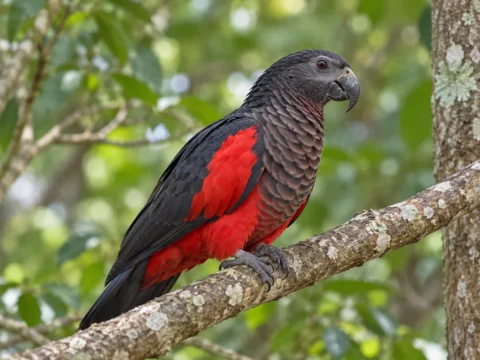
- Color. Much of it comes from pigments unique to parrots, called psittacofulvins, which produce reds and yellows no other bird makes the same way. The blues and greens come from feather structure rather than pigment.
Many parrots look identical to us and are not identical to each other: several species have markings visible only in ultraviolet light, which parrots can see and we cannot.
Habitat and Range
Parrots live mainly in the tropics and southern hemisphere: Central and South America, Africa, South and Southeast Asia, Australia, New Zealand and the Pacific islands.
Australia and South America hold the greatest diversity.
A few live in surprising places. The kea of New Zealand lives in snowy alpine country, and the thick-billed parrot reaches the mountains of northern Mexico.
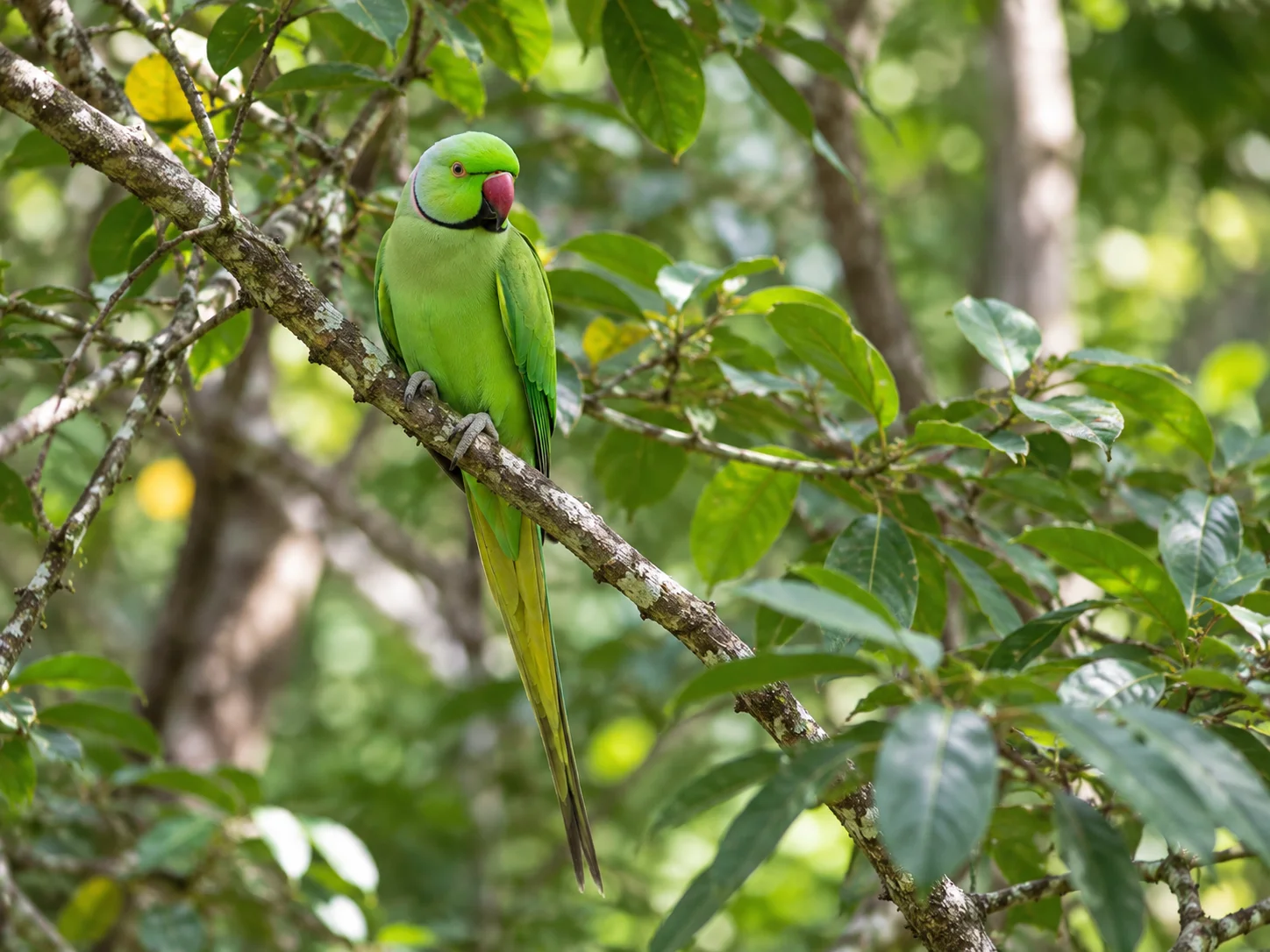
Escaped pets have established wild colonies well outside the tropics. Monk parakeets now breed in cities across the United States and Europe, and ring-necked parakeets are a familiar sight over London.
North America once had its own. The Carolina parakeet lived across the eastern United States in enormous flocks and was hunted and cleared out of existence, with the last one dying in 1918.
Diet and Feeding
Parrots are omnivores, eating seeds, nuts, fruit, flowers, buds, nectar and some insects.
Most are seed and nut specialists, and the beak is built for cracking what other birds cannot open.
Some have narrower diets. Lorikeets have brush-tipped tongues for nectar, and Pesquet’s parrot eats almost nothing but figs.
Macaws do something clever with poison. Many rainforest seeds contain toxins, and macaws eat clay from riverbanks, which appears to help neutralize them and provides minerals. Clay licks in Peru draw hundreds of macaws at once.
One parrot eats meat. The kea of New Zealand will feed on carrion, and has been recorded attacking sheep.
Behavior and Lifestyle
Parrots are intensely social, living in flocks, roosting communally and keeping in constant contact by call.
That sociability is the most important thing to understand about them as pets. A parrot alone in a cage is an isolated member of a flock species, and the consequences are real: screaming, feather-plucking and self-harm are common in bored or lonely birds.
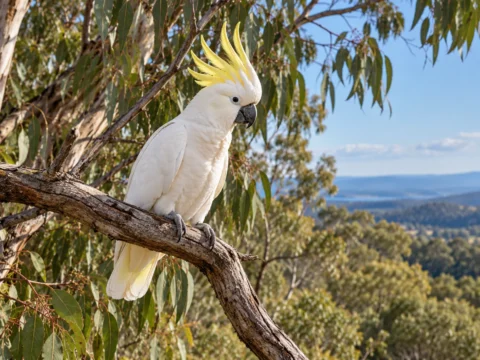
They are famous problem-solvers. Keas dismantle anything mechanical, have been filmed working cooperatively to get food, and are notorious for stripping rubber from cars. Cockatoos in Sydney learned to open wheelie bins for food, and the technique spread suburb by suburb as other cockatoos copied it, which researchers documented as genuine social learning.
Many parrots pair for life and sit in contact, preening each other.
And they live a long time. Large macaws and cockatoos commonly reach 50 to 80 years, which means a parrot bought as a pet may well outlive the person who bought it. They are routinely written into wills.
Reproduction and Life Cycle
Almost all parrots nest in cavities: tree holes, termite mounds, cliff crevices and, for the burrowing parrot, tunnels dug into riverbanks.
They cannot usually excavate their own, so they depend on old trees and on holes other animals made, which is why logging hits them so hard.
Clutches run to 2 to 8 white eggs, incubated two to four weeks, and chicks hatch blind and naked.
Chicks develop slowly for birds and stay in the nest for weeks or months, which gives them a long learning period and is part of why parrots are so capable.
The kakapo of New Zealand only breeds when a particular tree fruits heavily, which happens every two to four years, making it one of the slowest-breeding birds anywhere.
Predators and Threats
Hawks, eagles, snakes, monkeys and introduced rats and cats all take parrots or raid their nests.
The two human threats are habitat loss and the pet trade, and the pet trade is unusually damaging here. Nests are raided for chicks, and because parrots need old hollow trees, trappers often cut the tree down to reach the nest, destroying a nest site that would have served for decades.
Many wild-caught birds die before reaching a buyer.
Island parrots also suffer badly from introduced predators, since rats and cats arriving on an island with ground-nesting parrots are catastrophic.
Conservation Status
Parrots are one of the most threatened bird groups on Earth. Roughly a third of all parrot species are at risk of extinction, a far higher proportion than birds as a whole.
Some are nearly gone. Spix’s macaw was declared extinct in the wild, survived only in captivity, and has recently been reintroduced to Brazil. The kakapo fell to about 50 birds and has been brought back to around 250 under one of the most intensive conservation programs ever run, with every individual named and monitored.
Others are gone for good, including the Carolina parakeet.
The practical thing anyone can do is buy only captive-bred birds from reputable breeders, and be honest about whether a flock animal that lives sixty years and needs hours of attention is a sensible pet at all.
Role in the Ecosystem
Parrots are major seed dispersers and, less obviously, major seed destroyers. They crack and eat many seeds outright, which shapes which plants succeed, while carrying others away to drop intact.
Large macaws disperse big seeds that few other animals can swallow, so losing them leaves certain rainforest trees with no way to spread.
Lorikeets and other nectar feeders pollinate flowers, carrying pollen on their faces between trees.
Because they need old hollow trees, parrots are also a good indicator of forest age. A forest with breeding macaws is a forest with big old trees in it, and those take centuries to replace.