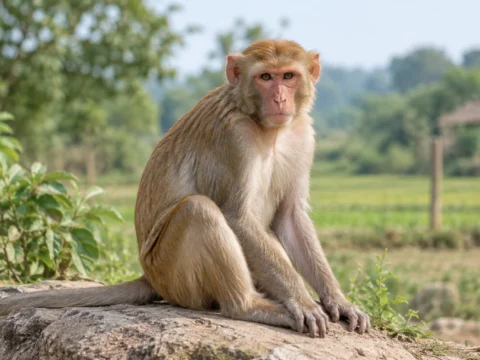
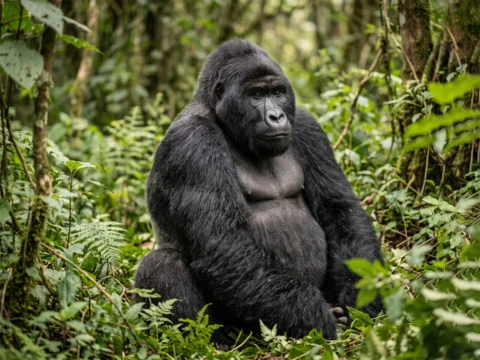
The Tail Is the First Thing to Check
It settles almost every case. Monkeys have tails, apes do not, and the rule holds right across both groups with only a handful of odd monkeys such as the Barbary macaque breaking it. If the animal has a tail, stop looking, it is a monkey.
What the tail does varies. The spider monkeys and howler monkeys of South America have prehensile tails, which means the tail grips like a fifth hand and can take the animal’s whole weight. African and Asian monkeys cannot do that. Their tails work as a balance pole instead, held out behind as they run.
Shoulders Built for Hanging
Strip away the fur and the skeletons are not alike at all. A monkey’s chest is narrow and deep, its shoulder blades sit at the sides like a cat’s, and its arms swing forward and back. That is the body of an animal that runs along the top of a branch on all fours.
An ape’s chest is broad and flat, its shoulder blades sit across the back, and its arms rotate in a full circle. That is the body of an animal that hangs underneath a branch and moves hand over hand. A gibbon does it faster than anything else in the forest, crossing thirty feet in a single swing. You have the same shoulder, which is why you can throw a ball overarm and a monkey cannot.
Big Brains and Long Childhoods
Apes are larger, with bigger brains for their body size, and they live far longer, up to around sixty years in the wild against thirty for the longest-lived monkeys. They also grow up slowly. A chimpanzee stays with its mother for five years or more, and an orangutan for seven or eight, which is the longest childhood of any animal except ours.
That slow childhood buys learning. Chimpanzees strip leaves off twigs to fish termites out of mounds, and crack nuts with stones chosen for the job. Orangutans make umbrellas out of large leaves. Different groups do these things differently and pass the method down, which is about as close to culture as animals get.
Where in the World
Monkeys split into two halves. New World monkeys live in Central and South America and include the capuchins, howlers, spider monkeys and marmosets, with flat noses whose nostrils point sideways. Old World monkeys live in Africa and Asia and include the baboons, macaques and colobus monkeys, with nostrils that point down.
Apes are Old World only. Gibbons and orangutans live in the forests of Southeast Asia, gorillas, chimpanzees and bonobos live in Africa. No ape is native to the Americas, so a tailless primate swinging through a South American rainforest is a spider monkey, not an ape.
We Are Apes Too
Humans are not merely related to apes, we are one. We sit inside Hominidae, the great ape family, alongside chimpanzees, bonobos, gorillas and orangutans, and our closest living relatives are the chimpanzee and the bonobo, from whom our line separated around six or seven million years ago.
Check yourself against the list. No tail. Broad chest. Shoulders that rotate. Big brain, long childhood, flat nails, opposable thumbs. You pass every test for an ape, which is the honest answer to why we do not have tails.