Meet the Manatee
Sailors used to mistake manatees for mermaids. Columbus recorded seeing three off Hispaniola and noted, with evident disappointment, that they were not as beautiful as the stories claimed.
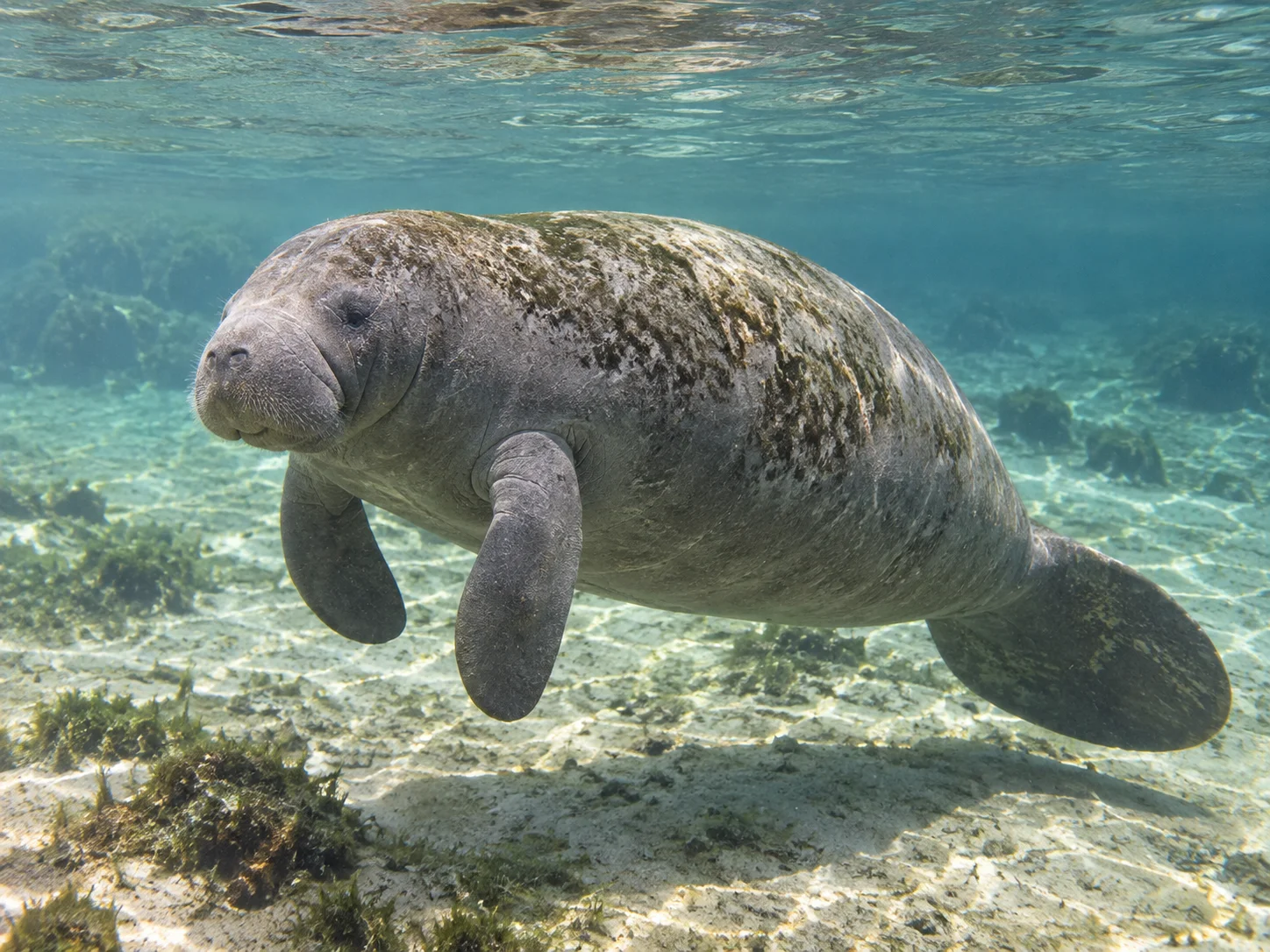
A manatee is a 1,200-pound vegetarian that drifts through warm shallow water eating plants, surfaces every few minutes to breathe, and has no natural predators at all.
Its closest living relative is not a whale or a seal. It is the elephant.
Scientific Name and Classification
There are three species of manatee, all in the genus Trichechus.
- West Indian manatee (Trichechus manatus), including the Florida manatee.
- Amazonian manatee (Trichechus inunguis), which lives entirely in fresh water.
- West African manatee (Trichechus senegalensis), the least studied of the three.
- Kingdom: Animalia
- Phylum: Chordata
- Class: Mammalia
- Order: Sirenia
- Family: Trichechidae
- Genus: Trichechus
The order Sirenia is named after sirens, the mermaid figures of Greek myth. It contains only manatees and the dugong, and sirenians are the only fully aquatic mammals that eat plants rather than meat.
Their land-dwelling ancestors were shared with elephants, and the family resemblance shows in surprising places.
How Is a Manatee Related to an Elephant?
Appearance and Anatomy
Manatees measure 8 to 13 feet long and weigh 800 to 1,200 pounds, with large individuals reaching 3,500. Amazonian manatees are the smallest.
- Tail. A single rounded paddle, which distinguishes a manatee from a dugong, whose tail is forked like a whale’s.
- Flippers. Used for steering, for walking along the bottom and for pushing food into the mouth.
- Lungs. Long and running along the back rather than the chest, helping control buoyancy. A manatee adjusts its depth largely by breathing.
- Bones. Dense and heavy, acting as ballast to keep it down in shallow water.
- Whiskers. Stiff bristles over the face and body, sensitive enough to detect changes in water movement.
Manatees have very little body fat despite their bulk, which is central to the problem described below: they look insulated and are not.
Habitat and Range
Manatees live in warm shallow water: coastal shallows, estuaries, rivers, springs and canals.
West Indian manatees occupy the Caribbean, the Gulf of Mexico and the southeastern United States. Amazonian manatees live in the Amazon basin in fresh water only. West African manatees range along the coast and rivers of west Africa.
They move freely between fresh and salt water, which few large mammals do.
Temperature rules their lives. Below about 68 degrees Fahrenheit a manatee begins to suffer cold stress, so Florida manatees crowd into warm springs and the outflows of power stations through winter, sometimes hundreds in one pool.
Diet and Feeding
Manatees are herbivores, and almost uniquely so for a fully aquatic mammal. They eat seagrass, water hyacinth, algae and other water plants.
An adult eats around 10 percent of its body weight every day, which can mean over 100 pounds of vegetation, and spends six to eight hours a day feeding.
They use their split upper lip to grasp plants and their flippers to push food toward the mouth, which is where the elephant resemblance is clearest.
Because their food is poor in nutrients and full of grit, they have both the marching teeth and a long gut full of microbes that ferment the material, much as a cow does.
Behavior and Lifestyle
Manatees are slow, gentle and mostly solitary, gathering in numbers only at warm-water sites or when breeding.
They cruise at about 3 to 5 miles an hour, and can burst to 15 for short distances when they need to.
They surface to breathe every three to five minutes while active, and can hold their breath for 20 minutes resting. Roughly 90 percent of the air in their lungs is exchanged per breath, against about 10 percent in ours.
They are more intelligent than their reputation suggests, performing about as well as dolphins on some learning tasks, and they recognize individual people and places.
They communicate with squeaks and chirps, and mothers and calves stay in constant vocal contact.
Reproduction and Life Cycle
Manatees reproduce very slowly, which is at the heart of their conservation problem.
Pregnancy lasts about 12 to 14 months and produces a single calf. Twins are rare.
A newborn weighs around 60 to 70 pounds and can swim to the surface within an hour, helped up by its mother.
Calves nurse for one to two years and stay with their mother while learning the migration routes and warm-water refuges they will need for life. That knowledge is taught, not instinctive, which means a lost generation loses the map.
Females give birth only every two to five years. Manatees live 50 to 60 years.
Predators and Threats
Manatees have essentially no natural predators. They are large, live in shallow water and are not worth the effort to most sharks or alligators.
Every serious threat is human:
- Boat strikes. The biggest killer. Manatees are slow and surface to breathe, and propellers cause terrible injuries. Most adult Florida manatees carry scars, and researchers identify individuals by their scar patterns.
- Cold. Having little body fat, manatees die of cold stress in unusually cold winters.
- Starvation. Pollution has caused algal blooms that killed off seagrass beds in parts of Florida, and manatees starved in large numbers as a result.
- Entanglement in fishing gear, and loss of habitat to coastal development.
Conservation Status
All three manatee species are Vulnerable, and in places the situation is worse than that suggests.
Florida manatees recovered well under protection, rising from a few hundred animals in the 1970s to several thousand. Then seagrass beds collapsed, and an unusual number starved over several recent winters, which reversed much of the gain.
Boat speed limits in manatee zones work and are enforced in Florida, and rescue centers rehabilitate injured animals and release them.
Their relative the Steller’s sea cow is the warning. A sirenian the size of a whale, it was discovered in 1741 and hunted to extinction within 27 years.
Role in the Ecosystem
Manatees are the gardeners of seagrass beds. Grazing keeps the grass cropped and growing rather than overgrown and choked, much as mowing keeps a lawn healthy, and seagrass beds are among the most productive habitats in the sea.
Those beds are nurseries for fish, shrimp and crabs, and they lock up large amounts of carbon, so the manatee’s grazing has effects far beyond itself.
In Amazonian rivers they control floating plants that would otherwise cover the surface and block light.
Their droppings fertilize the water, feeding the plants and plankton the rest of the system depends on.