Meet the Hoopoe
The hoopoe is a beautiful bird with a genuinely revolting defense.
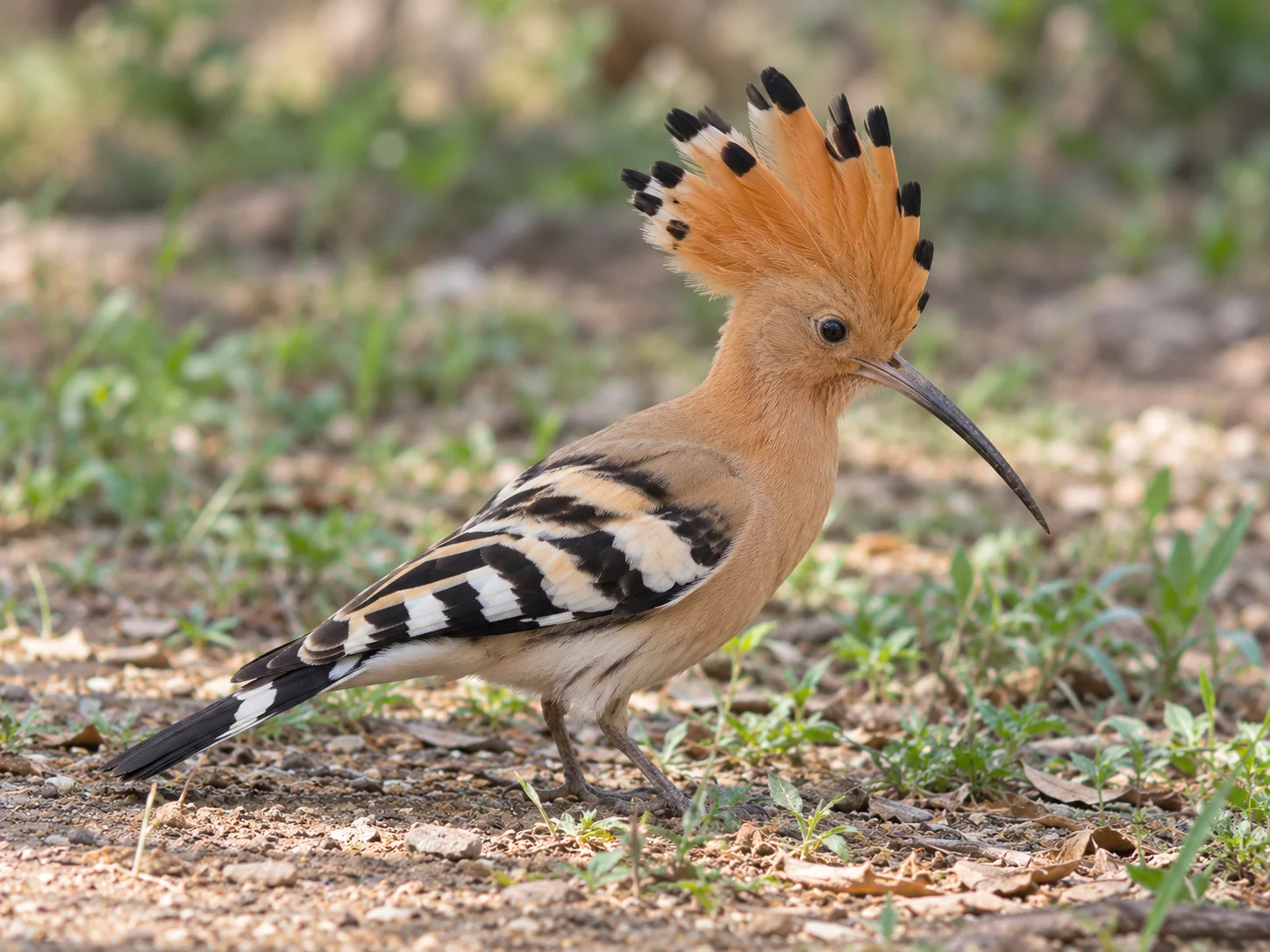
It has a crown of orange feathers that fans open like a headdress, bold black and white barred wings, and a long curved bill. It is also named after its own call, a soft repeated oop-oop-oop.
And when threatened, a nesting female and her chicks produce a liquid that smells of rotting meat, and the chicks can squirt droppings directly at an intruder’s face.
Scientific Name and Classification
The Eurasian hoopoe’s scientific name is Upupa epops, which is as close to its call as a name can get. Both halves are imitations of the sound.
- Kingdom: Animalia
- Phylum: Chordata
- Class: Aves
- Order: Bucerotiformes
- Family: Upupidae
- Species: Upupa epops
The hoopoe is almost alone in the world. Its family contains only hoopoes, and its closest relatives are hornbills and the wood hoopoes of Africa.
It is a bird of unusual cultural weight. The hoopoe appears in the Bible and the Quran, was sacred in ancient Egypt, leads the birds on their journey in the Persian poem The Conference of the Birds, and is the national bird of Israel.
The Hoopoe’s Chemical Defense
This is the hoopoe’s most remarkable trick, and it is more sophisticated than simple stink.
While nesting, the female and her chicks change the secretion from the preen gland at the base of the tail. It turns dark, oily and foul-smelling, something like rotting flesh, and she rubs it through her feathers and over the eggs.
The smell deters predators. But the liquid does something else: it is loaded with bacteria that produce antibiotics, and those bacteria live in the gland on purpose. Spread over the eggs, they attack the microbes that would otherwise rot them.
So the hoopoe keeps a colony of helpful bacteria and uses them as both chemical weapon and egg preservative.
The chicks add their own contribution, firing droppings at anything that reaches into the nest hole, and hissing like a snake.
Appearance and Anatomy
Hoopoes measure 10 to 13 inches long with a wingspan of 17 to 20 inches, and weigh 1.6 to 3 ounces.
- Crest. Orange with black tips, usually held flat along the head and raised into a full fan when the bird lands, is alarmed or is displaying.
- Bill. Long, thin and gently curved, for probing soil. The hoopoe opens it while it is buried in the ground, which takes real muscle.
- Wings. Broad and rounded with bold black and white bars, giving a floppy, butterfly-like flight that is unmistakable.
- Preen gland. Modified for chemical defense, as above.
- Legs. Short, and hoopoes spend much of their time walking on the ground.
That erratic flight is thought to make the hoopoe harder for falcons to catch, since a bird that does not fly in a predictable line is difficult to intercept.
Habitat and Range
The hoopoe lives across Europe, Asia and Africa, which is an enormous range for a single species.
It likes open country with bare or short ground to feed on and holes to nest in: farmland, orchards, olive groves, vineyards, savanna, parkland and village edges.
European hoopoes migrate to Africa for winter, crossing the Sahara. African and southern Asian populations mostly stay put.
They need both things at once: soft ground full of insects and a cavity nearby. Modern farming often provides one without the other.
Diet and Feeding
Hoopoes are mainly insect eaters and count as insectivores, taking beetle larvae, crickets, grasshoppers, ants, spiders, worms and occasionally small lizards and frogs.
They are specialists at finding what is underground. A hoopoe walks over bare soil tapping and probing, then drives the bill in and opens it below the surface to seize a grub.
Large prey gets dealt with efficiently: the bird bashes it on the ground to remove legs and wings, then tosses it into the air and swallows it.
Mole crickets, a serious crop pest, are a favorite, which makes hoopoes popular with farmers who know what they are looking at.
Behavior and Lifestyle
Hoopoes are usually seen alone or in pairs rather than flocks, feeding quietly on the ground.
They sunbathe in a posture that looks like injury: spreading the wings and tail flat on the ground, tilting the head back and lying there. They also take vigorous dust baths.
Males are territorial and fight over nest sites, sometimes seriously, stabbing with those long bills.
The call carries a long way for a soft sound, and a calling hoopoe is usually heard well before it is seen.
Reproduction and Life Cycle
Hoopoes nest in cavities: tree holes, wall crevices, cliffs, termite mounds and nest boxes. They cannot excavate, so they rely on holes that already exist.
The nest is notoriously filthy, and deliberately so. Droppings accumulate, the chemical secretion is added, and the result is a stinking cavity that most predators will not enter.
The female lays 5 to 9 eggs and incubates them alone for about 16 days while the male brings her food. The chicks fledge at around four weeks.
Hoopoes live around 10 years.
Predators and Threats
Falcons, hawks, snakes, cats and rats take hoopoes or raid nests, which is what all the chemistry is for.
Human pressures are the usual ones for a farmland bird: pesticides removing the insects it eats, loss of old trees and stone walls that provided nest holes, and intensive farming replacing the rough ground it hunts over.
Hoopoes are also hunted in some countries during migration.
Conservation Status
The hoopoe is listed as Least Concern, with a huge range across three continents and a large total population.
Locally the picture is less comfortable. Hoopoes have declined across much of northern and western Europe as farming intensified, and have disappeared from areas where they were once common.
They respond well to help. Putting up nest boxes in orchards and vineyards has brought hoopoes back to several regions, because the insects were still there and only the holes were missing.
Role in the Ecosystem
Hoopoes are effective natural pest controllers, and specifically of insects that live underground where few birds can reach them. Mole crickets and beetle larvae damage crops from below, and a hoopoe digs them out.
In vineyards and orchards they are valued enough that growers install boxes specifically to attract them.
Scientifically they are interesting for another reason. The antibiotic-producing bacteria in the hoopoe’s preen gland are studied by researchers looking for new antibiotics, so a bird that smells of rotting meat may eventually contribute to human medicine.
And as a cavity nester, the hoopoe depends on the holes other animals leave behind, which ties its fortunes to woodpeckers, old trees and old walls.