Meet the Goldfish
A goldfish called Tish was won at a funfair in Yorkshire in 1956 and died in 1999, aged 43.
That is the fact that should change how people think about goldfish. They are not disposable fairground prizes with three-month lifespans. Properly kept, a goldfish lives 10 to 20 years and can outlive the child it was bought for.
The reason so many die within months is not that goldfish are fragile. It is that almost everything the public believes about keeping them is wrong, starting with the bowl.
Scientific Name and Classification
The goldfish is Carassius auratus, a domesticated carp.
- Kingdom: Animalia
- Phylum: Chordata
- Class: Actinopterygii
- Order: Cypriniformes
- Family: Cyprinidae
- Species: Carassius auratus
Its family is the carps and minnows, which makes the goldfish a close relative of the koi and the common carp. Wild Carassius are drab olive-brown; the gold color is a mutation that people selected for.
The goldfish was domesticated in China over a thousand years ago, during the Song dynasty, when carp kept in ornamental ponds occasionally threw up a gold or orange fish. Those were bred deliberately, and keeping them became fashionable enough that at one point yellow varieties were reserved for the imperial family. That makes the goldfish one of the oldest domesticated animals that is not a farm animal or a pet mammal.
Do Goldfish Really Have a Three-Second Memory?
No. This is one of the most repeated animal myths there is, and the research says the opposite.
Goldfish have been trained to do a startling range of things:
- Remember for months. Goldfish trained to press a lever for food, or to respond to a particular sound before feeding, retain the association for months rather than seconds.
- Learn feeding times. They anticipate feeding and gather at the right spot at the right time of day.
- Tell people apart. They learn to recognize individual humans and respond differently to the one who feeds them.
- Navigate mazes and remember the route.
- Drive. In a 2022 study in Israel, goldfish were put in a water tank mounted on a wheeled robot that moved according to where the fish swam. They learned to steer it across a room to a target. A fish worked out how to operate a vehicle on land.
Where the myth came from is unclear, but it has been useful to anyone selling bowls, because an animal that cannot remember anything cannot be bored.
Appearance and Anatomy
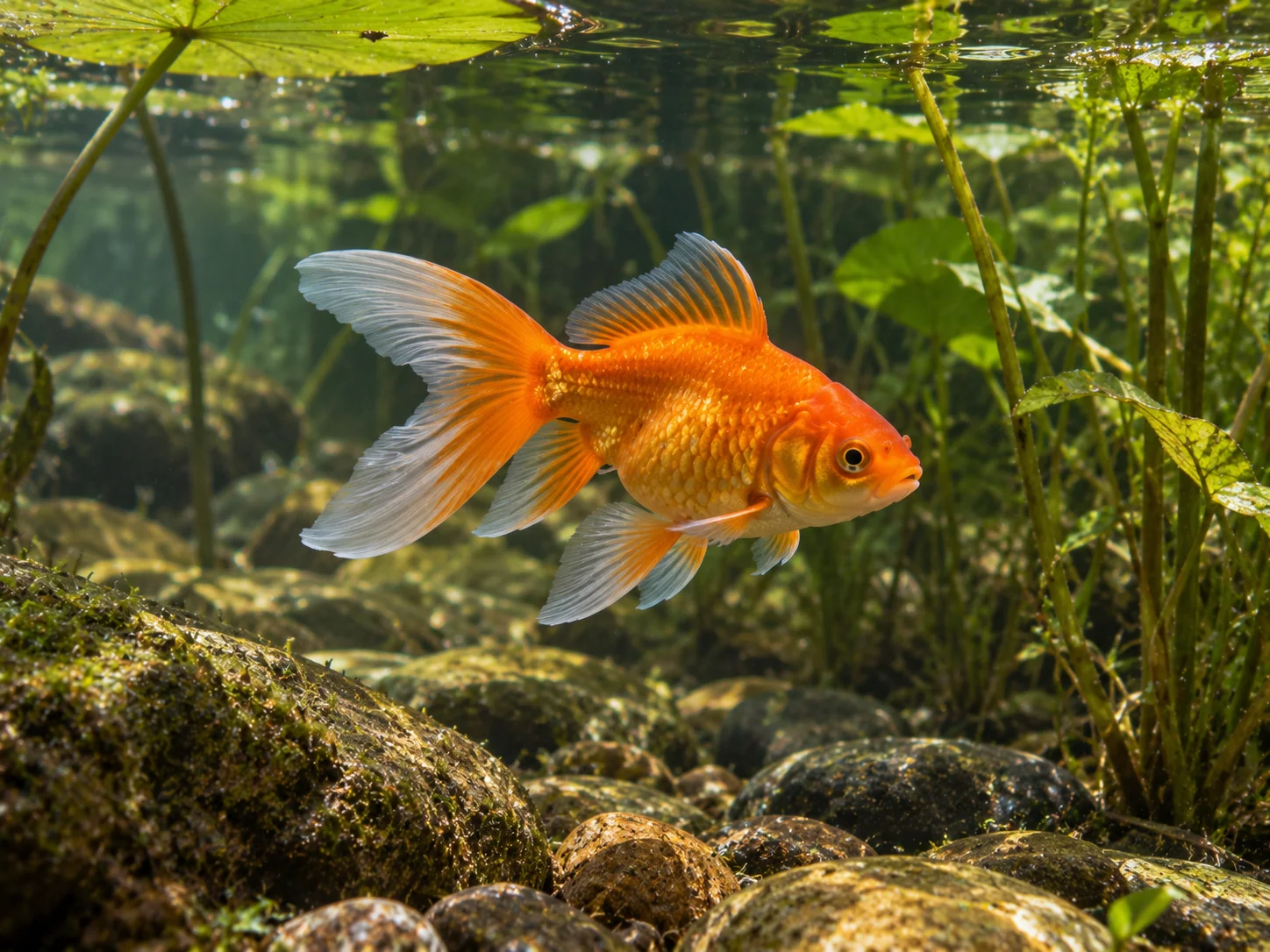
Fancy goldfish reach 6 to 8 inches; common and comet goldfish reach 10 to 14 inches and occasionally more. The record is around 18 inches. Weight runs from a few ounces to over 2 pounds.
Selective breeding has produced well over a hundred varieties, and some are startlingly altered: the telescope with protruding eyes, the bubble eye with fluid-filled sacs on its face, the ranchu with no dorsal fin, the lionhead with a raspberry-like growth over its head. Several of these varieties swim poorly and cannot compete for food with fitter fish, which is a cost worth knowing about before buying one.
- No stomach. Goldfish have no true stomach and digest continuously in the intestine, which is why overfeeding fouls water so quickly.
- Vision. They see more colors than we do, including ultraviolet.
- Teeth. In the throat, not the mouth.
- Lateral line. A row of sensors along the flank that detects water movement.
Goldfish also lose their color in darkness, because the pigment cells need light. A goldfish kept in an unlit room gradually fades.
Habitat and Range
As a domestic animal the goldfish lives wherever people keep it, in ponds and aquariums worldwide. Its wild ancestors came from slow fresh water in East Asia.
It is a cold-water fish, comfortable between about 65 and 72°F, and it does not need a heater. This matters practically: goldfish should not be housed with tropical fish, because neither will be at the right temperature.
Released goldfish have become a serious invasive problem, and this is the part most owners never hear. A goldfish let loose in a lake does not die. It grows to full size, breeds, stirs up sediment while rooting for food, and clouds the water. Specimens weighing several pounds have been pulled out of lakes in North America, Europe and Australia, and whole eradication programs have been run against them.
Never release a goldfish. Rehome it through an aquarium society, a shop, or someone with a pond.
Diet and Feeding
Goldfish are omnivores, eating plants, algae, insect larvae, small crustaceans and detritus.
In a tank they do best on sinking pellets rather than flakes, because gulping at the surface makes them swallow air, which contributes to the buoyancy problems fancy varieties are prone to. They also appreciate blanched vegetables: peas with the skins removed, courgette, spinach.
The important rule is to feed less than instinct suggests. A goldfish will beg continuously and never stops wanting food, and because it has no stomach, overfeeding passes straight through and becomes ammonia. Feed what is eaten in a minute or two, once or twice daily.
Behavior and Lifestyle
Goldfish are social and do better in groups, and they are active foragers that spend much of the day rooting through substrate.
They sleep, in a fashion, becoming still and losing color slightly, usually near the bottom. They have no eyelids, so they do it with their eyes open.
They are also responsive to people in a way that surprises new owners, learning who feeds them, coming to the glass, and in some cases taking food from a hand.
One behavior worth understanding: a goldfish gasping at the surface is not hungry. It is short of oxygen, usually because the water is too warm, overstocked or unfiltered, and it is a warning sign rather than a request for food.
Reproduction and Life Cycle
Goldfish spawn in spring in response to rising temperature and longer days. Males chase a female persistently, nudging her flanks until she releases eggs, which are fertilized in the water.
A female can release hundreds to thousands of sticky eggs, which attach to plants. The parents take no care of them whatsoever and will eat both eggs and fry given the chance.
Eggs hatch in four to seven days, and the fry are dark brown rather than gold, which is good camouflage. They take several months to develop adult color, and some never do.
Goldfish mature at about a year and live 10 to 20 years, with ponds generally producing longer lives than tanks. Tish, the record holder, reached 43.
Predators and Threats
In ponds, herons, kingfishers, cats, raccoons and large fish take goldfish, and a heron can empty a pond in a few visits.
In captivity the threats are almost entirely husbandry, and the same few mistakes account for most deaths:
- Bowls and unfiltered tanks. No filtration means ammonia builds up, and a small volume has too little surface area for oxygen exchange.
- Uncycled tanks. A new tank has no bacteria to process ammonia, which kills most beginner fish in the first month.
- Tanks far too small. A single fancy goldfish needs somewhere around 20 to 30 gallons, with more for each additional fish.
- Overfeeding, which fouls the water fast in a fish with no stomach.
- Being kept with tropical fish at the wrong temperature.
Fancy varieties also suffer swim bladder problems, largely because their compressed, egg-shaped bodies crowd the internal organs. That is a consequence of how they were bred, not bad luck.
Conservation Status
The goldfish is a domestic animal and is not assessed for conservation. There is no shortage of them.
Where they do appear in conservation discussion, it is as the problem. Feral goldfish are listed as invasive in numerous countries, and they damage shallow freshwater habitats by rooting through sediment and increasing turbidity.
There is also a welfare question that is slowly changing practice. Several countries and regions have restricted giving goldfish as fairground prizes, and some retailers have stopped selling bowls, on the straightforward grounds that the container cannot keep the animal alive.
Role in the Ecosystem
The goldfish’s wild ancestor is an ordinary part of a freshwater food web in its native range, eating invertebrates and plants and being eaten by larger fish and birds.
Everywhere else, the goldfish’s ecological role is as an introduced species, and an often damaging one.
Its real significance is to people. The goldfish is the most commonly kept pet fish in the world, the first aquarium fish most people ever meet, and a thousand-year-old demonstration that humans will selectively breed an animal into a hundred shapes simply because they like looking at it.
It is also, through the memory myth, a good lesson in how a convenient belief survives without evidence. A fish that can learn to steer a vehicle across a room has been sold for decades on the premise that it forgets everything within three seconds. If you are setting up a first tank, our beginner’s guide to keeping pet fish covers the water chemistry that actually keeps them alive.