Meet the Gila Monster
A medicine taken by millions of people for type 2 diabetes began with a chemical found in the saliva of this lizard.
The Gila monster is one of the few venomous lizards in the world. It spends around 95 percent of its life underground, eats perhaps five to ten meals a year, and stores the energy from them in its tail.
It is also slow, reluctant and almost never a danger to anyone who leaves it alone.
Scientific Name and Classification
The Gila monster’s scientific name is Heloderma suspectum. Heloderma means “studded skin”, after the beadlike scales, and suspectum means suspected, because the naturalist who named it suspected it was venomous but could not prove it.
- Kingdom: Animalia
- Phylum: Chordata
- Class: Reptilia
- Order: Squamata
- Family: Helodermatidae
- Species: Heloderma suspectum
Its family contains only the beaded lizards, its close Mexican relatives. There is nothing else quite like them.
It is named after the Gila River basin in Arizona and New Mexico, and the name is pronounced “heela”.
How Did a Gila Monster Help Treat Diabetes?
This is one of the best arguments for studying obscure animals that medicine has ever produced.
In the 1990s researchers examining Gila monster venom found a compound they named exendin-4. It closely resembled a human hormone called GLP-1, which the gut releases after a meal to tell the body to produce insulin.
Human GLP-1 is useless as a drug because the body destroys it within about two minutes. The lizard version lasted for hours.
That difference made it a usable medicine. Exendin-4 was developed into a drug called exenatide, approved in 2005 for type 2 diabetes, and it opened the whole class of GLP-1 medicines that are now used by millions of people for diabetes and weight management.
Why a lizard carries a long-lasting version of a digestive hormone is still being worked out, and it may relate to an animal that eats a few enormous meals a year and has to switch its digestion on and off rather than running it continuously.
Nobody set out to cure anything. Someone simply wondered what was in the venom of a desert lizard.
Is the Gila Monster Dangerous?
It is venomous, and it is also one of the least likely animals in the desert to hurt you.
Its venom delivery is unusual. Snakes have hollow fangs and inject venom under pressure. The Gila monster has venom glands in its lower jaw and grooved teeth, and it has to chew the venom in, holding on and working its jaws. There is no fast strike.
A bite is extremely painful, and causes swelling and a drop in blood pressure, but it is not considered life-threatening to a healthy adult, and no reliably documented human death has been attributed to one in modern times.
Almost every recorded bite involves someone picking the animal up. It is slow, it gives plenty of warning by hissing and gaping, and it would far rather retreat into a burrow.
The venom is probably defensive rather than for hunting, since most of what it eats is eggs and newborn animals that put up no fight.
Appearance and Anatomy
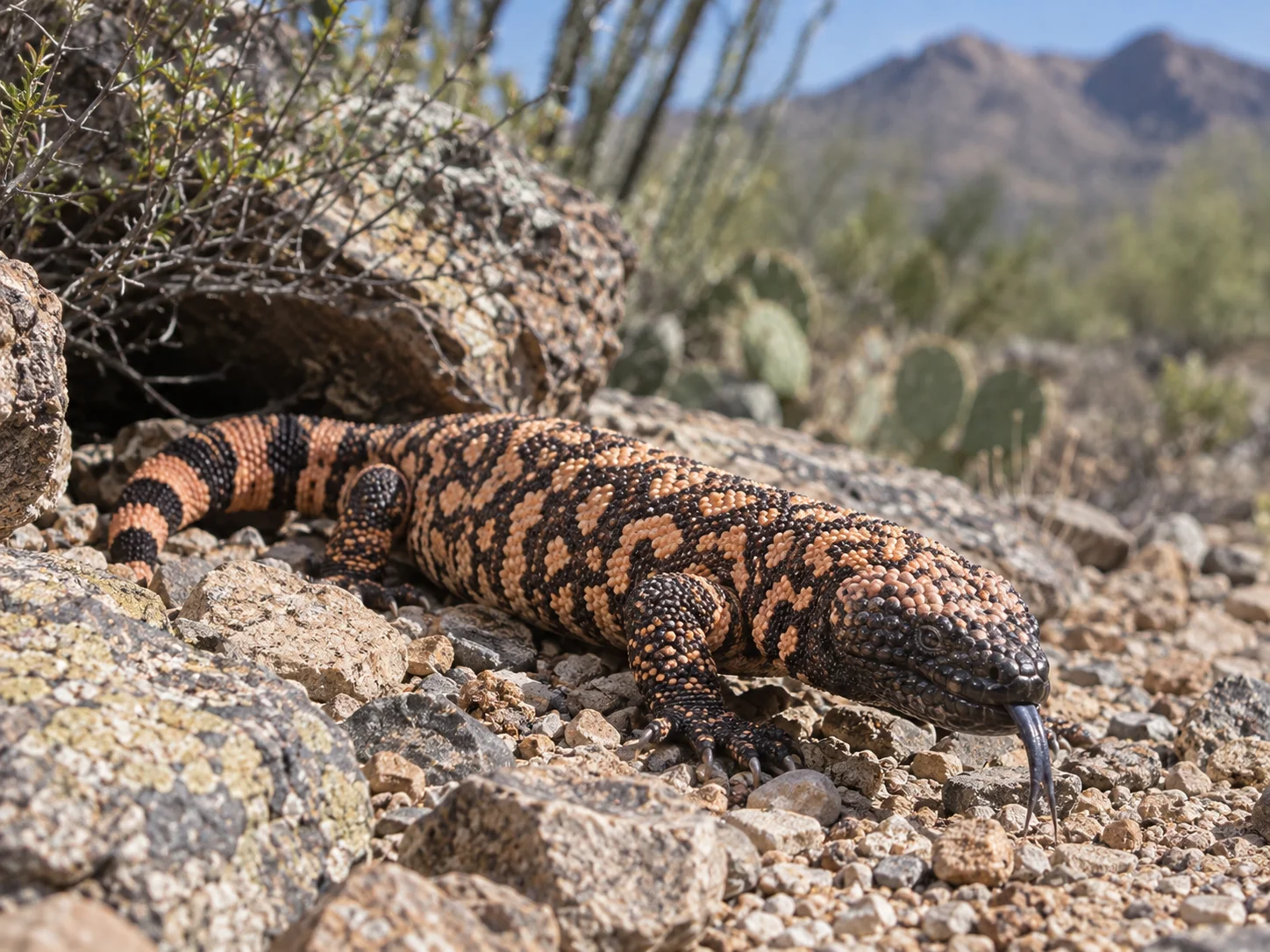
Gila monsters reach 18 to 22 inches in total length and weigh 3 to 5 pounds, making them the largest lizard native to the United States.
- Skin. Covered in bony beadlike scales called osteoderms, patterned in black with pink, orange or cream banding. The pattern is a warning, not camouflage.
- Tail. Short, thick and used as a fat store. A well-fed Gila monster has a plump tail; a hungry one has a thin one, and the tail is a direct read-out of how its year is going.
- Venom glands. In the lower jaw, with grooved teeth rather than hollow fangs.
- Tongue. Forked and flicked constantly, used to track scent trails.
- Claws. Strong and curved, for digging burrows and excavating buried eggs.
They are slow, managing about one mile an hour, and tire quickly. Everything about the animal is built to spend as little energy as possible.
Habitat and Range
Gila monsters live in the Sonoran, Mojave and Chihuahuan deserts of the southwestern United States and northwestern Mexico: Arizona, southern Nevada, southwestern Utah, southeastern California, New Mexico, Sonora and Sinaloa.
They prefer desert scrub, rocky foothills and canyon bottoms, not open sand dunes. They need ground they can dig into and rocks to shelter under.
The underground life is the central fact about them. A Gila monster spends roughly 95 percent of its time in burrows, emerging mainly in spring and after summer rains, and often active for only a few weeks a year in any visible way.
They avoid the worst heat, coming out in the morning and evening, and in the hottest months they may not appear at all.
Diet and Feeding
Gila monsters are carnivores, and specialists in food that cannot run away: eggs of birds, lizards and tortoises, plus newborn rabbits, baby rodents, nestling birds and carrion.
They find it by smell, following scent trails with the tongue, and they will dig several inches down to reach buried eggs.
The feeding pattern is extraordinary. A Gila monster may eat only five to ten times in a whole year, and a single meal can be a third of its own body weight. The energy goes into the tail as fat and is drawn down over the following months.
Hatchlings can eat half their body weight in one sitting.
They also store water in the bladder and reabsorb it during drought, which is a different trick to the same end.
Behavior and Lifestyle
Gila monsters are solitary and slow-living, and they are not territorial in any strong sense, though they use the same burrows repeatedly over years.
They are active by day in mild weather and shift to dusk in summer.
Threatened, the sequence is a hiss, an open mouth, and only then a bite. The bright banding is a warning that works: most desert predators leave them alone.
Males wrestle during the breeding season, pinning each other and trying to flip their rival onto its back, without using venom. As with most snakes and venomous lizards, the venom is for food and defense, not for settling arguments.
They can live a very long time for a lizard, which suits an animal that does almost nothing in a hurry.
Reproduction and Life Cycle
Mating happens in spring, and the female lays 2 to 12 eggs in a burrow in summer.
The eggs then sit through the winter underground and hatch the following spring, around nine months later, which is remarkably long for a lizard.
Hatchlings are about 6 inches long, fully venomous from the start, and entirely independent. There is no parental care.
They are slow to mature, taking three to five years, and a female may lay only every other year.
Gila monsters live 20 to 30 years in the wild and over 35 in captivity. Few eggs and slow breeding mean populations recover very poorly from losses.
Predators and Threats
Coyotes, badgers, birds of prey and rattlesnakes take young Gila monsters, and adults have few natural enemies thanks to the venom and the warning colors.
Habitat loss is the main human threat. Desert cleared for housing, roads and solar development removes the burrows and the rocky ground they need, and the American southwest has been among the fastest-developing regions in the country.
Road deaths matter a great deal for a slow animal. So does illegal collection for the pet trade, which is why they are legally protected.
And they are still killed on sight by people who believe they are deadly.
Conservation Status
The Gila monster is listed as Near Threatened, with populations declining in places but still present across most of its range.
It has a notable legal distinction: in 1952 Arizona made it the first venomous animal anywhere in the United States to be given legal protection, and it remains illegal to collect or kill one there.
Its biology is the underlying problem. An animal that lays a handful of eggs every other year, takes five years to mature and moves at one mile an hour cannot replace losses quickly, so local populations wiped out by development do not come back.
They do reasonably well where desert is left intact, which is the whole of the conservation requirement.
Role in the Ecosystem
Gila monsters are specialist nest predators, and that is an unusual role. By eating eggs and newborn animals they influence the breeding success of ground-nesting birds, lizards and rodents in a way faster predators do not.
Being cold-blooded and slow, they do that on an astonishingly small energy budget. A predator that eats ten meals a year costs its ecosystem almost nothing, and a desert with very little food can still support them.
Their burrows are reused by insects, snakes and small mammals.
Their largest contribution, though, is the one in the medicine cabinet. A GLP-1 drug class now used by millions of people traces back to a lizard that almost nobody has seen, which is the single best answer to the question of why it matters whether obscure animals survive.