Meet the Polar Bear
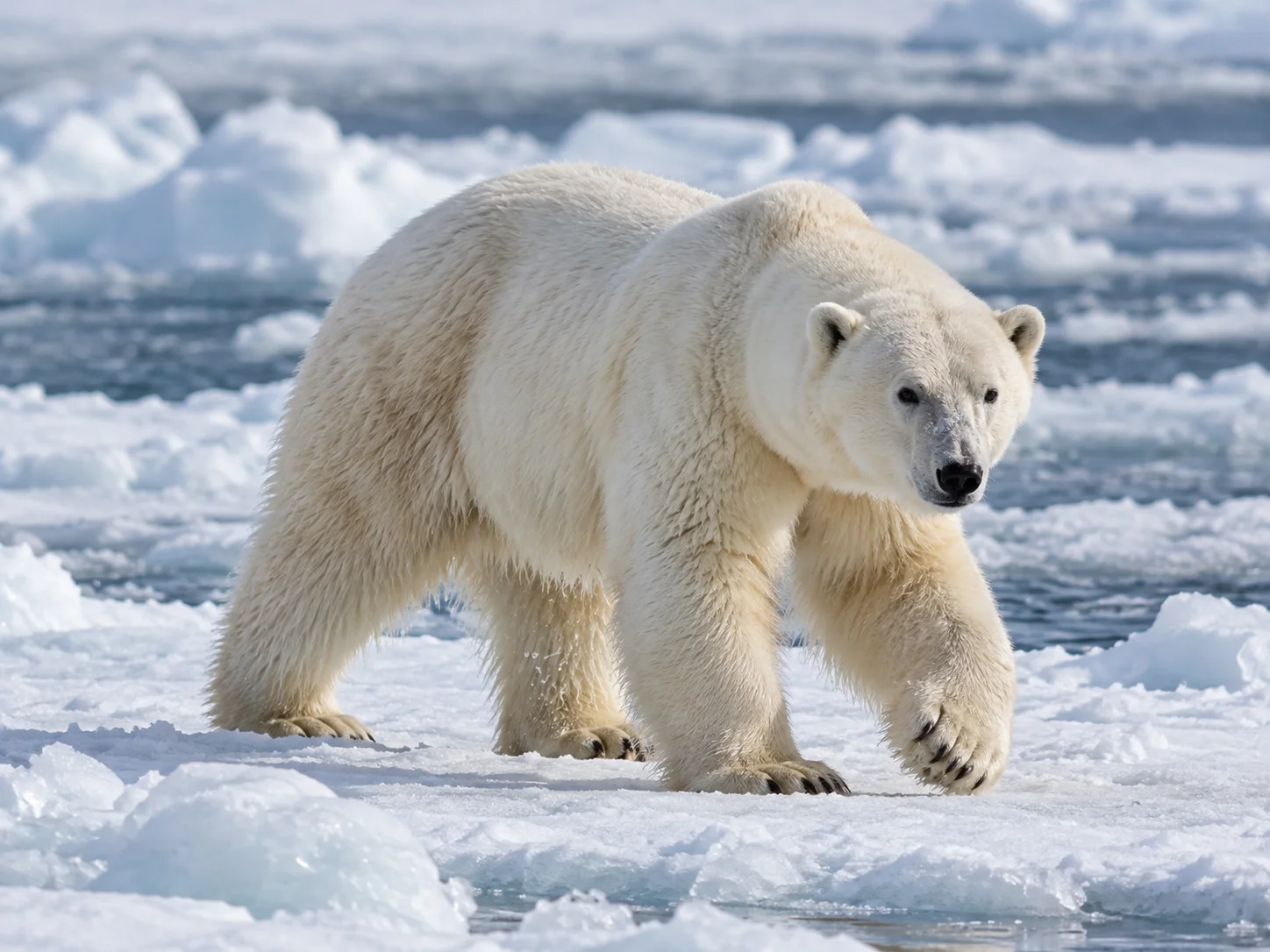
A polar bear is not white, and it does not have white fur.
Each hair is hollow and clear, with no pigment in it at all. The hairs scatter light the way snow or crushed glass does, which is why the animal looks white. Underneath, its skin is black.
You can see this in zoos in warm places, where algae sometimes grows inside the hollow hairs and turns a polar bear faintly green.
Scientific Name and Classification
The polar bear is Ursus maritimus, which means sea bear, and the name is accurate: it is the only bear classed as a marine mammal.
- Kingdom: Animalia
- Phylum: Chordata
- Class: Mammalia
- Order: Carnivora
- Family: Ursidae
- Species: Ursus maritimus
It evolved from the brown bear, and recently enough that the two are still genetically close. They can interbreed, and wild hybrids, sometimes called pizzly bears, have been documented in the Canadian Arctic since 2006, with more appearing as brown bears move north.
Estimates for when the split happened vary from several hundred thousand to a few million years ago, and the DNA evidence is genuinely messy, because the two species have interbred repeatedly since.
Built for Cold, and the Problem That Creates
The polar bear’s insulation is so effective that its real difficulty is not freezing but overheating.
- Two coats. A dense woolly underlayer plus long hollow guard hairs that shed water, so the bear can shake itself nearly dry.
- Black skin. Underneath the clear fur, which absorbs whatever sunlight gets through.
- Four inches of fat. Blubber, mostly, which also makes the bear buoyant.
- Small ears and tail. Less surface to lose heat from.
- Furred feet. Hair between the pads for warmth and grip, with soft bumps on the soles that work like tread on ice.
The result is an animal that barely registers a blizzard but has to move slowly and rest often to avoid overheating, even in sub-zero air. A polar bear that runs for any distance is in trouble.
They are also nearly invisible to thermal cameras, which struggle to find them against cold ground, because so little heat escapes.
Appearance and Anatomy
Males stand 8 to 10 feet long and weigh 900 to 1,500 pounds (410 to 680 kg), occasionally more. Females are roughly half that, at 400 to 700 pounds. On their hind legs, large males reach around 10 feet.
Compared with a brown bear, a polar bear has a longer neck, a narrower head and no shoulder hump, all of which suit reaching into seal holes and swimming rather than digging.
The paws are enormous, up to 12 inches across, spreading weight on thin ice and serving as paddles. Polar bears swim with the front legs only, dragging the hind legs as rudders.
Their sense of smell is the real weapon. A polar bear can detect a seal through three feet of packed snow, and pick up a carcass from miles away downwind.
Habitat and Range
Polar bears live right around the Arctic, in five countries: Canada, the United States (Alaska), Russia, Greenland and Norway (Svalbard). Canada has roughly two thirds of them.
Their habitat is not really land. It is sea ice, and specifically the ice over shallow continental shelf water where seals are plentiful. Land, for most populations, is where a bear waits when the ice has gone.
Scientists recognize 19 subpopulations, and they behave quite differently. Some stay with the pack ice year-round; others, like the bears of Hudson Bay, are forced ashore every summer and must fast until the water freezes again.
Diet and Feeding
The polar bear is the most carnivorous bear, and essentially a seal specialist. Ringed and bearded seals are the mainstay.
The main hunting method is called still-hunting, and it is mostly waiting. The bear finds a breathing hole in the ice, lies down beside it, and stays motionless for hours until a seal surfaces. Most attempts fail.
They also break into snow dens to take seal pups, and stalk seals resting on the ice, creeping flat and then rushing the last few yards.
What they eat is mainly fat rather than meat. A bear will often take the blubber and skin and leave the rest, which feeds Arctic foxes and gulls that follow bears around for exactly that reason.
One warning that is worth repeating: never eat polar bear liver. It holds such concentrated vitamin A that a single meal can be fatal, something Arctic explorers learned the hard way.
Behavior and Lifestyle
Polar bears are solitary and roam enormous distances, with individual ranges sometimes covering tens of thousands of square miles.
They are strong swimmers. One tracked female swam continuously for nine days across 426 miles of open water, which was recorded as remarkable rather than normal, and she lost a fifth of her body weight and her cub doing it.
Polar bears do not hibernate. Only pregnant females den up, and the rest stay active all winter, which is their best season, since winter means ice and ice means seals. The hard time is summer.
Young males wrestle for hours in what looks like play fighting and probably is, and adults can be surprisingly tolerant of each other at a big carcass.
Reproduction and Life Cycle
Mating happens on the spring ice. The female then uses delayed implantation, holding the fertilized egg in suspension for months so that development starts only when she has put on enough fat.
In the fall she digs a den in a snowdrift and gives birth around December to one or two cubs, each weighing little more than a pound, blind and nearly hairless.
She stays in the den without eating or drinking for up to eight months in total, nursing on her own reserves with milk about a third fat. By the time she emerges in spring the cubs weigh 20 to 25 pounds, and she may have lost half her weight.
Cubs stay with her for two and a half years, learning to hunt, which is a skill that takes that long to acquire. Polar bears live 20 to 25 years in the wild, rarely 30.
Predators and Threats
An adult polar bear has no natural predator. Cubs are vulnerable to adult males and occasionally to wolves.
The threat is sea ice. A polar bear needs ice as a platform to hunt from, and as Arctic ice forms later and breaks up earlier, the hunting season shortens at both ends.
In western Hudson Bay, the ice-free period has lengthened by several weeks over recent decades, and the bears there are measurably thinner, have fewer cubs, and have declined substantially in number. Thin bears come ashore looking for food, which is why conflicts with Arctic towns are increasing.
Pollution adds to it. Industrial chemicals accumulate up the food chain and reach high concentrations in bear fat, and in the milk cubs drink.
Conservation Status
The polar bear is listed as Vulnerable, with a global population usually estimated at 22,000 to 31,000.
The honest position is that the numbers are uncertain. Several of the 19 subpopulations have never been properly surveyed, because counting bears across millions of square miles of moving ice is extremely difficult and expensive. Of those with good data, some are declining, some are stable, and a couple have been stable or recovering since hunting was regulated.
That mix is sometimes used to argue the species is fine. It misses the point, which is that a bear population can look healthy right up until the ice season gets too short, and the trajectory of the ice is not in doubt.
Hunting is now largely regulated under a 1973 agreement between the five polar bear nations, which worked. That is encouraging, because it proves these countries can act together; it is also a reminder that the current threat cannot be fixed in the Arctic alone.
Role in the Ecosystem
As the Arctic’s top predator, the polar bear limits seal numbers, and seals in turn shape fish populations, so the bear’s influence runs down through the whole system.
It also feeds a lot of other animals by accident. Because bears eat fat and abandon the rest, Arctic foxes, gulls and ravens live substantially on polar bear leftovers.
They matter to people too. Polar bears have been central to Inuit life, hunting and story for thousands of years, long before they became a symbol on a poster.
And they are the clearest single measure of the Arctic’s condition, because a polar bear cannot be conserved separately from the ice. Protect the bear and you have to protect the sea ice, which is a far harder and far more useful task.