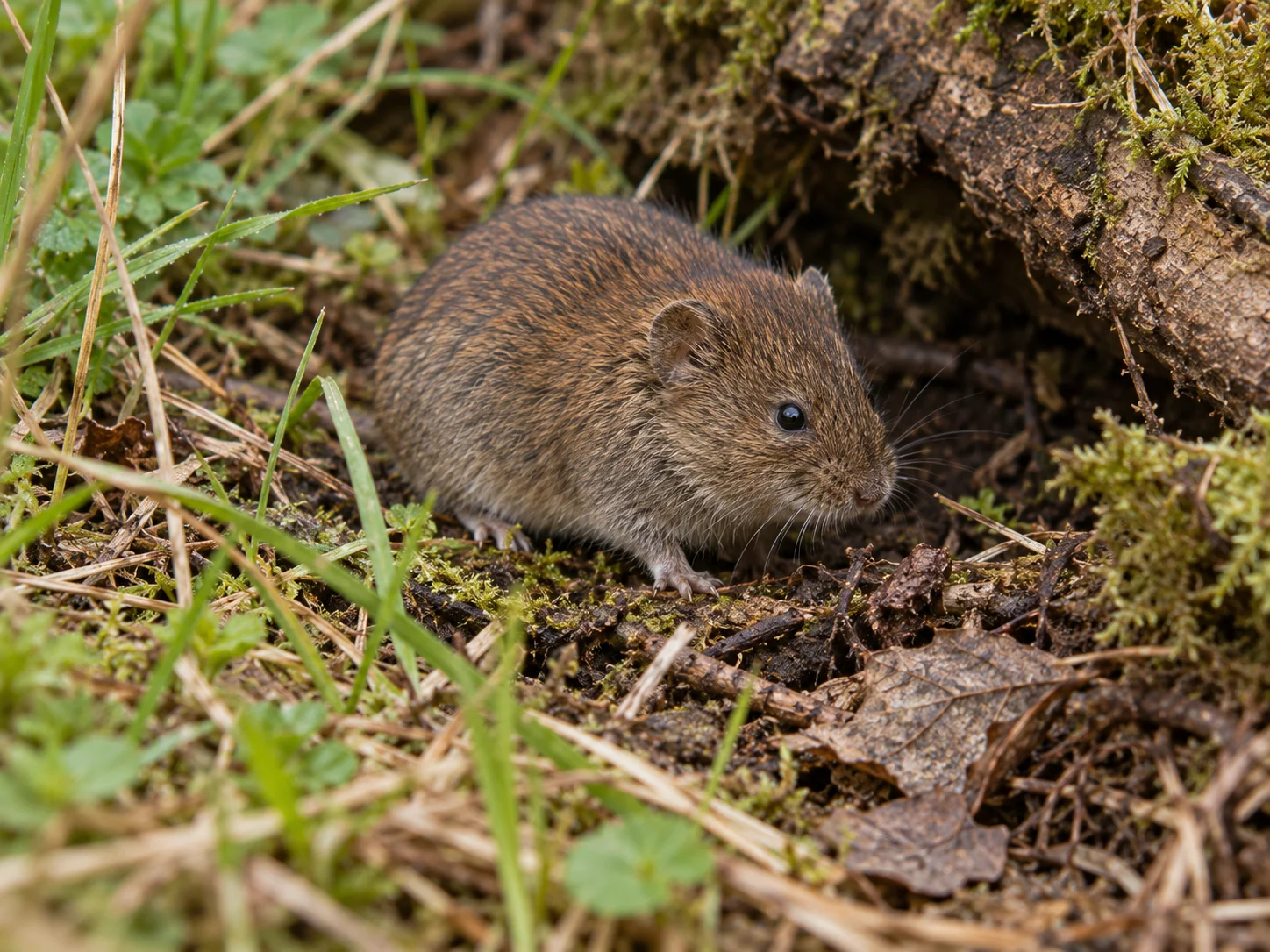
Meet the Vole
A vole eats its own body weight in plants every single day. It matures in a month, breeds monthly through the warm season, and a single pair can leave a hundred descendants in a year. Voles are small plant-eating rodents, the subfamily Arvicolinae, with around 155 species spread across Asia, Europe and North America.
It also usually dies almost immediately. As many as 88 percent of voles are dead within their first month, and most never reach a second winter.
That combination of enormous output and enormous losses is what a vole is. It sits near the bottom of the food chain across the whole northern hemisphere, and almost everything that hunts small animals is eating voles.
Scientific Name and Classification
Voles are not a single species. There are approximately 155 of them, spread across a number of genera in the subfamily Arvicolinae.
- Kingdom: Animalia
- Phylum: Chordata
- Class: Mammalia
- Order: Rodentia
- Family: Cricetidae
- Subfamily: Arvicolinae
Arvicolinae also contains the lemmings and the muskrats, so those are a vole’s closest relatives. The largest genus is Microtus, the meadow and field voles; others include the water voles, the red-backed voles, the mole voles and the tree voles.
With that many species in that many situations, the group carries no single conservation status. Most voles are abundant; a few island and specialist species are not.
A Vole Is Not a Mole, and Not a Mouse
The names cause endless confusion, and the three animals are genuinely different.
A mole is not a rodent at all. It is a burrowing insect-eater with spade-like front feet and almost no use for eyes, and it is after earthworms and grubs rather than plants. If something is tunneling under your lawn and pushing up heaps of soil, that is a mole.
A mouse is a rodent and a relative, but it looks different once you know what to check. Set beside a mouse, a vole is stouter and rounder-headed, with smaller eyes, smaller ears and a shorter, hairier tail. Its molars are the real giveaway: high-crowned with sharp angular cusps, built for grinding tough plant material rather than for a varied diet.
Appearance and Anatomy
Voles measure 3 to 9 inches (8 to 23 cm) depending on the species, with most well under 3 ounces (85 g). The water vole of Europe is among the largest; many meadow species would sit comfortably in a cupped hand.
- Compact, thickset body with a blunt rounded head
- Small eyes and small, often fur-hidden ears
- Short tail covered in hair
- Dense brown or gray fur
- High-crowned grinding molars with angular cusps
Everything about the shape suits life in a tunnel through grass. Small ears and small eyes do not catch on stems or get injured, and a short-haired tail is one less thing for a predator to grab.
Habitat and Range
Voles live across North America, Europe and Asia, in grassland, meadow, woodland, marsh, farmland, orchards and gardens: anywhere with ground cover and something green to eat.
Most species dig shallow burrows and connect them with runways: narrow paths worn through the base of the grass, roofed over by the vegetation itself. A vole spends its life moving along these lanes, rarely stepping into the open, and the runways are usually the easiest sign that voles are present.
Different species specialize. Tree voles live up in conifers, mole voles stay almost entirely underground, and water voles keep to banks and ditches.
Diet and Feeding
Voles are plant eaters. They take grasses and herbaceous growth above ground and bulbs and root systems below it, and they will also eat nuts, fruit and occasionally dead animals.
The quantity is the striking part: a vole consumes its own body weight in plant material every 24 hours. Plant food is low in energy and the animal is small, so it loses heat fast and has to keep refilling, which means a vole is feeding for much of every day and night rather than at set mealtimes.
Reproduction and Life Cycle
Voles breed from spring through fall, producing litters monthly. A litter holds two to nine young, pregnancy lasts about three weeks, and the young are themselves ready to breed a month after birth.
Run those numbers forward and one mating pair can produce around 100 offspring in a year. It is why vole populations can grow very large very quickly, sometimes before anyone has noticed them at all.
Against that stands the mortality. Up to 88 percent of voles die inside their first month. Smaller species average three to six months of life and rarely pass a year; even the larger ones, like the European water vole, usually die in their second winter. Captive voles may reach three years, which tells you the limit is predation and hardship rather than old age.
The Prairie Vole and the Study of Pair Bonds
One vole has become unexpectedly famous in laboratories. The prairie vole forms lasting pair bonds: males generally stay with one female and help raise the pups, which is uncommon among mammals.
Its close relative the meadow vole does not. Having two similar species that behave so differently has made them a standard comparison for studying what produces attachment, and the work points to the brain chemicals vasopressin, dopamine and oxytocin.
In one experiment, increasing the expression of a particular gene in meadow voles made the males behave more like prairie voles. It is worth saying plainly that this is contested, with other researchers disputing how large a role that gene really plays, and that a vole is not a person. But it is a rare case where a specific piece of biology can be linked to a social behavior at all.
Predators
The list is long: owls, hawks and falcons from above; foxes, coyotes, bobcats, lynxes, martens, weasels, raccoons and domestic cats on the ground; and snakes into the burrows.
Owl pellets tell the story neatly. Pull one apart and it is largely vole bones, which is how researchers survey vole populations without catching a single animal.
One recent addition surprised everyone. In 2024 scientists at UC Davis watched California ground squirrels actively hunting and eating voles, behavior nobody expected from an animal filed under seed-eater.
Voles in Gardens and Orchards
Voles do real damage, and the worst of it is hidden. Feeding on bulbs and root systems can kill a plant from below with no sign above ground until it collapses.
The serious injury in an orchard is girdling: a vole chews the bark in a ring right around the base of a young tree, which cuts the channel the tree uses to move food from its leaves to its roots. The tree may look fine for a while and then die.
Role in the Ecosystem
Voles are the engine underneath a great many food chains. They convert grass into meat at speed and in bulk, and that supply is what supports owls, hawks, foxes, weasels and much else besides.
They work the soil as well. Burrowing and feeding mixes and moves nutrients through the upper layers of ground, which is a quiet service to the plants that remain.
It is an unglamorous existence and a short one. But a landscape without voles would support far fewer predators, and the owl that most people are delighted to see is there because something small and brown is running through the grass below it.