Meet the Frilled Lizard
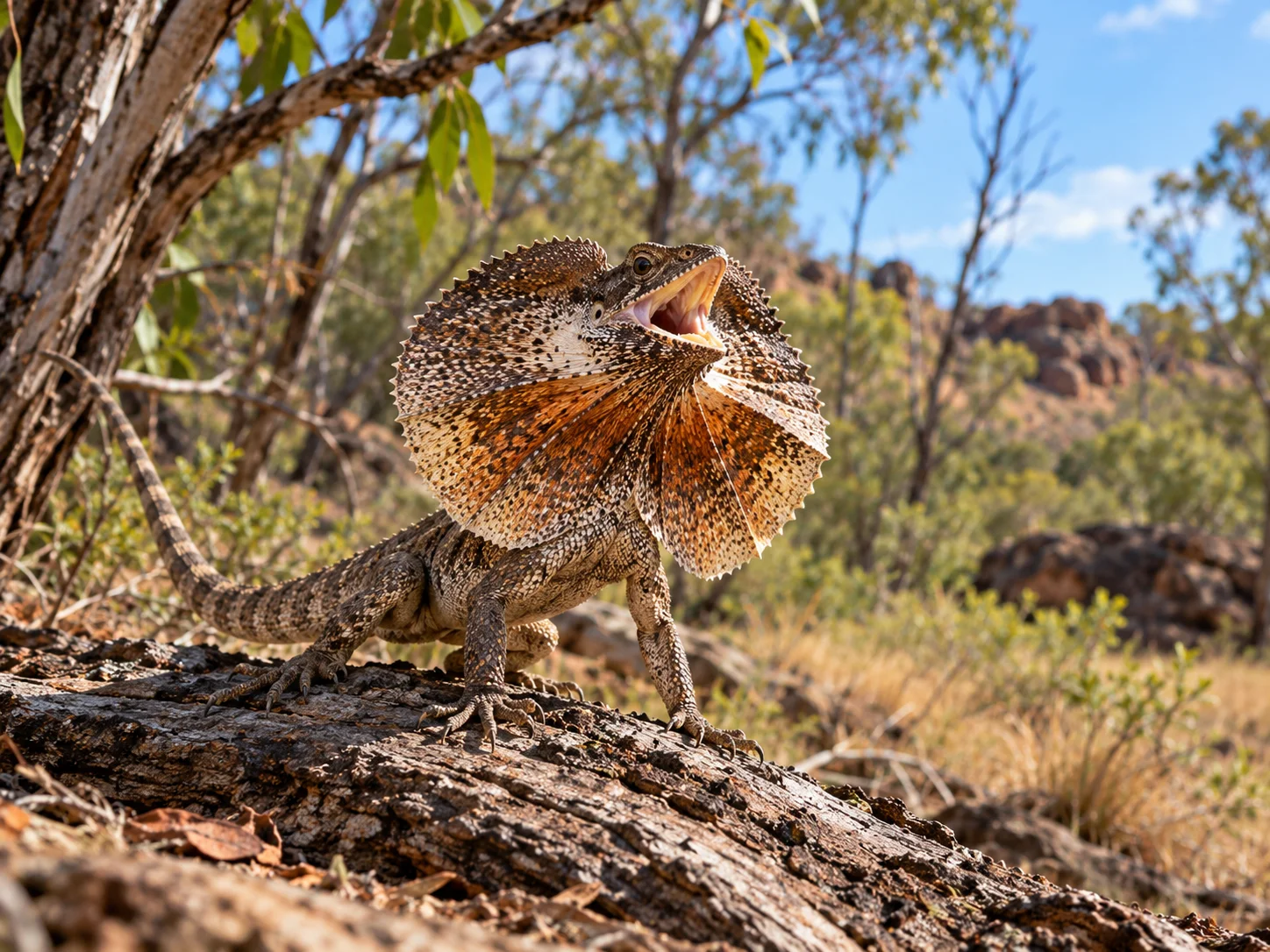
Cornered, a frilled lizard turns to face whatever is threatening it, opens its mouth, and a disc of skin more than eight inches across snaps out around its head. The frilled lizard (Chlamydosaurus kingii) is a tree-dwelling reptile of northern Australia and southern New Guinea.
Then it hisses, lashes its tail, and rushes forward at the threat rather than away from it, often rearing onto its hind legs.
The entire performance is bluff. A frilled lizard has no venom, no dangerous bite and no weapon of any kind, and it is roughly the weight of a can of drink. What it has is theater, and the theater works often enough that the species has relied on it for millions of years.
Scientific Name and Classification
The frilled lizard is Chlamydosaurus kingii, the only species in its genus. Chlamydosaurus means cloaked lizard.
- Kingdom: Animalia
- Phylum: Chordata
- Class: Reptilia
- Order: Squamata
- Family: Agamidae
- Species: Chlamydosaurus kingii
It is an agamid, or dragon lizard, which makes it a relative of the bearded dragon and the agama lizards of Africa. Several other names are in use for the same animal, including frilled dragon, frilled-neck lizard and frilly lizard.
It is not related to the dinosaur it gets compared to. The Dilophosaurus in Jurassic Park was given a frill the real animal never had, borrowed from this lizard, and that single invention is why many people think the frill is a prehistoric feature.
How the Frill Works
The frill is a flap of skin stiffened by long rods of cartilage attached to the jaw bones, and it is mechanically linked to the mouth. Open the jaws wide and the frill deploys, because the same movement that gapes the mouth pulls the cartilage rods outward.
That coupling is why the display always comes with an open mouth, and it makes the whole thing a single reflex rather than two actions.
What it achieves is apparent size. A frilled lizard with the frill up looks several times bigger than it is, and the frill is often brightly colored in orange, red, yellow or pink, which is startling against the plain brown body.
The frill has at least three other jobs, which is more interesting than the defense story alone:
- Fighting rivals. Males display at each other, and most territorial disputes are settled by whose frill is bigger without any contact.
- Courtship. Males display to females as well.
- Temperature. The frill is richly supplied with blood, and the lizard can raise it to shed heat or to catch morning sun, warming up faster than it otherwise would.
Research has found that frill size correlates with male dominance and condition, so it is an honest signal in the technical sense: a weak lizard cannot grow a convincing one.
Appearance and Anatomy
Frilled lizards are 24 to 36 inches long including the tail and weigh 1 to 2 pounds (450 to 900 g). The tail is about two thirds of the total length. Males are noticeably larger than females.
The body is gray, brown or orange-brown, matching bark closely, and a lizard pressed against a trunk with the frill folded is genuinely hard to see.
Their hind legs are long and their stance upright, and they can run on their hind legs alone, tail held out behind for balance, which is the behavior that earned them the Australian nickname bicycle lizard. They are among the few lizards that habitually run bipedally over distance rather than briefly at a sprint.
They also have good color vision and the parietal eye common to many lizards, a light-sensitive spot on the top of the head.
Habitat and Range
Frilled lizards live across northern Australia and in southern New Guinea, in tropical savanna woodland and dry sclerophyll forest.
They are arboreal to an extent most people do not realize. A frilled lizard spends the great majority of its time in trees, clinging vertically to trunks, and comes down mainly to feed or move between trees. The famous running-on-two-legs footage is a lizard crossing open ground between trunks, which is exactly where it least wants to be.
Their year is split by the monsoon. In the wet season they are active, feeding and breeding; through the long dry season they become largely inactive, staying high in trees, eating little and losing weight, which is a form of sitting the drought out.
Diet and Feeding
Frilled lizards are carnivores, eating mainly insects: termites, ants, beetles, cicadas, caterpillars, moths and spiders, plus small lizards and the occasional small mammal.
Termites and ants are the staple, and a frilled lizard will sit beside a termite trail and eat steadily.
They hunt by watching from a trunk and dropping on prey below, then returning to the tree, which minimizes the time spent on the ground where they are most vulnerable.
Through the dry season they eat very little for months, and studies have found individuals losing a substantial share of their body mass before the rains return.
Behavior and Lifestyle
Frilled lizards are solitary and diurnal, and territorial in the wet season when males hold areas and display at each other.
Their first response to danger is not the frill at all. It is to freeze and rely on camouflage, flattened against a trunk, and to shuffle around the trunk to keep the tree between itself and the threat, which is the behavior anyone who has tried to photograph one will recognize.
The frill display comes only when that fails and running is not an option. The sequence is: hide, then run, then bluff, in that order. The spectacular part is the last resort.
If the bluff fails too, the lizard turns and sprints on its hind legs for the nearest tree, and once it reaches the trunk it goes straight up and around the far side.
Reproduction and Life Cycle
Breeding follows the first rains, between about September and December, with males displaying and competing for females.
The female digs a nest in soft, sunlit soil, lays 8 to 23 eggs, fills the hole and smooths the surface over, and then leaves. There is no parental care.
Eggs incubate for two to three months, and nest temperature decides sex: extreme temperatures at either end produce females, while the middle range produces a mix. That is an unusual pattern and it leaves the species exposed to changes in climate in a way that is hard to predict.
Hatchlings emerge fully able to display the frill, and they do it from the first day.
They mature at about 18 months and live 10 to 20 years in captivity, though probably less in the wild, where few reach old age.
Predators and Threats
Birds of prey, large snakes, quolls, dingoes, monitor lizards and introduced cats and foxes all take frilled lizards, and eggs are dug up by goannas and pigs.
The cane toad is the threat specific to this animal, and it is severe. Cane toads are poisonous, frilled lizards eat things that move, and a lizard that takes a young cane toad dies. Toads have spread across much of northern Australia, and declines in frilled lizards and in several related predators have followed their arrival.
Fire management matters too. Northern Australia burns regularly, and changed fire regimes alter the woodland structure these lizards depend on, with intense late-season fires removing the trees and the leaf litter at once.
They are also collected for the pet trade, though most animals in the trade are now captive-bred.
Conservation Status
The frilled lizard is listed as Least Concern, with a wide range across northern Australia and New Guinea and no evidence of a species-wide collapse.
Local declines are real, particularly where cane toads have arrived, and monitoring in parts of the Northern Territory has recorded drops.
One promising approach to the toad problem is conditioned taste aversion: researchers offer predators small, non-lethal toad portions or toad-flavored baits laced with a nausea-inducing compound, so the animal learns to avoid toads before the toads arrive in force. It has worked with quolls and goannas and is being explored more widely.
The frilled lizard appeared on the Australian two-cent coin until 1991 and remains one of the country’s most recognizable animals, which gives it more public attention than most reptiles get.
Role in the Ecosystem
Frilled lizards are significant insect predators in tropical savanna, taking large numbers of termites and ants, and they are prey for raptors, snakes and mammals in turn.
Because they are mid-level predators that are easy to count and tied closely to woodland structure, they are useful for monitoring the health of northern Australian savanna, and their decline after cane toads arrive is one of the clearer measures of that invasion’s effect.
They also make a good teaching animal, in a way that goes beyond being photogenic. The frill is a clean, visible example of a bluff: no venom, no strength, no speed advantage, just a convincing display of being larger and angrier than it is. Plenty of animals do this, and most do it in ways too subtle to notice. This one does it at eight inches across, in orange, while running at you on two legs.