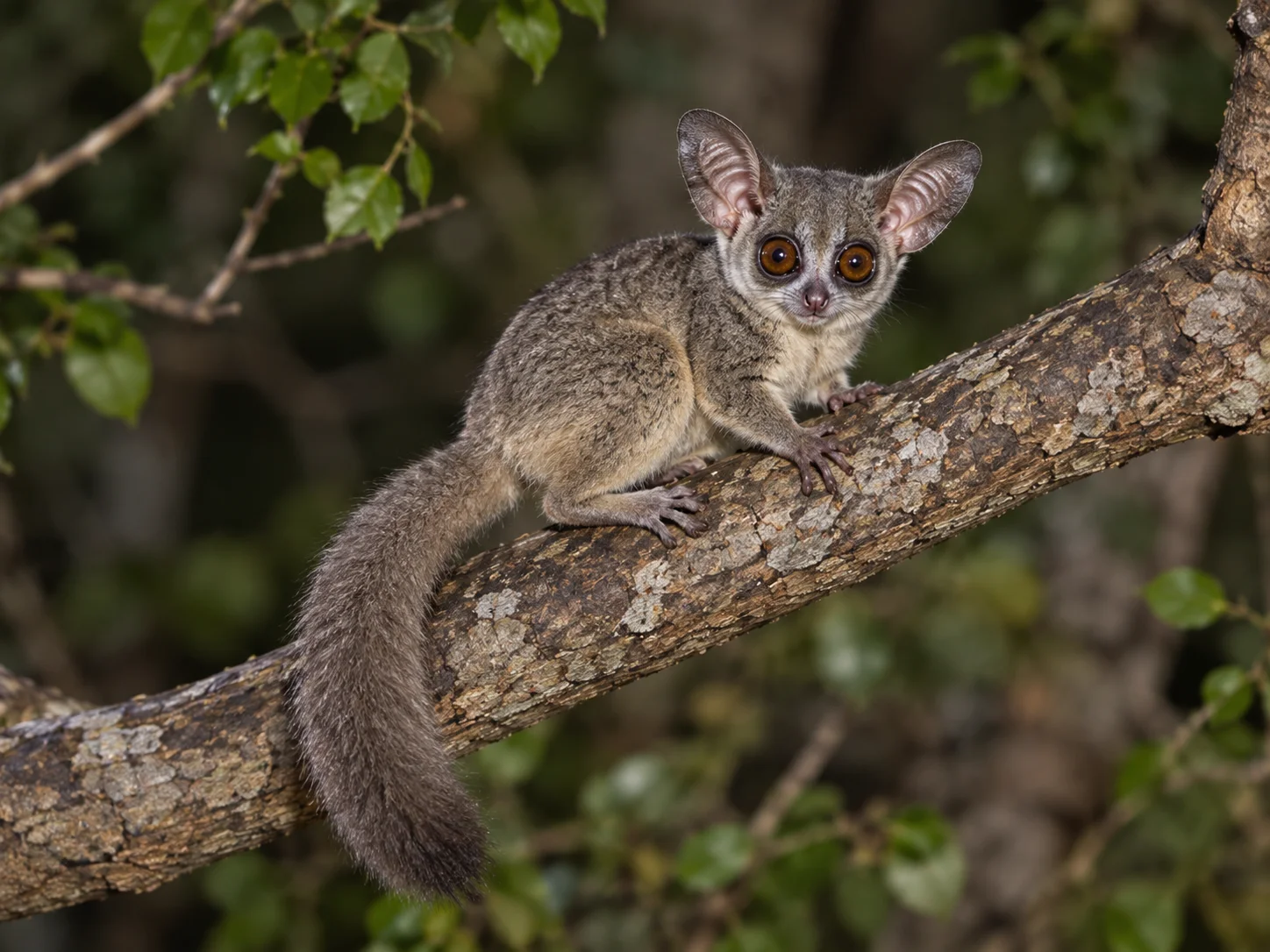
Meet the Bushbaby
Bushbabies are named after a sound. At night in the African bush, something starts crying like a human infant, and the first time you hear it the hair goes up on your arms. It is a primate the size of a kitten, calling to others of its kind.
They are also called galagos, and they are built almost entirely for the dark: enormous eyes, ears that swivel like radar dishes, and back legs that can launch them more than fifteen feet between branches.
“Bushbaby” covers a whole family of about 18 to 20 species living across sub-Saharan Africa. They are among the most successful primates on the continent, and most people who live alongside them have heard one far more often than they have seen one.
Scientific Name and Classification
Bushbabies are a family rather than one species, so they have no single two-word scientific name. The family is Galagidae.
- Kingdom: Animalia
- Phylum: Chordata
- Class: Mammalia
- Order: Primates
- Family: Galagidae
Counting the species is unusually interesting here. Before 1980 scientists recognized only about six kinds of bushbaby. Then researchers started recording their calls, and discovered that animals which looked nearly identical were shouting completely different things at each other. Those calls split the group apart. The IUCN now recognizes around 18 species, Britannica says more than 20, and most experts think more are still waiting to be described.
Bushbabies belong to a branch of the primate family tree called the strepsirrhines, which also includes lemurs and lorises. That makes them relatives of monkeys and apes, but distant ones.
Types of Bushbaby and Their Characteristics
The species fall into a few broad groups, and the three below are the ones most often seen.
| Bushbaby | Scientific name | Weight | Where it lives |
|---|---|---|---|
| Southern lesser galago | Galago moholi | 5-7 oz (150-200 g) | Southern Africa |
| Senegal (northern lesser) galago | Galago senegalensis | 5-9 oz (150-250 g) | West to East Africa |
| Brown greater galago | Otolemur crassicaudatus | 2-3 lb (1-1.5 kg) | Southeastern Africa |
One group is worth singling out. The needle-clawed bushbabies of west-central Africa have sharp, pointed nails that let them cling to bare tree trunks head-down, gouge the bark with specialized teeth, and lap up the gum that bleeds out.
Appearance and Anatomy
Across the family, bushbabies weigh from about 2 ounces to 3 pounds (50 g to 1.5 kg), with bodies 5 to 14 inches long and a tail that is usually longer than the body.
The fur is soft and woolly, gray, brown or reddish, often paler underneath. Everything else about the animal is an adaptation to working at night.
- Eyes. Huge, and fixed in place. They are too large to swivel in their sockets, so a bushbaby turns its whole head to look around, much as an owl does. A mirror-like layer behind the retina bounces light back through it, which is why they shine in a torch beam.
- Ears. Thin, mobile, and able to move independently to pinpoint a moth in the dark. They fold flat against the head when the animal crashes through foliage.
- Hind legs. Very long, with an extended ankle bone that acts like an extra lever. The leaping muscles are six to nine times more powerful, weight for weight, than a frog‘s.
- Tail. Long and bushy, used as a counterweight and rudder in mid-air.
- Hands. Flattened fingertip pads for grip, and a grooming claw on one toe.
Habitat and Range
Bushbabies live throughout sub-Saharan Africa, from Senegal in the west across to Somalia and down to South Africa.
Different species take different habitats. The lesser galagos prefer dry thornbush and acacia savanna. The greater galagos favor coastal forest and woodland. The needle-clawed species stick to dense rainforest.
They adapt to people better than most primates, and will live in farmland, plantations and suburban gardens wherever there are enough trees to sleep in and feed from. By day they sleep in tree holes, dense tangles of vegetation, or nests of leaves, usually in small groups.
Diet and Feeding
Bushbabies are omnivores, and the two staples are insects and tree gum.
Gum is the surprising one. When a tree is damaged it seeps a sticky sap, and several bushbaby species have built their lives around that resource, gouging acacia bark to keep it flowing. For some species gum makes up well over half the diet. The thick-tailed bushbaby runs closer to half insects and mollusks, with fruit and gum making up the rest depending on the season.
They also eat fruit, flowers, nectar, seeds, moths, beetles, spiders and the occasional small bird or lizard.
Hunting is done by ear. A bushbaby will sit still, rotate its ears until it has located a flying insect, then snatch it out of the air with both hands, sometimes leaping to do it.
Behavior and Lifestyle
Bushbabies are strictly nocturnal. They emerge at dusk, forage all night, and are back in a sleeping site before dawn.
The jumping is what people remember. A lesser galago can clear five meters, about sixteen feet, in a single leap between trees, landing on a branch it chose in near-total darkness. On the ground they cannot run properly, so they hop upright on their back legs like a tiny kangaroo.
Then there is urine washing. A bushbaby dribbles urine onto one palm, wipes it along the sole of the foot on that side, and repeats with the other. It sounds unpleasant and it is entirely practical: it leaves a scent trail along regularly used branches, so animals can follow known routes in the dark, and it may improve grip on smooth bark.
Socially they sit between solitary and group-living. They forage alone but sleep in small family parties, usually females with young, and keep in touch across the dark with a vocabulary of cries, clicks, grunts and chatters. Each species has its own set, which is exactly how scientists pulled the family apart into so many species.
Reproduction and Life Cycle
In bushbabies, pregnancy lasts roughly 110 to 133 days depending on the species, and produces one or two young, occasionally three.
Babies are born in a nest with their eyes half shut and almost no fur. For the first days the mother leaves them in the nest while she feeds. When she does move them, she carries them in her mouth and parks them on a branch while she hunts nearby, collecting them afterward.
Young bushbabies are climbing within a few weeks and mostly independent by a few months. Some species live 4 to 8 years in the wild, and captive animals have reached about 16.
Predators and Threats
Small, soft and active at night, bushbabies are prey for a long list of hunters: owls, genets, mongooses, civets, snakes, and larger primates. Domestic cats take them near settlements.
Their defense is to be hard to catch. They freeze, they are difficult to see, and if something does come close the escape is a leap into the dark that almost nothing can follow.
Human pressures vary by species. Forest clearance is the main one, along with hunting for bushmeat in parts of their range and capture for the pet trade. Keeping a bushbaby as a pet is a poor idea: they are nocturnal, they need to leap, and like other primates they carry diseases that pass to people.
Conservation Status
There is no single status for bushbabies, because the family holds around 18 to 20 species with different fortunes.
The common, widespread ones are doing well. The southern lesser galago is listed as Least Concern, with a stable population and no significant threats, and in some areas its range is actually expanding.
Species tied to shrinking forest are a different matter, and several of the rainforest galagos are considered threatened. The harder problem is that some species are so newly recognized, and so difficult to survey in the dark, that nobody yet knows how many there are.
Role in the Ecosystem
Bushbabies that eat fruit spread seeds in their droppings, which helps woodland and thicket plants regenerate across southern Africa.
Those that feed on nectar carry pollen between flowers, making them unexpected pollinators for a handful of African trees.
They eat very large numbers of insects, and in turn they are a staple for night hunters. In a healthy African woodland the bushbaby is one of the main links between the insect world and everything that hunts after dark.
Difference Between Bushbaby and Lemur
Bushbabies and lemurs look alike for a good reason: they are genuine relatives, both members of the strepsirrhine branch of the primates. But they are not the same animal.
- Where they live. This is the clean test. Lemurs live only on Madagascar. Bushbabies live only on mainland Africa. Neither occurs where the other does.
- Size. Lemurs range up to the dog-sized indri. Bushbabies are all small, topping out at about 3 pounds.
- When they are active. Every bushbaby is nocturnal. Many lemurs, including the ring-tailed, are active by day.
- How they move. Bushbabies are extreme leapers with long ankles. Most lemurs climb and walk along branches more than they jump.
Bushbabies are sometimes mistaken for the tarsier too, another huge-eyed nocturnal leaper. Tarsiers live in Southeast Asia and are not closely related at all. All three independently arrived at the same answer to the same problem: enormous eyes and powerful legs for hunting in the dark.