Meet the Bumblebee Bat
A bumblebee bat weighs about two grams. That is lighter than a penny, roughly the same as two paper clips, and small enough that a grown adult could sit in a teaspoon with room to spare.
It is the smallest bat in the world, and depending on how you measure, possibly the smallest mammal of any kind. It also has a snout like a tiny pig, no tail at all, and ears that look far too big for its head.
What makes it remarkable is not only the size. The bumblebee bat is the only living member of its family, Craseonycteridae. Not the only species in its genus, the only species in the entire family. If it disappears, a whole branch of the mammal family tree goes with it, and that branch was only discovered in 1973.
Scientific Name and Classification
The bumblebee bat’s scientific name is Craseonycteris thonglongyai, described by British zoologist John E. Hill in 1974.
The species name honors Kitti Thonglongya, the Thai zoologist who found it. That is also why the animal’s other common name is Kitti’s hog-nosed bat. You may also see it called simply the hog-nosed bat or Kitti’s bat.
- Kingdom: Animalia
- Phylum: Chordata
- Class: Mammalia
- Order: Chiroptera
- Family: Craseonycteridae
- Genus: Craseonycteris
- Species: Craseonycteris thonglongyai
When Hill examined the specimens, the bat was so unlike anything already known that naming a new species was not enough. It needed a new genus too, and then a new family to hold the genus. All three were created in 1974 in a single scientific paper. Craseonycteridae holds the record as the smallest taxonomic family of bats, because it has only ever contained this one animal.
Later molecular work placed the family in the superfamily Rhinolophoidea, alongside the horseshoe bats.
Appearance and Anatomy
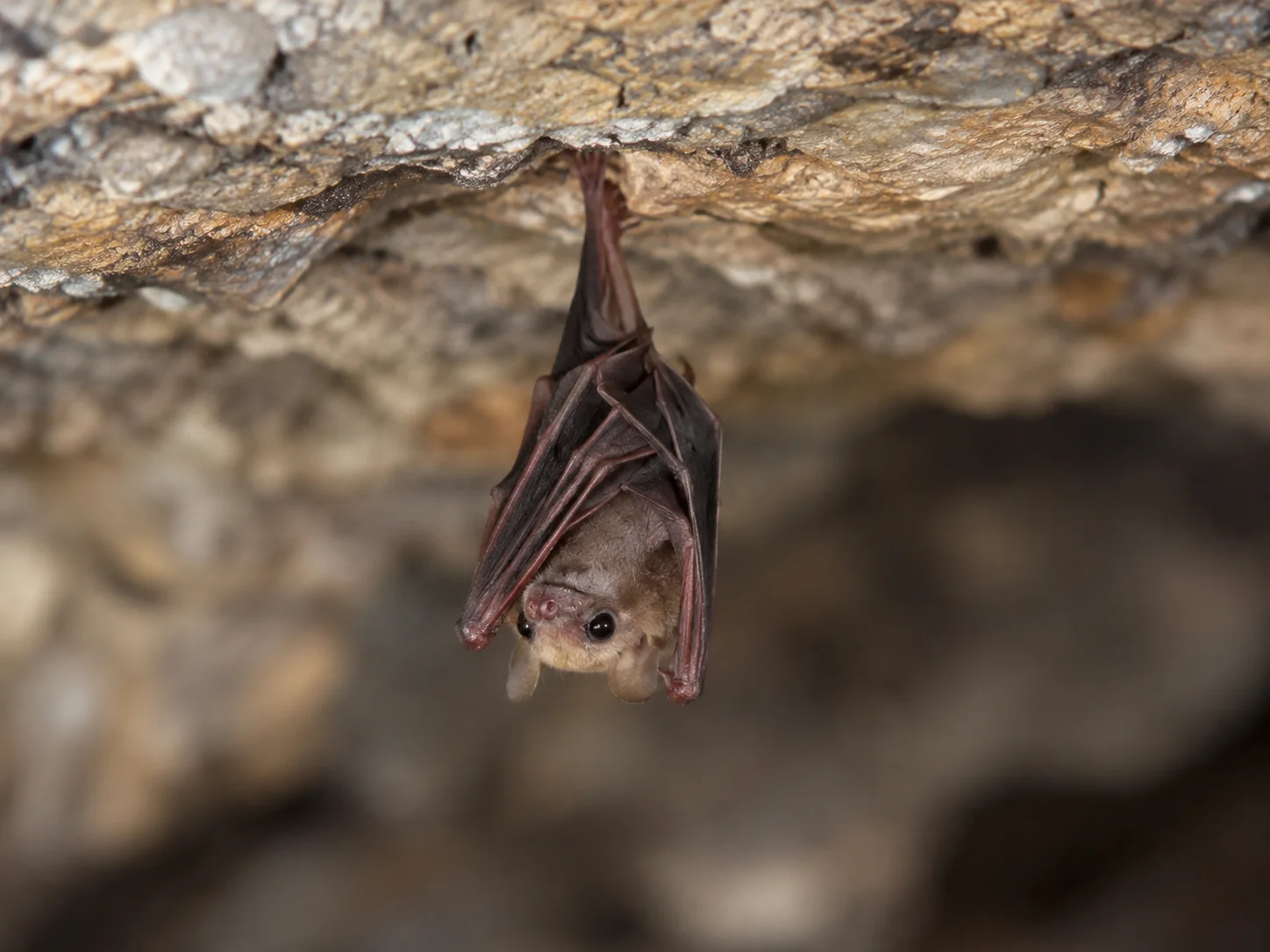
An adult measures 29 to 33 mm (1.1 to 1.3 inches) from nose to rump and weighs 1.7 to 2 grams, about 0.07 of an ounce. The wingspan reaches roughly 13 cm (5 inches). The skull is around 11 mm long.
The fur is reddish-brown or gray on top and paler underneath, with darker wings. The snout is the feature everyone notices first: short, upturned and pig-like, with wide nostrils separated by a broad band of skin.
- Ears. Large for the body at 9 to 10.2 mm, with a prominent flap called a tragus standing about halfway up inside each one.
- Teeth. Twenty-eight, including unusually long, narrow lower incisors.
- No tail. It has two tail bones but nothing visible outside the body, and a broad membrane stretched between the hind legs.
- Wings. Long and broad with extended tips, which lets the bat hover in a way most bats cannot.
- Eyes. Small and mostly buried in fur. This animal navigates by sound, not sight.
Is the Bumblebee Bat the Smallest Mammal?
Yes and no, and the reason is worth knowing.
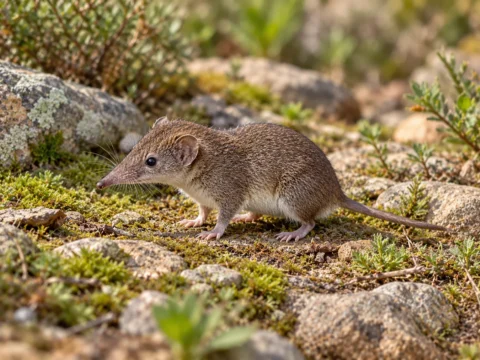
It depends on whether “smallest” means shortest or lightest. By length the bumblebee bat wins: its 11 mm skull is shorter than that of any other mammal on Earth. By weight it loses, narrowly, to the Etruscan shrew, which can drop to 1.2 grams against the bat’s 1.7 to 2.
So the honest answer is that the bumblebee bat is the world’s smallest mammal by length, and the Etruscan shrew is the smallest by mass. Both titles are real. It simply depends which ruler you pick up.
The two animals solve the problem of being tiny in opposite ways. The shrew burns energy at a furious rate and must eat constantly. The bat does the reverse, hanging still and cool in a cave for most of the day and flying for less than an hour.
Habitat and Range
Bumblebee bats live in limestone caves along rivers, in dry evergreen and deciduous forest, at elevations up to about 500 m (1,640 feet).
The range is remarkably small. In Thailand they are confined to Kanchanaburi Province in the west, around the Sai Yok area. In Asia they occur nowhere else except Kayin and Mon states in southeastern Myanmar, just across the border. That is the entire world distribution of the species.
Inside a cave the bats choose warm upper chambers well back from the entrance, and hang apart from one another rather than clustering together. Outside, they need trees to hunt around. They tolerate farmland near their caves reasonably well, as long as enough trees are left standing.
Diet and Feeding
Bumblebee bats are insectivores. They eat small insects and some spiders, catching prey in flight and also plucking it off leaves, much as the aardvark laps up termites, foraging around bamboo and the upper canopy, usually within about a kilometer of the roost.
Hovering is what makes the leaf-picking possible. Those broad wings let the bat hold its position beside a leaf long enough to take an insect off it, which most bats of any size cannot manage.
Navigation and hunting are done entirely by sound. The calls have a steady section around 35 kHz followed by a short downward sweep, with fainter echoes at 70 and 105 kHz. All of it is far too high for human ears.
Behavior and Lifestyle
The bumblebee bat keeps one of the shortest working days of any mammal. It leaves the roost for about 30 minutes at dusk and around 20 minutes at dawn. That is roughly 50 minutes of activity in a 24-hour day.
The rest of the time it hangs in the cave, often in torpor, a deep rest in which the body slows right down to save energy.
Colony sizes vary from cave to cave and reports differ, ranging from small groups of a dozen or so up to around a hundred. Even in a shared cave the bats are not especially sociable, and they keep a little space between themselves rather than huddling.
An animal this small loses heat very quickly, which explains both the long hours of torpor and the choice of the warmest corner of the cave.
Reproduction and Life Cycle
Bumblebee bats breed once a year. Females give birth to a single pup late in the dry season, usually around April or May.
The pup clings to its mother in the roost, and is left behind in the cave while she goes out to feed. Beyond that, remarkably little has been written down. Nobody has described how these bats choose their mates, or how long the young stay with the mother.
Lifespan in the wild is unknown. Five to ten years is the usual estimate, but that comes from comparing the bat with its relatives rather than from watching the animals themselves.
Predators and Threats
No natural predators have been recorded, which says more about how little the species has been studied than about how safe it is.
The threats that matter are all human:
- Roost disturbance. These bats abandon caves that people enter too often. The cave where the species was discovered, at Sai Yok Noi, was deserted by the bats after tourism increased there.
- Limestone quarrying. The caves themselves are the resource being mined away.
- Deforestation. Clearing the forest around a cave removes the insects the bats depend on.
- Collection. In the years after the discovery, bats were taken for museum collections and sold to tourists as souvenirs.
A species that lives in a handful of caves inside one Thai province and a strip of Myanmar has very little room for error.
Conservation Status
The IUCN Red List classifies the bumblebee bat as Near Threatened, assessed in 2019, with a decreasing population trend.
Older sources often say Vulnerable or Endangered, and some still quote a figure of about 5,100 animals. Those are out of date. Surveys in the 2000s found the bat in more places than expected. A 2006 survey estimated around 1,500 in Myanmar across nine caves, and fieldwork published in 2009 concluded the range and population were both larger than previously believed. The listing was eased because scientists found more bats, not because the bats became safe.
One open question could change the picture completely. Thai and Burmese bats look identical but use different echolocation calls, which may mean they are two separate species rather than one. If that turns out to be true, each would have a smaller population and a smaller range than the single species does now, and both would need assessing again.
Role in the Ecosystem
As an insect eater, the bumblebee bat helps keep insect numbers down around its caves, including species that damage crops. In fairness, given how few of these bats there are and how little each one eats, the effect is modest next to what a large bat colony does.
Its real significance is evolutionary. Craseonycteridae has exactly one member. Losing this animal would not mean losing one species from a well-stocked family. It would mean deleting an entire family of mammals, a lineage different enough from every other bat that scientists needed to invent a new branch to put it on.
Discovery
The bumblebee bat was unknown to science until late 1973.
Kitti Thonglongya, a Thai ornithologist and mammalogist, was surveying bats in caves near the Sai Yok waterfall in Kanchanaburi Province. On 8 December 1973 he collected the specimen that would become the official type specimen, one of more than fifty bats he could not identify, and sent material to John E. Hill at the British Museum of Natural History in London.
Thonglongya died of a sudden heart attack on 12 February 1974, at the age of 45. He never learned what he had found. Hill finished the description and named the species thonglongyai after the man who collected it.
Thonglongya had already discovered the white-eyed river martin in 1969, and later identified Salim Ali’s fruit bat from a specimen that had been misfiled in an Indian museum collection. The bumblebee bat was his last discovery, and the one that carries his name.