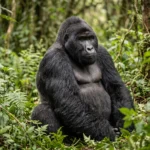
Meet the Gorilla
The gorilla is the largest primate alive. A fully grown male silverback can weigh 440 pounds and is several times stronger than a person.
He also eats almost nothing but leaves, lives in a close family group, and spends most of the day quietly feeding and resting. The chest-beating display that made gorillas famous is a way of avoiding a fight, not starting one.
Gorillas share about 98 percent of their DNA with us, which makes them, after chimpanzees and bonobos, among our closest living relatives.
Scientific Name and Classification
There are two species of gorilla, so the genus name Gorilla covers both.
- Western gorilla (Gorilla gorilla), including the western lowland and Cross River subspecies.
- Eastern gorilla (Gorilla beringei), including the mountain gorilla and Grauer’s gorilla.
- Kingdom: Animalia
- Phylum: Chordata
- Class: Mammalia
- Order: Primates
- Family: Hominidae
- Genus: Gorilla
Gorillas are apes, not monkeys. They have no tail, broad flat chests, and shoulders that rotate fully, which is the ape pattern.
How Strong Is a Gorilla?
Genuinely very strong, though the internet exaggerates it.
Estimates put a silverback at roughly four to nine times stronger than an average adult human, and the figures vary because nobody has run controlled strength tests on wild gorillas. Claims of twenty or thirty times are not supported by anything.
What is measurable is the build: enormous shoulder, arm and jaw muscles, a bite force stronger than a lion’s, and arms longer than the legs with a span reaching about 8 feet.
The important point is how rarely that strength is used. Gorillas are not aggressive animals. A silverback threatened by a rival runs through a sequence of hoots, standing upright, throwing vegetation, chest-beating and a sideways charge, almost all of it designed to settle the matter without contact. Chest-beating also carries information: larger males produce a lower-pitched sound, so a rival can judge size without coming close.
Appearance and Anatomy
Males stand 5.5 to 6 feet tall and weigh 300 to 440 pounds. Females are roughly half that, at 150 to 220 pounds. This is one of the biggest size differences between sexes of any mammal.
- Silver back. Males turn silver-gray across the back and hips at around 12 years old, which is when they are mature. Hence “silverback”.
- Sagittal crest. A ridge of bone along the top of the skull, anchoring the huge muscles needed to chew tough vegetation. It gives adult males their domed heads.
- Arms. Longer than the legs, with a span of about 8 feet in a big male.
- Knuckle-walking. Gorillas move on all fours, resting on the knuckles of their hands.
- Nose prints. The pattern of wrinkles on a gorilla’s nose is unique to the individual, and researchers use it to tell them apart, much like fingerprints.
Habitat and Range
Gorillas live only in the forests of central Africa, across ten countries including Gabon, Congo, Cameroon, the Democratic Republic of the Congo, Rwanda and Uganda.
Western lowland gorillas occupy dense tropical rainforest and swamp. Mountain gorillas live far higher, in cloud forest up to about 13,000 feet, where it is cold and wet. They have thicker, longer fur as a result.
No gorilla lives in a zoo-style open plain. They need dense forest with plenty of ground vegetation, which is both their food and their cover.
Diet and Feeding
Gorillas are overwhelmingly plant eaters. Leaves, stems, pith, shoots and bark make up most of the diet, with fruit important to lowland gorillas when it is in season. They also take the occasional insect, including ants and termites.
A silverback eats up to 40 pounds of vegetation a day. That is how the largest primate on Earth is built almost entirely on greenery, and it explains the belly: a gorilla’s wide gut houses the bacteria that ferment all that fiber.
They rarely need to drink. Their food holds enough water to keep them going.
Behavior and Lifestyle
Gorillas live in stable family troops of about 5 to 30 animals, led by one dominant silverback with several females and their young.
The silverback decides where the group feeds and sleeps, settles disputes, and defends everyone. If he is killed the troop usually falls apart, which is why losing a single male costs far more than one animal.
Days follow a gentle rhythm: feed through the morning, rest and groom and play through the middle of the day, feed again, then build fresh nests of bent branches and leaves to sleep in. Every gorilla over about three builds a new nest each night.
They use more than twenty distinct vocalizations, including a contented rumbling hum that gorillas make while eating food they particularly like.
Gorillas use simple tools in the wild, testing water depth with a stick before wading and using branches as bridges across swampy ground.
Reproduction and Life Cycle
Pregnancy lasts about 8.5 months, close to a human term, and produces a single infant weighing around 4 pounds.
Babies cling to their mother’s chest from the start, ride on her back from about four months, and stay dependent for three or four years. Mothers and infants are inseparable in the early years.
Females give birth only every four years or so, and may raise just three or four surviving young in a lifetime. That slow rate is exactly why gorilla populations recover so painfully slowly.
Gorillas live 35 to 40 years in the wild and longer in captivity.
Predators and Threats
Leopards occasionally take gorillas, and crocodiles are a risk in some areas, but an adult silverback has essentially no natural predator.
Every serious threat is human:
- Habitat loss from logging, mining and farming, especially mining for the minerals used in electronics.
- Poaching for bushmeat, and snares set for other animals that maim gorillas.
- Disease. Ebola has killed thousands of western gorillas, and because they are so closely related to us they catch human illnesses easily. A common cold can kill a gorilla, which is why visitors must keep their distance and wear masks.
- Conflict. Civil war across parts of central Africa has made protection dangerous and sometimes impossible.
Conservation Status
Both species of gorilla are Critically Endangered, the highest level of risk before extinction in the wild.
Grauer’s gorilla has suffered catastrophic losses in eastern Congo. The Cross River gorilla may number only a couple of hundred animals.
Against that sits one of conservation’s genuine successes. Mountain gorillas fell to around 250 animals in the 1980s and were expected to disappear. Intensive protection, veterinary care and carefully managed tourism that pays local communities to keep the forest standing have brought them back above a thousand. They are the only great ape population currently increasing.
It took decades, armed rangers, and giving people living beside the forest a reason to want gorillas alive. It worked.
Role in the Ecosystem
Gorillas are forest gardeners. Lowland gorillas eat large quantities of fruit and pass the seeds far from the parent tree, and several rainforest trees depend heavily on them to spread.
Their feeding opens up the understory. A troop working through dense vegetation lets light reach the forest floor, which allows new growth to come through.
They are also an umbrella species. Protecting enough intact forest for a gorilla troop protects everything else that lives there, which is why gorilla conservation has knock-on benefits far beyond the animal itself.