Meet the Tarsier
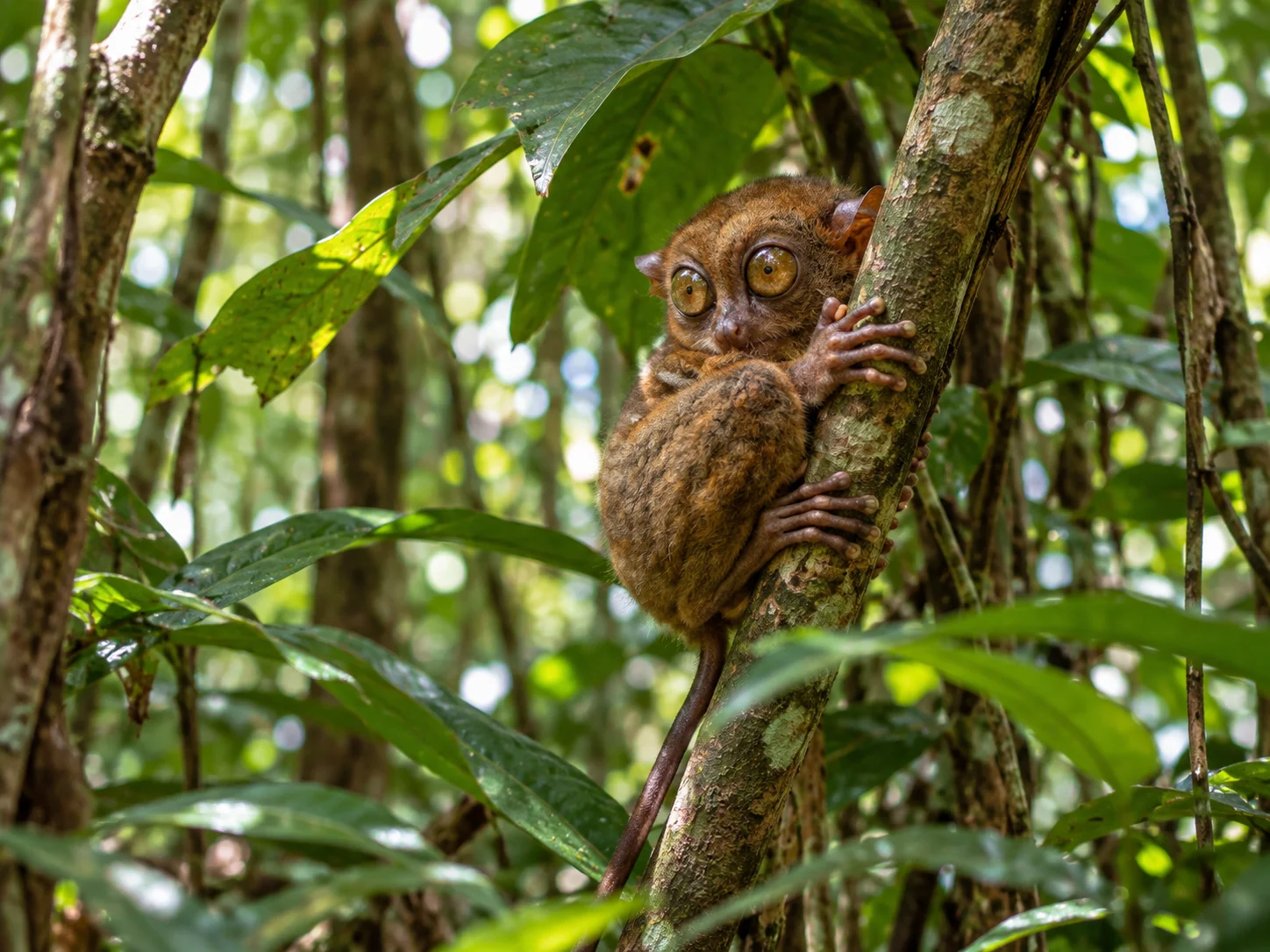
A tarsier has the largest eyes relative to its body of any mammal on Earth. Each eyeball is roughly as big as its brain, and it has two of them. Tarsiers are a family of small night-hunting primates, the Tarsiidae, found only on islands in Southeast Asia.
Those eyes are so large they cannot move in their sockets, so the tarsier turns its head instead, nearly 180 degrees in each direction, like an owl.
And some tarsiers scream in pure ultrasound, at frequencies far above anything a human ear can detect. For years people thought they were opening their mouths silently.
Scientific Name and Classification
Tarsiers form the family Tarsiidae, with around 13 to 20 species depending on who is counting, so there is no single two-word name. The Philippine tarsier is Carlito syrichta.
- Kingdom: Animalia
- Phylum: Chordata
- Class: Mammalia
- Order: Primates
- Family: Tarsiidae
Tarsiers are primates, which makes them relatives of monkeys, apes and ourselves, and they sit in an awkward spot on the family tree. They were long grouped with lemurs and bushbabies as prosimians, but are now placed on the same branch as monkeys and apes, making them closer relatives of ours than any lemur is.
They are an old lineage. Tarsier-like fossils go back over 45 million years, and the living species are the last of a group that was once widespread across Asia, Europe and North America.
Why Are a Tarsier’s Eyes So Big?
Because it hunts at night and its ancestors lost the equipment that would normally help.
Most night-active mammals have a reflective layer behind the retina, the tapetum lucidum, which bounces light back through the eye and gives animals that familiar eyeshine in a torch beam. Tarsiers do not have one.
The accepted explanation is that their ancestors were day-active and lost the tapetum, and when the line went back to hunting at night it could not simply re-evolve it. So it solved the problem by brute force instead: eyes so enormous they gather enough light on their own.
The cost is the same one owls pay. An eyeball that size cannot be rotated in its socket, so a tarsier’s eyes are effectively fixed and it must turn its head to look anywhere. Extra flexibility in the neck lets it swivel almost 180 degrees each way.
To get a sense of the scale: if our eyes were proportioned like a tarsier’s, each one would be about the size of a grapefruit.
The Ultrasonic Scream
Researchers studying Philippine tarsiers noticed something odd: the animals would open their mouths as though calling, and nothing audible came out.
Recording equipment capable of picking up high frequencies found the answer. The tarsiers were calling at around 70 kilohertz, roughly three times higher than the upper limit of human hearing, and they can hear up to about 90 kilohertz themselves.
That puts them among a very small number of mammals that communicate entirely in ultrasound, alongside some bats, whales and rodents.
The advantage is privacy. Most of the animals that hunt a tarsier cannot hear those frequencies, so a tarsier can call to another tarsier without advertising itself to anything else. It is a private channel.
Appearance and Anatomy
Tarsiers measure 3.5 to 6 inches in the body with a tail of 8 to 10 inches, and weigh 3 to 6 ounces. They fit comfortably in a cupped hand.
- Eyes. Each about 0.6 inches across and roughly the size of its brain, fixed in the socket.
- Hind legs. Extremely long, with a greatly extended ankle bone. The name tarsier comes from the tarsus, the ankle, because that bone is the animal’s defining feature.
- Jumping. Those legs let a tarsier leap over 15 feet between trunks, more than 40 times its own body length, landing feet-first and gripping.
- Fingers. Long and thin with rounded pads, and it has both nails and one or two grooming claws.
- Ears. Thin, mobile and almost constantly moving, folding and unfolding as it listens.
- Neck. Specially flexible, allowing nearly 180 degrees of rotation each way.
They cling to vertical trunks rather than sitting on branches, which is how they are almost always photographed.
Habitat and Range
Tarsiers live only in Southeast Asia: the Philippines, Borneo, Sumatra, Sulawesi and nearby islands in Indonesia and Malaysia.
They occupy tropical rainforest, secondary forest, bamboo thickets and scrub, and need dense low vegetation with plenty of small vertical stems to jump between and cling to.
Many species are confined to single islands, which is a precarious way to exist. Several are known from one small area and nowhere else on Earth.
They sleep by day clinging to a vertical stem in thick cover, usually in the same few favorite spots.
Diet and Feeding
Here is something unique: the tarsier is the only entirely carnivorous primate. Every other primate, including us, eats at least some plant food. Tarsiers eat none.
They are carnivores living mainly on insects: crickets, beetles, moths, cicadas, grasshoppers, ants and spiders. Larger species also take lizards, small birds, bats and snakes, including venomous ones.
They hunt by sitting still on a trunk, listening, then leaping and seizing the prey with both hands in mid-air, biting it as they land.
A tarsier eats a large amount for its size, around a tenth of its body weight a night, which is what a diet of nothing but insects requires.
Behavior and Lifestyle
Tarsiers are nocturnal and spend the night moving through low vegetation in a series of long leaps.
Social arrangements vary by species. Philippine tarsiers are largely solitary, while some Sulawesi species live in small family groups and sing duets at dawn, with the pair calling together in a coordinated sequence that defines their territory.
They scent-mark their territory with urine and glandular secretions.
Something important needs saying about them. Tarsiers are badly suited to captivity and do extremely poorly as pets. They are highly strung, they need a constant supply of live insects, and stressed tarsiers have been recorded injuring themselves by banging their heads against enclosure bars. Some have died in captivity within days. They are protected animals, and the tourist trade that passes them around for photographs does them real harm.
Reproduction and Life Cycle
Pregnancy lasts around six months, which is extraordinarily long for an animal this small.
A single infant is born, and it is enormous relative to its mother, at roughly a quarter to a third of her weight. The equivalent for a human mother would be a baby weighing over 30 pounds.
The infant arrives furred, with its eyes open, and can climb almost immediately. The mother carries it in her mouth when she needs to move fast, or it clings to her belly.
She sometimes parks it on a branch while she hunts and returns to collect it.
One baby after six months of pregnancy is a very slow rate of reproduction, and it is a large part of why tarsier populations recover so poorly. They live 12 to 20 years.
Predators and Threats
Owls, hawks, snakes, monitor lizards, civets and feral cats all eat tarsiers. Domestic and feral cats are a serious problem near settlements.
Habitat loss is the main human threat. Forest cleared for farming, palm oil, logging and settlement removes the dense low vegetation they depend on, and tarsiers do not adapt to open or heavily disturbed ground.
They are also captured for the pet trade and for tourist attractions, and because they survive captivity so poorly, most of those animals die.
Pesticides reduce the insects they live on, which matters more for a strict insect-eater than for a flexible feeder.
Conservation Status
There is no single status across the family, and most tarsiers are in some degree of trouble.
Several are Endangered or Critically Endangered, including the Siau Island tarsier, which is among the most threatened primates in the world and known only from one small volcanic island.
The Philippine tarsier is Near Threatened and declining, and is protected by law.
The hopeful part is that well-run sanctuaries work. Facilities that keep tarsiers in large enclosures of natural forest, with no handling and limited viewing, have had far better results than the roadside attractions, and they give local communities a reason to protect the forest rather than clear it.
Role in the Ecosystem
As pure insect eaters, tarsiers control insect numbers in forest understory at night, filling a niche that is otherwise mostly occupied by bats.
Eating around a tenth of their weight nightly, a healthy tarsier population removes a considerable quantity of insects, including agricultural pests in forest near farmland.
They are prey for owls and snakes, linking insects to the forest’s larger predators.
Scientifically they are valuable out of proportion to their size. As an ancient lineage sitting between the lemurs and the monkeys, tarsiers help answer questions about how primates evolved, and their eyes in particular show what happens when an animal returns to night-time living without the equipment for it.