Meet the Boa Constrictor
The boa constrictor is one of the very few animals whose everyday name is also its scientific name. It is Boa constrictor, in both senses, which is unusual enough to be worth noting.
It is also a snake that gives birth rather than laying eggs, and in a handful of documented cases females have produced young with no male involved at all.
And despite the films, it is not a man-eater. A boa is large, strong and best left alone, but it is nowhere near the size needed to swallow a person.
Scientific Name and Classification
The boa constrictor’s scientific name is Boa constrictor. The genus is Boa and the species is constrictor, so the Latin name and the common name are the same words.
- Kingdom: Animalia
- Phylum: Chordata
- Class: Reptilia
- Order: Squamata
- Family: Boidae
- Species: Boa constrictor
Several subspecies are recognized, and the one most often kept in captivity is the red-tailed boa.
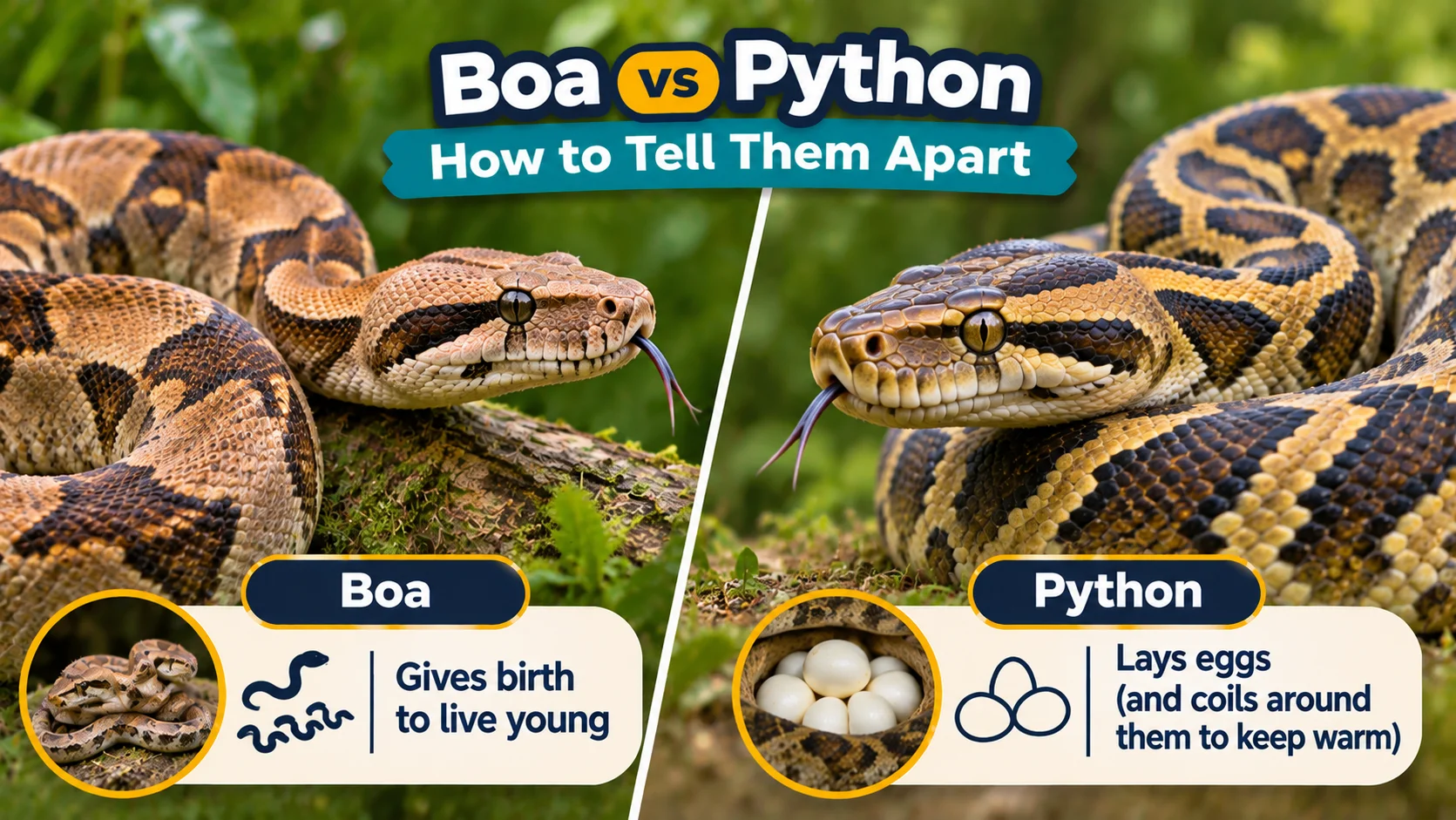
It is a boa, which matters for one clear reason: boas give birth to live young, while pythons lay eggs. The two families look alike and hunt alike and are not the same thing. The green anaconda is a boa too, and a much larger one.
How Big Does a Boa Constrictor Actually Get?
Smaller than its reputation, and the honest numbers are worth having.
A typical adult boa constrictor is 6 to 10 feet long and 20 to 50 pounds. Large females reach 12 feet, and anything beyond 13 feet is exceptional and rare. Males are noticeably smaller than females.
Size also varies a great deal by location. Boas on some small islands off Central America stay under 5 feet as adults, because a small island supports only small prey.
For comparison, the green anaconda is far heavier at the same length and the reticulated python is far longer. The boa constrictor is a big snake, not a record-breaking one.
Its reputation comes partly from the name. “Boa constrictor” sounds like a description of something enormous, and the name has been applied loosely in fiction to any large snake.
Appearance and Anatomy
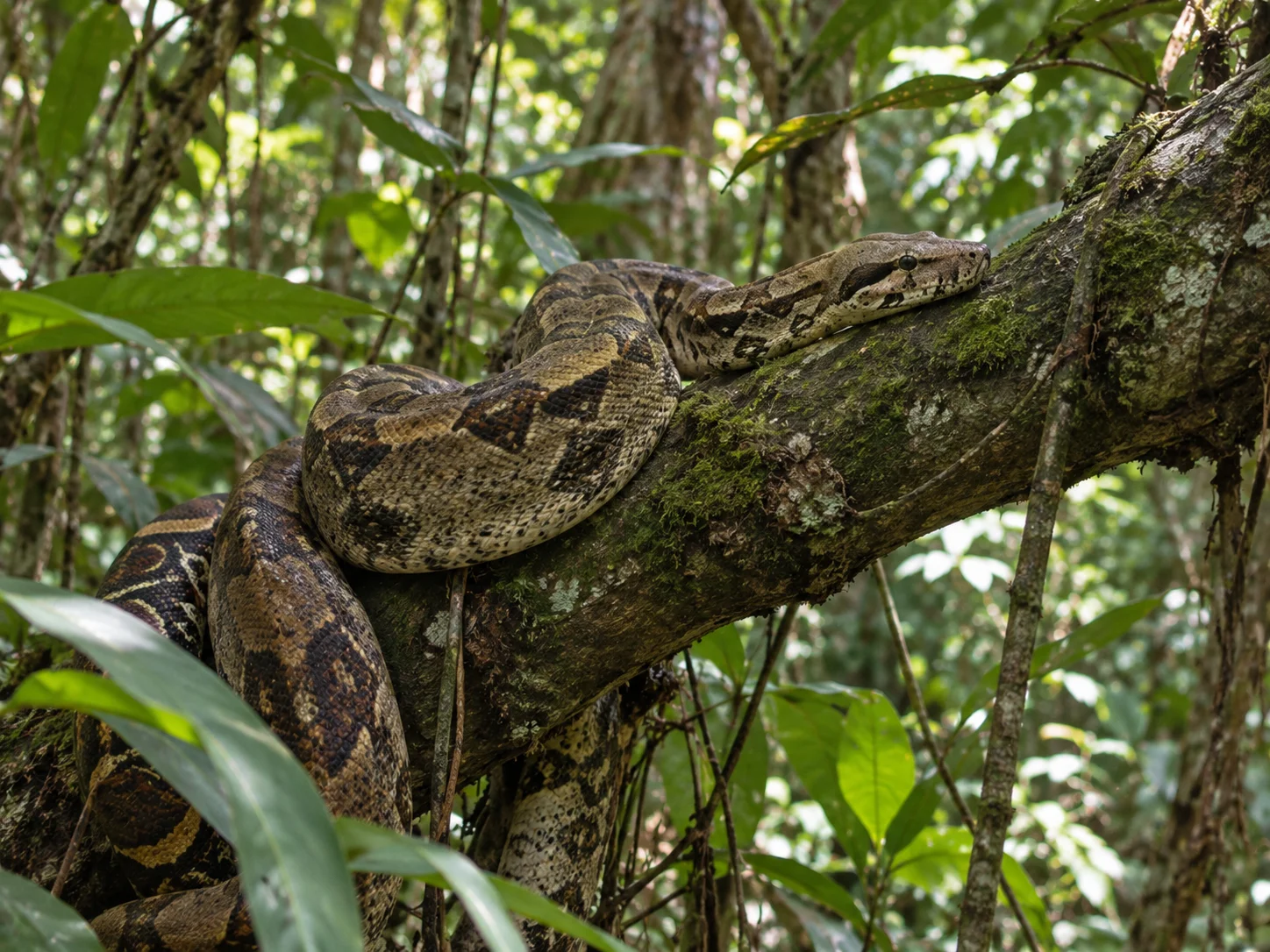
- Pattern. Tan or cream with dark brown saddle markings that become reddish toward the tail, which is where the red-tailed boa gets its name. The pattern breaks up the body outline beautifully on a forest floor.
- Head. Narrow and distinctly separate from the neck, with a dark stripe running from the snout through the eye.
- Teeth. Sharp, backward-curving and non-venomous, built to grip rather than to kill.
- No heat pits. Unlike pythons, boas lack the lip pits that detect infrared, and rely more on sight, scent and vibration.
- Pelvic spurs. Two small claws near the tail, leftovers of hind legs, more prominent in males and used in courtship. They are direct evidence that snakes descend from legged ancestors.
Like all snakes they smell with the tongue, flicking it out to collect scent particles and pressing it against a sensory organ in the roof of the mouth.
Habitat and Range
Boa constrictors live from northern Mexico through Central America and across much of tropical South America to northern Argentina, plus several Caribbean islands.
They use a wide range of habitats: rainforest, dry forest, savanna, scrub, farmland and the edges of villages. That flexibility is why they remain common across most of that range.
Young boas climb and spend much of their time in trees. Adults become heavier and increasingly ground-dwelling, though they will still climb and swim well.
Escaped and released pets have established a breeding population in southern Florida, where boas are now treated as an invasive species alongside the Burmese pythons.
Diet and Feeding
Boa constrictors are carnivores, eating rats, mice, squirrels, opossums, bats, birds, lizards and monkeys.
They are ambush hunters, lying motionless beside a trail or branch and waiting, sometimes for days, which is cheap in energy and works well for a cold-blooded animal.
Constriction is often described wrongly, so it is worth stating plainly: the snake does not crush bones and does not suffocate its prey. The coils cut off blood circulation, and the animal loses consciousness within seconds from lack of blood to the brain. It is far quicker than crushing would be.
Bats are a specialty in some places. Boas have been recorded hanging at cave mouths and taking bats out of the air as they fly past.
A large meal lasts a long time, and a boa may not feed again for weeks or months.
Behavior and Lifestyle
Boas are solitary and mostly nocturnal, and they spend an enormous proportion of their lives doing nothing at all. Waiting is the strategy.
They are generally calm for a large snake, which is exactly why they became one of the most commonly kept pet snakes in the world. A well-handled captive boa is usually placid.
They shed their skin in one piece several times a year, and the eyes cloud over beforehand as the old skin loosens.
Threatened, a boa hisses loudly, and a big one can deliver a painful bite and a powerful squeeze. They are not aggressive, but a 10-foot constrictor is an animal to respect, and keepers are advised never to handle a large one alone.
Reproduction and Life Cycle
Boas do not lay eggs. The young develop inside the mother for five to eight months and are born live, usually 10 to 40 of them, each already 15 to 20 inches long.
They are independent from birth, with no parental care whatsoever, and climb straight into the vegetation.
Then there is the genuinely strange part. Captive boa constrictors have produced young without any male, through a process called parthenogenesis. One well-documented case in 2010 involved a female that produced two litters of all-female offspring, and genetic testing confirmed no father was involved. The young also carried an unusual chromosome arrangement found almost nowhere else.
Virgin birth has since been recorded in several snake species, and it appears to be a genuine if rare backup rather than a laboratory artifact.
Boas live 20 to 30 years, and captive animals have passed 40.
Predators and Threats
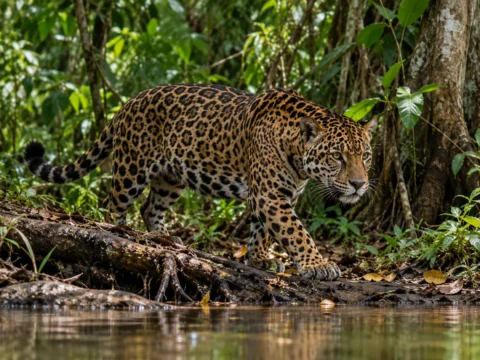
Young boas are eaten by birds of prey, coatis, crocodilians, large cats and other snakes. Adults have few enemies besides jaguars and the occasional large eagle.
The pressures from people are the skin trade, which has taken very large numbers for leather, collection for the pet trade, and killing on sight out of fear.
Habitat clearance reduces prey and shelter, and road traffic kills many.
Boas are, by snake standards, doing reasonably well, because they tolerate farmland and village edges where more specialized snakes cannot survive.
Conservation Status
The boa constrictor is widespread and common across most of its range and is not considered globally threatened.
It is listed under CITES, the international wildlife trade convention, which regulates how many can be exported, because the skin and pet trades have historically taken enormous numbers.
Some island populations are in real trouble. Island boas have small ranges and tiny populations, and several are threatened by habitat loss and collection, including those on a few Caribbean islands.
In Florida the position reverses, and introduced boas are managed as a problem rather than protected.
Role in the Ecosystem
Boa constrictors are serious rodent predators, and that is their main ecological contribution. Rats and mice damage crops and spread disease, and a boa living around farmland is effective free pest control.
Being cold-blooded, they do that work on remarkably little food. A boa needs a tiny fraction of the energy a mammal predator of the same weight requires, so a patch of forest supports more predator weight in snakes than it could in cats.
They also control bat numbers at some cave roosts, and feed jaguars and eagles in turn.
There is a practical reason to make the case for them. Boas are killed on sight across much of their range by people who believe they are dangerous, when the animal eating the rats in the barn is doing more good than harm.