Meet the Rattlesnake
The rattlesnake is one of the few dangerous animals that tells you it is there. The rattle is not a threat so much as a request: go away, and neither of us has a problem.
“Rattlesnake” covers around 30 to 50 species, depending on which authority you follow, split between two groups of pit vipers. They live only in the Americas, from southern Canada down to Argentina, and more of them live in the southwestern United States and Mexico than anywhere else.
They also hunt in a way that sounds like science fiction: they see heat. A pit on each side of the face detects the warmth of a mouse in total darkness, accurately enough to strike it.
Scientific Name and Classification
Rattlesnakes are not one species, so they have no single two-word scientific name. They are split across two genera, Crotalus and Sistrurus, inside the pit viper subfamily.
- Kingdom: Animalia
- Phylum: Chordata
- Class: Reptilia
- Order: Squamata
- Family: Viperidae
- Subfamily: Crotalinae (pit vipers)
- Genera: Crotalus and Sistrurus
Both names are musical. Crotalus comes from the Greek for castanet, and Sistrurus refers to the sistrum, an ancient Egyptian rattle.
Crotalus holds most of the species and the large ones. Sistrurus holds the small ones, the pygmy rattlesnakes and massasaugas, whose rattles are so slight they buzz like an insect rather than click.
How the Rattle Works
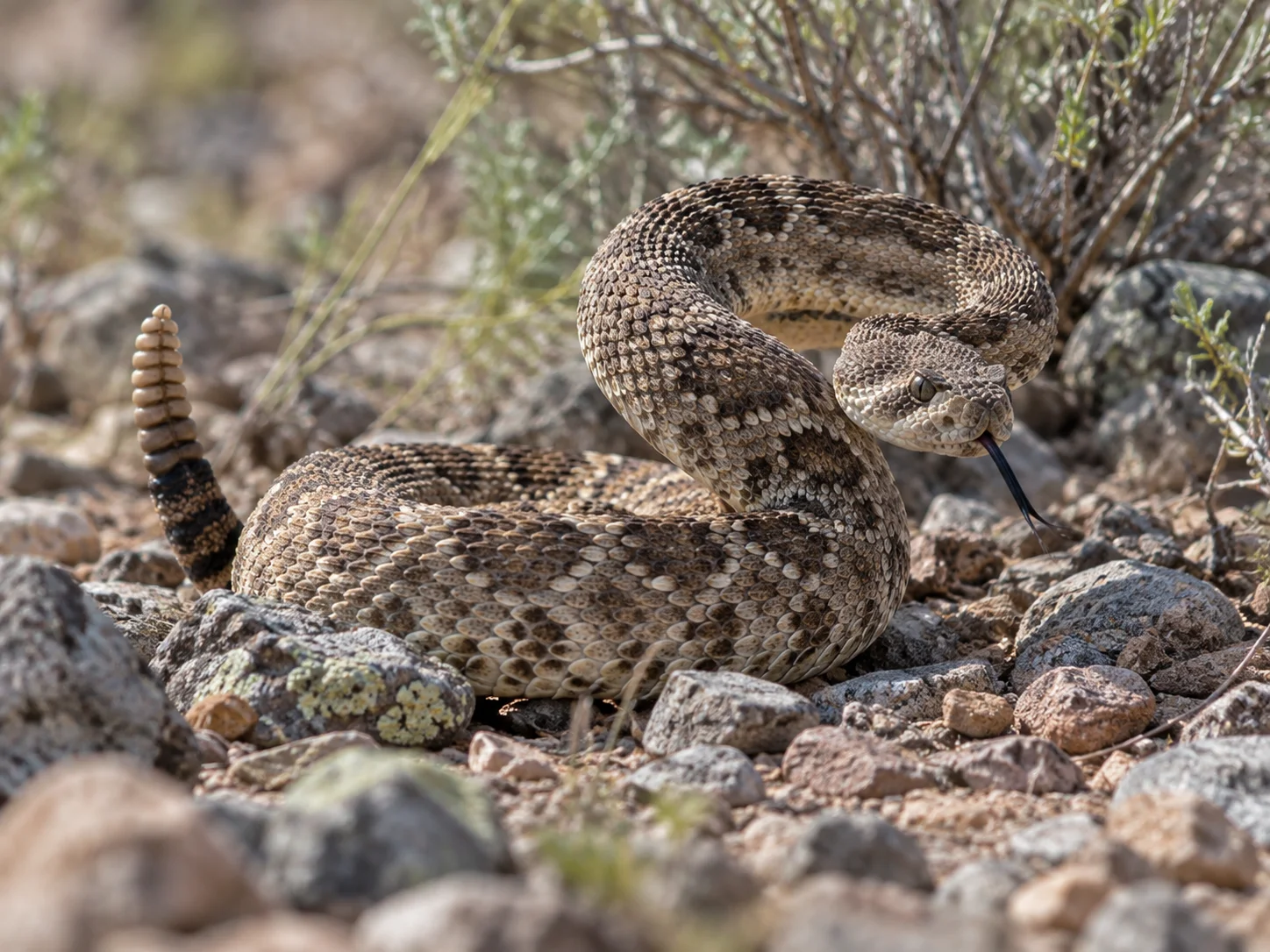
The rattle is made of keratin, the same material as your fingernails, and it is hollow.
A rattlesnake is born with a single button on its tail and no rattle at all. Every time it sheds its skin, a new interlocking segment is left behind at the tip. Shaken at speed, those loose segments knock against each other and produce the buzz. There is nothing inside; nothing rattles around.
Now the myth. You cannot tell a rattlesnake’s age by counting the segments. A snake may shed one to four times a year, so segments do not equal years, and the end of the rattle breaks off regularly as it catches on rocks and brush. It is unusual to find one with more than about a dozen segments.
Two more things worth knowing. A rattlesnake does not have to rattle before it strikes, so silence is not safety. And one species has given up entirely: the Santa Catalina rattlesnake, on an island off Mexico, has evolved without a working rattle, most likely because it hunts birds in trees and silence pays better than warning.
Types of Rattlesnake and Their Characteristics
| Rattlesnake | Scientific name | Size | Notes |
|---|---|---|---|
| Eastern diamondback | Crotalus adamanteus | Up to 8 ft (2.4 m) | The largest rattlesnake, up to about 20 lb |
| Western diamondback | Crotalus atrox | 3-5 ft (0.9-1.5 m) | Responsible for most US bites |
| Timber rattlesnake | Crotalus horridus | 3-5 ft (0.9-1.5 m) | Southern populations have more neurotoxic venom |
| Mojave rattlesnake | Crotalus scutulatus | 2-4 ft (0.6-1.2 m) | Strongly neurotoxic venom |
| Massasauga | Sistrurus catenatus | 2-2.5 ft (0.6-0.8 m) | Small, with a quiet buzzing rattle |
Appearance and Anatomy
Rattlesnakes range from about 1.5 feet to 8 feet long, and from a few ounces to around 20 pounds for a big eastern diamondback. Most are heavy-bodied, patterned in diamonds, blotches or bands in browns, grays and olives that disappear against rock and leaf litter.
- Pit organs. A hole on each side of the face between eye and nostril, lined with heat-sensitive tissue. It builds a crude thermal image, letting the snake strike accurately in complete darkness.
- Fangs. Hollow and hinged. They fold flat against the roof of the mouth and swing forward to stab. Fangs are replaced regularly through life.
- Head. Broad and triangular, housing the venom glands. Useful but not a reliable identifier, since harmless snakes flatten their heads to imitate it.
- Tongue. Flicked out to collect scent particles, then pressed to a sensory organ in the roof of the mouth. The fork lets the snake tell which side a smell came from.
- Rattle. Interlocking keratin segments at the tail tip.
Habitat and Range
Rattlesnakes are found only in the Americas, from southern Canada through the United States and Mexico to South America. They live in every US state except Alaska and Hawaii.
Desert and dry scrub suit them best, and the southwestern United States and northern Mexico hold the greatest variety. But rattlesnakes also live in prairie, forest, swamp, rocky hillside and mountain, up to around 11,000 feet.
In colder parts of the range, snakes gather in large numbers to overwinter in shared dens, sometimes with other snake species, returning to the same site year after year.
Diet and Feeding
Rattlesnakes are carnivores and eat mostly rodents: mice, rats, ground squirrels, gophers and rabbits, plus lizards, birds and occasionally other snakes.
Hunting is mostly waiting. A rattlesnake coils beside a trail its prey uses and stays there, sometimes for days, locating a warm body by its pit organs.
The strike takes a fraction of a second. The snake injects venom, then releases the animal rather than holding on, which avoids being bitten or scratched in a struggle. It waits, then follows the scent trail to wherever the prey died.
Prey is swallowed whole and head first. A rattlesnake can go weeks between meals, and large ones may eat only a handful of times a year.
Behavior and Lifestyle
Rattlesnakes are cold-blooded, so the day is organized around temperature. They bask in the morning sun, retreat to shade or burrows through the hottest hours, and in desert summer switch to hunting at night.
They are not aggressive. A rattlesnake’s first choice is to stay still and be missed, its second is to warn, and its third is to flee. Striking is a last resort, and it costs the snake venom it needs for food.
Rattlesnakes shed their skin one to four times a year, and are briefly near-blind beforehand as the eye covering clouds over, which makes them more defensive than usual.
Reproduction and Life Cycle
Rattlesnakes do not lay eggs. The eggs develop inside the mother and the young are born live, usually in late summer, in litters that run from about one to 25 depending on species.
Newborns arrive fully equipped with fangs and venom, and a single button where the rattle will grow. They cannot rattle yet.
The mother stays with them for the first week or so until their first shed, which is more care than most snakes give. After that they are on their own, and most do not survive their first year.
Females of many species breed only every two or three years, because carrying young is costly. Rattlesnakes can live 15 to 20 years or more in the wild.
Predators and Threats
Plenty of animals eat rattlesnakes. Eagles, hawks and roadrunners take them, as do coyotes, foxes, badgers and king snakes, which are resistant to the venom. Young rattlesnakes are eaten by almost anything.
Human pressure is the larger issue: habitat loss, roads, and deliberate killing. Organized rattlesnake roundups still remove thousands of snakes a year in parts of the United States, and the timber rattlesnake and massasauga have both declined sharply.
Are Rattlesnakes Dangerous to People?
A rattlesnake bite is a genuine medical emergency and needs hospital treatment immediately. It is also much less often fatal than people assume.
In the United States roughly 7,000 to 9,000 venomous snakebites are reported each year, and around five to twelve people die. Antivenom works, and it is widely available.
Most rattlesnake venom is hemotoxic: it destroys tissue and stops blood clotting properly. Some species, notably the Mojave rattlesnake and some timber rattlesnake populations, also carry neurotoxins that affect nerves and breathing.
Most bites happen when someone tries to handle, kill or move a snake. Leave it alone and walk around it, and the risk is very small. If bitten: get to a hospital, keep the limb still and below the heart, remove rings and watches, and do not cut, suck, apply ice or use a tourniquet. Those old remedies make the injury worse.
Role in the Ecosystem
Rattlesnakes are among the most effective rodent controllers in North America. A single timber rattlesnake can eat dozens of mice in a season, and studies have linked healthy rattlesnake populations to lower rates of tick-borne disease, because fewer mice means fewer ticks carrying Lyme disease.
They are prey as well as predator, feeding raptors and mid-sized carnivores.
Their venom has also proved medically valuable. Compounds derived from pit viper venom have been developed into drugs for blood pressure and clotting disorders, which is a reasonable argument for keeping the animals around.