Meet the Betta Fish
A male betta builds a nest out of bubbles. He gulps air at the surface, coats each bubble in saliva so it holds together, and assembles a raft of them under a leaf. Then he courts a female, wraps around her to fertilize the eggs as she releases them, catches each falling egg in his mouth and spits it into the nest.
He then guards it alone, retrieving any egg that drops, and drives the female away. He does not eat for days.
This is the animal sold in a plastic cup with a plant stuck on top, on the claim that it lives in puddles and eats roots. Neither of those things is true.
Scientific Name and Classification
The fish sold as a betta is Betta splendens, the Siamese fighting fish. The genus Betta contains over 70 other species, most of them plain and little known.
- Kingdom: Animalia
- Phylum: Chordata
- Class: Actinopterygii
- Order: Anabantiformes
- Family: Osphronemidae
- Species: Betta splendens
Bettas are gouramis, in the group known as labyrinth fish, and that group name points to their defining feature.
The name is often said to come from an ancient warrior clan, though the more likely origin is a Malay word for a fish. Its Thai name, pla kat, means biting fish.
The Labyrinth Organ, and Why It Is Misused
A betta has a labyrinth organ above its gills: a maze of folded, blood-rich bone plates that lets it absorb oxygen directly from air gulped at the surface.
It is genuinely remarkable. A betta can survive in water so low in oxygen that most fish would suffocate, and must reach the surface to breathe: a betta held underwater with no surface access will drown.
And this is precisely why they are kept so badly. The labyrinth organ means a betta can stay alive for weeks in a cup of stagnant, unheated water, which the industry has treated as permission. Surviving is not the same as thriving, and an animal’s tolerance for bad conditions is not an argument for providing them.
The specific claims on betta packaging, corrected:
- “They live in puddles.” They live in shallow, slow, warm water in Southeast Asia, including rice paddies, which are large bodies of water. In the dry season they can be stranded in small pools, and that is a hardship they survive, not a habitat they prefer.
- “They eat plant roots.” Flatly false. A betta is a carnivore and will starve slowly on a vase with a peace lily in it.
- “They do not need a heater.” They are tropical and need water around 78 to 80°F. Kept cold, a betta becomes lethargic, stops eating and is vulnerable to disease.
- “They prefer small spaces.” No fish does. A betta needs a minimum of five gallons, filtered and heated.
Appearance and Anatomy
A betta is 2.5 to 3 inches long including the tail, and weighs a fraction of an ounce.
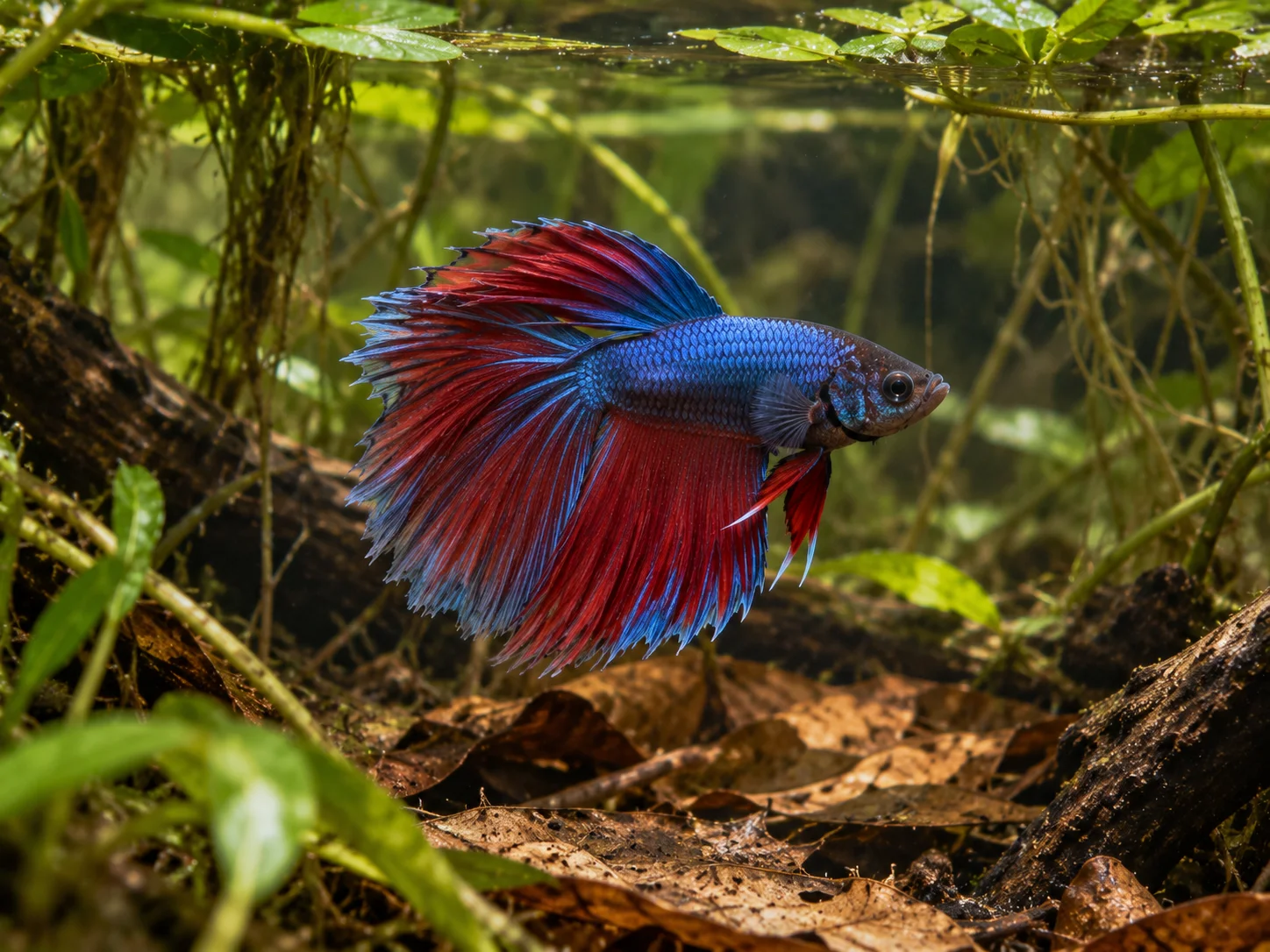
Wild Betta splendens look almost nothing like the pet-shop fish. They are dull brownish-green with short fins and only flush color when displaying. Every long-finned, brilliantly colored variety is the product of generations of selective breeding, and the tail types have names: veiltail, crowntail, halfmoon, plakat, double tail.
Those enormous fins come at a cost. They are heavy and hard to swim with, tear easily, and are prone to rot in poor water, so the most spectacular bettas are usually the least robust.
They also have upturned mouths for taking food at the surface, and can change color somewhat with mood and health, darkening when displaying and paling when stressed or ill.
Habitat and Range
Wild bettas live in the Mekong basin in Thailand, Cambodia, Laos and Vietnam, in rice paddies, floodplains, marshes and slow canals: shallow, warm, heavily vegetated water with little current.
Here is the part that rarely gets mentioned alongside the millions sold each year. The wild Siamese fighting fish is listed as Vulnerable. Its habitat is being drained, built on and polluted, and the wild population is fragmented and declining, even as the domesticated form is one of the most abundant pet fish on earth.
Escaped and released domesticated bettas have also established populations in places they do not belong, including parts of Australia, where they are considered a pest.
Diet and Feeding
Bettas are carnivores, and in the wild they eat insects and insect larvae, including mosquito larvae, plus small crustaceans and zooplankton.
Their upturned mouth and surface-feeding habit suit picking insects off the water film, and a wild betta will take an insect that lands on the surface within reach.
In a tank they need a protein-rich pellet made for bettas, ideally with frozen or live bloodworms, daphnia or brine shrimp a couple of times a week. Generic tropical flakes are largely plant-based and not adequate.
They are prone to being overfed, because they beg convincingly and their stomachs are about the size of their eye. A few pellets once or twice a day is enough, and a weekly fasting day is often recommended.
Behavior and Lifestyle
Males are genuinely aggressive toward each other, and two in one tank will fight until one is badly injured or dead. That is real, and it is why they are sold individually.
What is not real is the idea that a betta is therefore a solitary creature content in isolation. In a community tank of the right species a betta does well, and with no tankmates at all it needs enrichment: plants, caves, leaf litter and places to explore. A bored betta becomes listless.
The fighting was deliberately exploited. Betta fighting has been a betting sport in Thailand for centuries, with fish bred for aggression rather than color, and it was reportedly licensed and taxed by the Siamese king in the nineteenth century. The ornamental bettas sold today descend from that selective breeding, which is why they are quite so combative.
They are also more interactive than most fish, learning to recognize their owner, following a finger, and in some cases being trained to swim through hoops. They sleep, sometimes lying on a leaf or wedged in a plant, which alarms new owners who assume the fish has died.
Reproduction and Life Cycle
The bubble nest is the center of betta breeding. A male in breeding condition builds a raft of saliva-coated bubbles at the surface, often under a leaf, and a male will build one even with no female present, which is generally a sign of a healthy, comfortable fish.
Spawning is an embrace: the male wraps around the female, and as she releases eggs he fertilizes them. The eggs sink, and he collects each one in his mouth and spits it into the nest.
He then chases the female off, because she will eat the eggs, and tends the nest alone for two to three days, catching and replacing any egg that falls and not feeding while he does it. This is one of the clearest cases of male-only parental care in a popular aquarium fish.
Fry hatch in 24 to 36 hours and are free-swimming within three days, at which point the male’s job ends and he must be removed. Bettas live two to four years, occasionally five.
Predators and Threats
In the wild, larger fish, birds, snakes and frogs eat bettas, and their dull wild coloring is camouflage in vegetated water.
In captivity the threats are husbandry, and the list is short and consistent: cold water, unfiltered water, tanks far too small, cups left on shop shelves for weeks, tankmates that nip long fins, and fin rot from poor water quality.
The wild species faces habitat loss from drainage, agriculture and pollution across the Mekong basin, which is what the Vulnerable listing reflects.
Conservation Status
Wild Betta splendens is listed as Vulnerable, which is one of the odder situations in the animal world: a species simultaneously among the most numerous pet fish on earth and at risk in its native habitat.
The domesticated population is not a reserve for the wild one. Centuries of breeding for fins and color have produced a fish quite different from the wild type, and releasing pet bettas into Southeast Asian waters would damage the wild populations rather than help them.
Several other Betta species are in worse trouble, with a number of them restricted to single peat swamps that are being drained.
Role in the Ecosystem
In its native wetlands the betta is a small predator of insect larvae, including mosquito larvae, and prey for larger animals in turn.
It is also a well-established laboratory animal, used in studies of aggression, display behavior and learning, partly because its threat displays are so consistent and easy to measure.
Its largest role, though, is as the most misrepresented animal in the pet trade. A fish with a specialized air-breathing organ, elaborate courtship, genuine male parental care and the ability to recognize its keeper is sold on the premise that it wants to live in a cup of cold water and eat a plant.
Kept properly, in five gallons of warm filtered water with plants and somewhere to hide, it is one of the most rewarding small aquarium animals there is. Our beginner’s guide to keeping pet fish covers the setup in detail.