Meet the Etruscan Shrew
The Etruscan shrew is the lightest mammal on Earth. A full-grown adult weighs about 1.8 grams, roughly the same as a paper clip, and you could balance one on a one-euro coin with room to spare.
Being that small comes at a brutal cost. The shrew’s heart can beat more than 1,500 times a minute, the fastest heartbeat ever recorded in any warm-blooded animal. It must eat up to twice its own body weight every single day. Go hungry for a few hours and it will not survive.
Despite the name, it is not a mouse and not a rodent. Shrews are insect eaters, more closely related to moles than to anything with gnawing front teeth.
Scientific Name and Classification
The Etruscan shrew’s scientific name is Suncus etruscus, described by the Italian naturalist Paolo Savi in 1822. The name comes from Etruria, the part of central Italy where the first specimens were found.
It also goes by the Etruscan pygmy shrew, the white-toothed pygmy shrew and Savi’s pygmy shrew. The “white-toothed” part matters to scientists: one big group of shrews has red-tipped teeth, and this one does not.
- Kingdom: Animalia
- Phylum: Chordata
- Class: Mammalia
- Order: Eulipotyphla
- Family: Soricidae
- Genus: Suncus
- Species: Suncus etruscus
Scientists published a full genome sequence for the species in 2024, which should help answer some of the questions about how an animal this small manages to stay alive.
Appearance and Anatomy
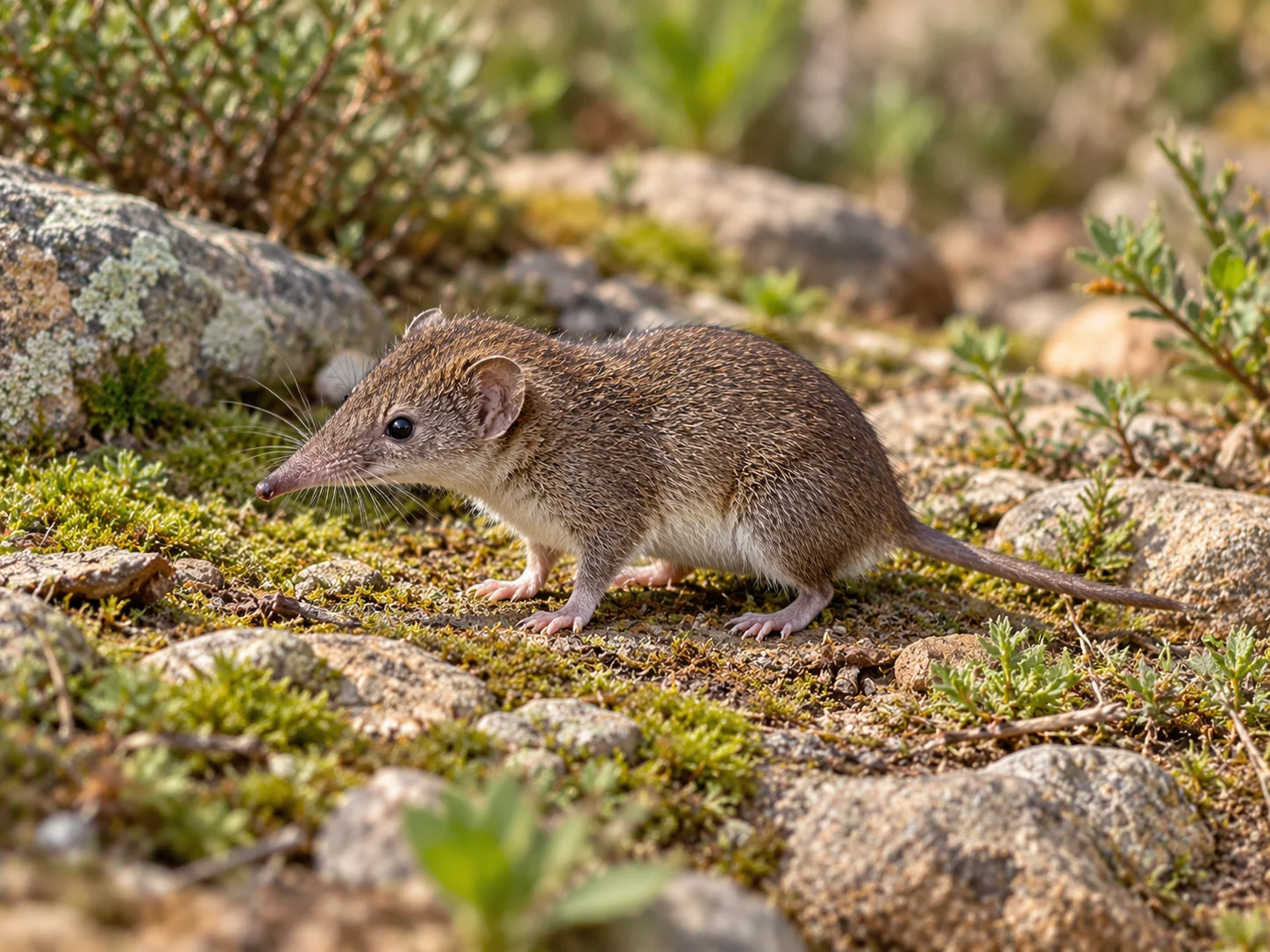
The body measures 3 to 5.2 cm (1.2 to 2 inches), not counting a tail that adds another 2.4 to 3.2 cm. Weight ranges from 1.3 to 2.5 grams, usually around 1.8.
The fur is pale brown on the back and sides and light gray underneath. The body is slender, the snout long and pointed and constantly twitching, and the whiskers are long and highly sensitive. The eyes are tiny and the ears relatively large and bare.
For comparison, a greater white-toothed shrew, a close relative, can be twice as long and four to five times heavier.
The heart is the standout. It makes up about 1.2 percent of the animal’s body weight, a far bigger share than in most mammals, because it has to move blood fast enough to keep the shrew alive.
Is the Etruscan Shrew the Smallest Mammal?
By weight, yes. Nothing else with fur and warm blood is lighter.
But there is a rival. The bumblebee bat of Thailand has a skull only 11 mm long, shorter than the shrew’s, and a shorter body. The bat is heavier, at 1.7 to 2 grams against the shrew’s 1.3 to 2.5.
So the two share the title. The Etruscan shrew is the smallest mammal by mass, and the bumblebee bat is the smallest by length. Which one you call the winner depends on whether you reach for the scales or the ruler.
They also solve the problem of being tiny in opposite ways, which is the interesting part. The shrew runs its body at full speed and eats constantly. The bat does the reverse, hanging still in a cave for 23 hours a day and flying for less than one.
Habitat and Range
The Etruscan shrew lives across a broad warm belt roughly between 10 and 40 degrees north. That takes in southern Europe and the Mediterranean, North Africa, the Middle East, and onward across southern Asia to India, southern China and Malaysia. It also lives on Malta and other Mediterranean islands.
It likes warm, damp ground with plenty of low cover: scrub, undergrowth, stone walls, gardens, olive groves and farmland. Dense cover matters because it hides the shrew from predators while it hunts.
Rather than dig its own tunnels, it usually moves into cracks in rock and walls or burrows another animal has abandoned.
Diet and Feeding
The Etruscan shrew eats insects, spiders, worms and other small invertebrates, and will take small vertebrates too. It regularly attacks prey as large as itself, including young lizards and grasshoppers nearly its own size.
It eats 1.5 to 2 times its body weight every day. For a person weighing 70 kg, that would mean getting through more than 100 kg of food between breakfast and bedtime.
Hunting happens in short bursts around the clock, with naps in between. The shrew works mostly by touch and smell, sweeping its whiskers across the ground, and it strikes extremely fast once it finds something.
Behavior and Lifestyle
Etruscan shrews live alone and defend the patch of ground they hunt over. Adults come together only to breed.
Everything about the animal runs fast. A resting shrew’s heart averages around 835 beats a minute and can reach 1,511, the highest figure ever measured in a warm-blooded animal. It breathes several hundred times a minute. Gram for gram, it burns more energy than any other mammal.
The reason is simple physics. A very small body has a great deal of surface compared with its volume, so heat pours out of it. The Etruscan shrew is permanently close to freezing to death, and only its racing metabolism keeps it warm.
When food runs short or the night turns cold, it drops into torpor and lets its body cool. Warming back up is remarkable to watch: it can raise its own temperature by as much as 0.83 degrees Celsius per minute, among the fastest rewarming rates known in any mammal.
Reproduction and Life Cycle
Breeding mostly happens in the warmer, wetter months, often from spring into fall, and a female may raise more than one litter in a good year.
Litters usually contain two to six young, born in a hidden nest of dry grass and leaves tucked into a crevice or an old burrow. The babies arrive blind and hairless and grow very quickly, which they have to, since their mother cannot spare much time away from hunting.
Life is short. Around two years is the usual estimate, and many wild shrews do not manage that.
Predators and Threats
Owls are the main hunters of Etruscan shrews, and shrew bones turn up regularly in the pellets owls cough up. Snakes, small cats and other carnivores take them too, and domestic cats kill a great many near villages and farms.
Many mammal predators kill shrews and then leave them uneaten, because scent glands on the shrew’s flanks make it taste unpleasant. Owls, which have a poor sense of smell, are not put off at all.
Unlike some of its relatives, the Etruscan shrew is not venomous.
The broader pressures are habitat loss, as scrub and field edges are cleared or built on, and pesticides, which remove the insects it needs.
Conservation Status
The IUCN Red List classifies the Etruscan shrew as Least Concern. Its range is enormous, stretching across three continents, and the species is not considered at risk.
That does not make it common. Across most of that range it is thinly spread and rarely seen, partly because it is genuinely scarce in places and partly because an animal the size of a paper clip, hidden in undergrowth, is very hard to find. Much of what is known about where it lives comes from bones found in owl pellets.
Role in the Ecosystem
An animal that eats twice its weight in insects daily gets through a startling number of them over a lifetime, including many that damage crops. In gardens, olive groves and farmland, that is quiet, free pest control.
Shrews also feed the animals above them, particularly owls, turning insects into food for larger predators.
For scientists the shrew is valuable in another way. It sits at the smallest size a warm-blooded animal can be, which makes it the natural subject for studying how hearts, lungs and metabolism cope at the limit. Much of what researchers know about the physics of being tiny comes from this one species.