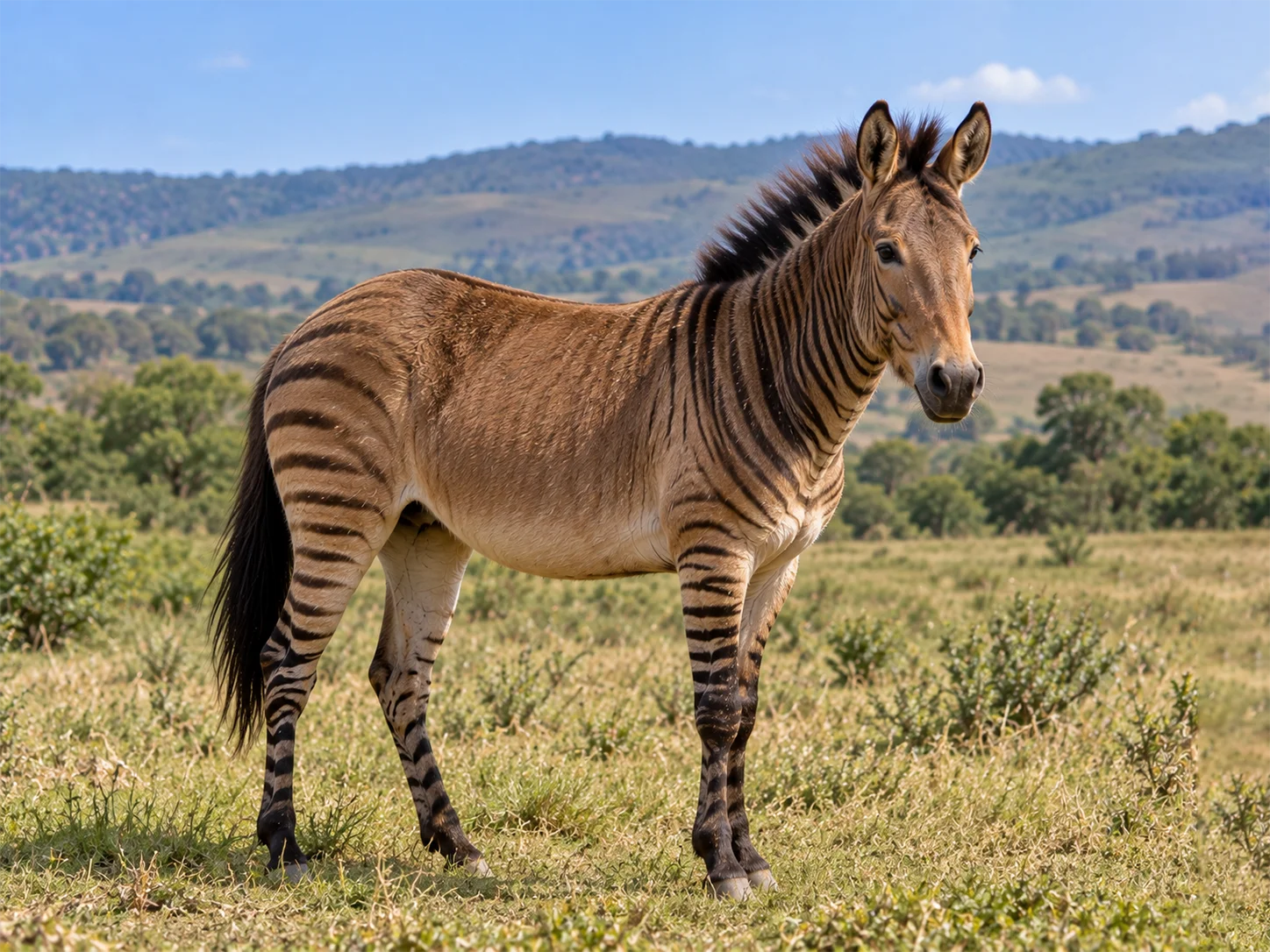
Meet the Zorse
A zorse is the foal of a zebra stallion and a horse mare. It usually looks like a horse that has been partly painted.
The stripes do not cover it evenly. They come through where the coat is pale and vanish where it is dark, so a zorse can have strongly striped legs, a faintly barred shoulder, and a plain body, all on the same animal.
And a zorse has one more claim on your attention. Two centuries ago, a cross like this one produced a foal that fooled Charles Darwin and sent biology down a wrong road for most of a century.
Classification
- Kingdom: Animalia
- Phylum: Chordata
- Class: Mammalia
- Order: Perissodactyla
- Family: Equidae
- Parentage: a zebra, usually Equus quagga, crossed with the domestic horse, Equus caballus
A zorse has no scientific name of its own, because scientific names belong to species and a sterile hybrid is not one.
Zorse, Hebra, Zonkey: Which Is Which
The general word for any zebra hybrid is zebroid, and the names are built by combining the parents, father first. Which parent was the zebra changes the name.
- Zorse: zebra father, horse mother
- Hebra, also called a zebrinny: horse father, zebra mother
- Zony: zebra father, pony mother
- Zonkey: zebra crossed with a donkey
The best known hebra is Eclyse, born in Germany in 2007 to a zebra mare and a horse stallion, and famous for coming out in patches rather than stripes.
Appearance
A zorse is built like a horse and takes its base coat from its horse parent, which is why no two look quite alike. A zorse out of a pale mare can be striped over much of its body. A zorse out of a dark bay may show stripes only down the legs.
- Horse-shaped head and body, often with a stiffer, more upright mane
- Striping concentrated on the legs, belly and hindquarters
- Base color inherited from the mare: bay, chestnut, gray or dun
- Size between the two parents, so broadly horse-sized
Health is a genuine concern with zebra crosses. Dwarfism turns up in them more often than it should, and the animals are typically harder to handle than purebred horses. A zebra is strong, quick-tempered and has never been domesticated the way a horse has, and that comes through in the foal.
Why a Zorse Cannot Have Foals
It comes down to an odd number.
A domestic horse has 64 chromosomes. A plains zebra has 44. A foal inherits half of each parent’s set, which leaves a zorse with somewhere around 54, and crucially with two sets that do not match each other.
Making eggs or sperm requires chromosomes to line up in pairs and separate cleanly. Mismatched sets cannot do that, the division fails, and the animal is sterile. A mule is sterile for exactly the same reason.
Under what biologists call Haldane’s rule, the two sexes are not equally affected. Female hybrids are poorly fertile rather than absolutely infertile, so rare exceptions are recorded among them. Males are effectively always sterile.
The Foal That Fooled Darwin
In 1815 Lord Morton crossed a quagga stallion with one of his mares. The quagga was a zebra of southern Africa, and it was hunted to extinction later that century, so the cross used an animal nobody will ever see again.
The hybrid foal was unremarkable. What happened next was not.
Morton later bred the same mare to an ordinary stallion, and those foals were reported to have faint stripes on their legs. The surgeon Sir Everard Home wrote the case up, and the conclusion drawn from it was that the quagga had somehow left a mark on the mare that showed up in later foals by a different father.
That idea has a name. Telegony is the belief that a mother’s earlier mate can influence her later young, and it is very old, going back to Aristotle. Lord Morton’s mare became its star exhibit, and Charles Darwin cited the case in Variation of Animals and Plants Under Domestication in 1868.
It was wrong.
How Telegony Was Knocked Down
There is no mechanism for it. A foal gets one set of chromosomes from the egg and one from the sperm that fertilizes it, and that is the entire genetic contribution. A stallion the mare met years earlier has nothing left in her to pass on.
The stripes had a duller explanation. Both the mare and the later stallion can carry a recessive gene variant without showing it themselves, and a foal that inherits it from both parents will show a pattern neither of them had. Faint leg barring turns up in ordinary horses for just this reason.
The telling part is how it was finally settled, which is where zorses come back in. In the 1890s James Cossar Ewart bred zebras with ponies in Scotland for the specific purpose of testing telegony: produce hybrid foals, then breed the same mares to ordinary stallions and look carefully at what came out. Researchers in Germany and Brazil ran their own versions. Nobody found any evidence of it. In 1909 Karl Pearson added a simple argument from human families: if telegony were real, a couple’s later children should look more and more like the father, and they do not.
So the zorse is a rare thing, an animal bred as an experiment that actually settled the question. The hybrids were made to test an old idea, and they killed it.
Why Else People Bred Zorses
Mostly for work, and mostly because of a disease.
Zebras resist sleeping sickness, which kills horses and ponies across much of tropical Africa. A hybrid that kept the zebra’s resistance and the horse’s willingness to be harnessed would have been genuinely useful, and people kept trying to make one.
- During the South African War the Boers crossed Chapman’s zebras with ponies to pull guns
- Zoos bred zebroids through the twentieth century, partly chasing that same disease-resistant work animal
- Today they are kept mainly as curiosities in circuses and smaller zoos, and occasionally ridden or driven
It never became an industry, for a reason built into the animal. A sterile hybrid cannot found a breed, so every zorse has to be made from scratch out of a zebra and a horse. You cannot improve a line that has no second generation.
Conservation Status
A zorse has no conservation status. The IUCN assesses species, and a hybrid is not one, so there is nothing to count.
Its parents are assessed. Domestic horses are not, being farm animals, but zebras are, and their listings run from Near Threatened to Endangered depending on the species. The quagga that started this story is beyond assessment entirely.
What the Zorse Teaches
Two things, and the second one is the better lesson.
The first is where a species boundary actually sits. A zebra and a horse are close enough to make a living, healthy foal together, and too far apart for that foal to make another. The line between species is not whether two animals can breed. It is whether their young can carry on.
The second is about being wrong. A respected surgeon reported the striped foals honestly, and the greatest biologist of the age repeated the story in print, and the explanation they reached for was still false. What fixed it was not a cleverer argument but somebody breeding the animals on purpose and looking at the results. That is the whole method, and a striped horse in a Scottish field is as good an illustration of it as you will find.