Meet the Yak
A yak lives where almost nothing else large can. Herds graze the Tibetan Plateau at 10,000 to 20,000 feet, on open ground with no trees, air holding roughly half the oxygen of sea level, and winter temperatures reaching minus 40.
Whole human cultures exist up there because the yak does. It supplies milk, meat, wool, leather, transport and, on a plateau with no firewood, the dried dung that people burn to cook and stay warm.
There is a catch that tells you how specialized it is. Take a yak down to low altitude and it does badly. It is built for thin cold air and struggles in the warm thick air the rest of us live in.
Scientific Name and Classification
There are two yaks, and the distinction matters.
- Domestic yak (Bos grunniens), over 20 million of them, kept across the Himalayas and Central Asia.
- Wild yak (Bos mutus), the wild ancestor, far larger, with only 10,000 to 20,000 left.
- Kingdom: Animalia
- Phylum: Chordata
- Class: Mammalia
- Order: Artiodactyla
- Family: Bovidae
- Genus: Bos
Being in the genus Bos makes yaks close relatives of cattle, close enough to interbreed with them.
The names are a small joke at the animals’ expense. Grunniens means grunting, because yaks grunt rather than moo. Mutus means mute, because the wild one was thought to be silent.
How Do Yaks Survive at High Altitude?
Through a stack of adaptations, several of which have no equivalent in ordinary cattle.
- Enormous lungs. A yak’s lung capacity is close to three times that of cattle, so each breath of thin air delivers far more.
- Blood built for thin air. Yaks carry large numbers of small red blood cells packed with hemoglobin, which moves oxygen efficiently when there is little to be had.
- No sweat glands to speak of. They shed heat by panting instead, which loses less water in dry air but leaves them helpless in real warmth.
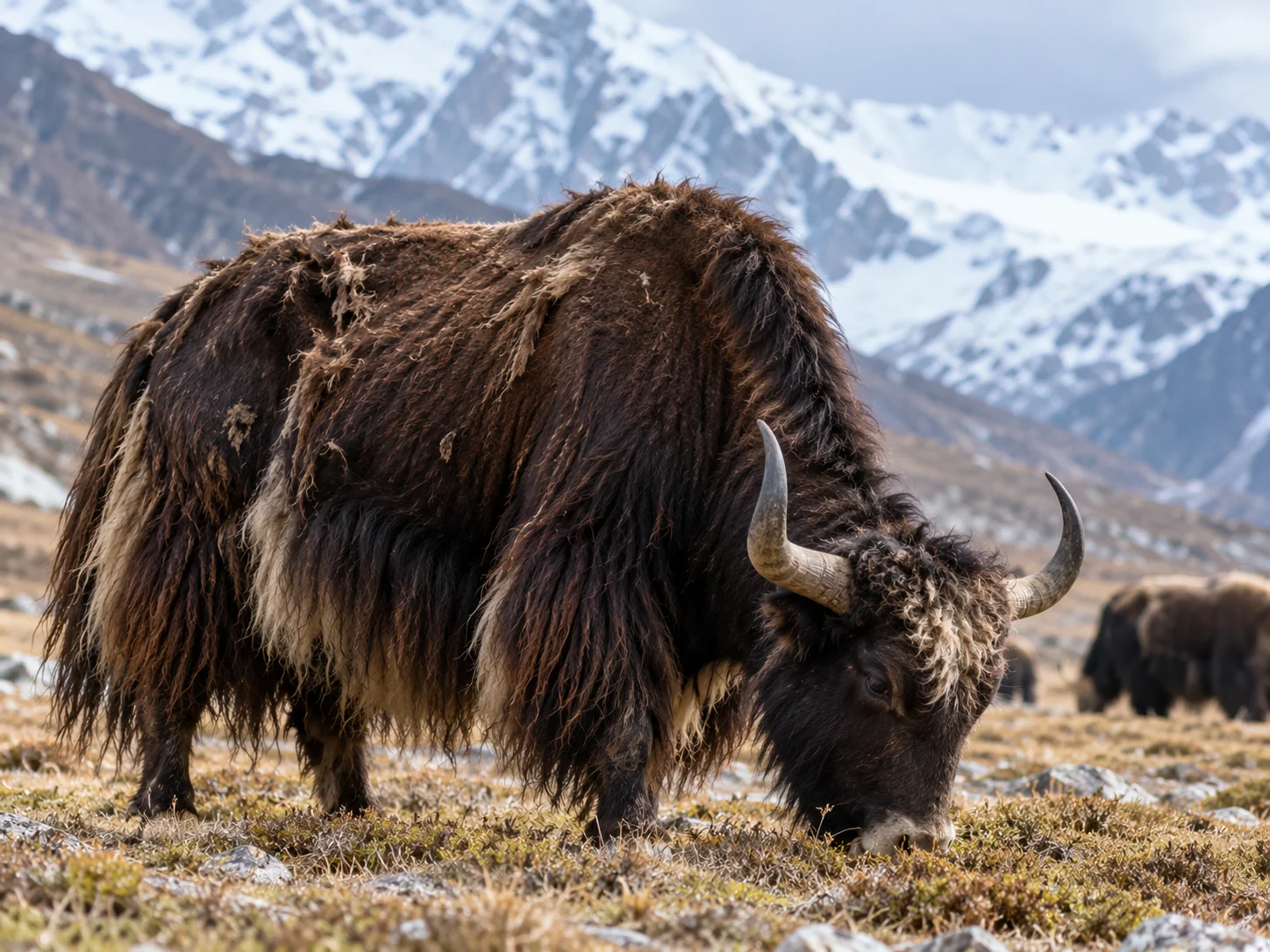
- A double coat. A dense woolly undercoat under long outer hair that hangs almost to the ground, forming a skirt that blocks wind off the legs and belly.
- Thick skin with few sweat glands and a layer of fat beneath it.
- Wide splayed hooves with sharp edges for grip on rock, ice and snow.
The trade-off is severe. Below about 10,000 feet yaks suffer heat stress and breathing trouble, and above roughly 60 degrees Fahrenheit they are visibly uncomfortable. A yak is not simply a hardy cow; it is an animal that has given up the lowlands entirely.
Appearance and Anatomy
Wild yaks are much the bigger animal, standing up to 6.5 feet at the shoulder and weighing up to about 2,200 pounds. Domestic yaks are considerably smaller, usually 3.5 to 4.5 feet at the shoulder and 500 to 1,200 pounds.
- Humped shoulders. A pronounced hump over the shoulders, higher than the rump, giving the sloping profile.
- Horns. Both sexes have them, curving outward and up. On a wild bull they can reach 3 feet.
- Coat. Long guard hairs over dense wool, usually black or dark brown in wild yaks; domestic ones come in black, brown, white and piebald.
- Tail. Long and bushy like a horse’s rather than tufted like a cow’s.
- Lungs and heart. Both large for the body.
Habitat and Range
Yaks live on the Tibetan Plateau and through the surrounding mountains of Asia: Tibet and western China, Nepal, Bhutan, northern India, Mongolia and parts of Central Asia.
They occupy alpine meadow, alpine steppe and cold desert steppe, nearly all of it treeless. Wild yaks live highest of all, in remote country of the northwestern plateau where few people go.
Herders move with the seasons, taking yaks higher in summer for fresh grazing and lower in winter, a pattern of transhumance that has run for thousands of years.
Diet and Feeding
Yaks are herbivores and ruminants, grazing grasses, herbs, lichens, mosses and whatever low plants the plateau offers.
They are efficient in a way that matters up there. Yaks extract more from poor forage than cattle do and need less of it for their size, which is the difference between surviving a plateau winter and not.
In winter they push snow aside with their heads and hooves to reach whatever is underneath, and will eat snow for water when streams are frozen.
Like all ruminants they chew the cud, fermenting rough plant matter in a four-chambered stomach.
Behavior and Lifestyle
Yaks are herd animals. Wild herds of females and young can number in the hundreds, while bulls live alone or in small bachelor groups outside the breeding season.
They are calm but not tame in temperament, and a wild yak is genuinely dangerous when provoked. Charging rather than fleeing is a reasonable strategy for an animal that size on open ground.
They swim readily, including across cold rivers, and are far more surefooted than their bulk suggests, crossing scree and ice that would stop a horse.
And they grunt. The low grunting noise in place of a moo is distinctive enough to have given the species its name.
Reproduction and Life Cycle
Yaks mate in the fall, usually September, and pregnancy lasts around 258 days, roughly eight and a half months, producing a single calf in late spring when grazing returns.
Calves are up and following the herd within about ten minutes, which matters on open ground with wolves about.
They nurse for a year or so. Females usually calve only every other year, since raising a calf at that altitude is costly.
Yaks live around 20 to 25 years.
What Is a Dzo?
A dzo is a cross between a yak and a domestic cow, and it is one of the most useful hybrids in farming anywhere.
A male is a dzo, a female is a dzomo, and in Nepal a female hybrid kept for milk is often called a chauri.
Hybrids are bigger and stronger than either parent and give far more milk than a yak, which is why herders value them. They also cope with middle altitudes where a pure yak overheats and a pure cow struggles for breath, so they fill the band of country between the two.
There is one catch, and it is the familiar one with hybrids: male dzos are sterile. Females are fertile and can be bred back to either a yak or a bull, so herders must keep making the cross afresh each generation.
Predators and Threats
The Tibetan wolf is the main predator, taking calves and occasionally weakened adults. Snow leopards and brown bears take calves where their ranges overlap. Healthy adult yaks form a defensive ring around the young, horns outward.
For wild yaks the real threats come from people: historic overhunting, competition with domestic herds for grazing, and disease passed from domestic animals.
The subtlest threat is interbreeding. Wild bulls mate with domestic females, and every hybrid calf dilutes what remains of the wild gene pool. A species can be lost by blending as surely as by killing.
Conservation Status
The two yaks could hardly be further apart.
The domestic yak is a farm animal, over 20 million strong, and in no danger whatsoever.
The wild yak is listed as Vulnerable, with estimates between 10,000 and 20,000 animals left, down from a range that once covered most of the Tibetan Plateau.
Protection now focuses on reserves in the remote northwest of the plateau, keeping domestic herds out of core wild areas to prevent interbreeding and disease, and enforcing hunting bans. Wild yak genetics also have practical value: crossing wild bulls back into domestic lines has produced hardier, better-performing animals.
Role in the Ecosystem
Yaks are the main large grazers of the Tibetan Plateau, and their grazing shapes the alpine grassland in the way bison once shaped the prairie. Their dung fertilizes thin soil and supports the insects and fungi that break it down.
They also feed the predators at the top of that system, the Tibetan wolf above all.
Their importance to people is harder to overstate. On a treeless plateau, dried yak dung is the fuel that cooks food and heats homes, yak wool becomes tents and rope, yak butter goes into lamps and tea, and yaks carry the loads. Human settlement at those altitudes has depended on this one animal for thousands of years.