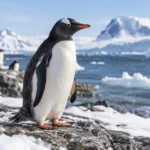
Meet the Yellow-Eyed Penguin
Penguins are supposed to nest in crowds. Thousands of birds packed together on open ground, shoulder to shoulder, in the noisiest animal gathering most people will ever see.
The yellow-eyed penguin refuses. It is the least colonial penguin in the world: pairs nest alone in forest and dense scrub, deliberately out of sight of each other, though still within earshot.
It is also in serious trouble. On the New Zealand mainland the breeding population has fallen from 739 pairs in 2008 to 143 in 2025, a collapse of around 80 percent in under twenty years.
Scientific Name and Classification
The yellow-eyed penguin is Megadyptes antipodes, the only living species in its genus. In New Zealand it is known by its Maori name, hoiho.
- Kingdom: Animalia
- Phylum: Chordata
- Class: Aves
- Order: Sphenisciformes
- Family: Spheniscidae
- Genus: Megadyptes
- Species: Megadyptes antipodes
The IUCN lists it as Endangered. It was first classed as threatened in 1988 and moved to endangered in 2000, and the numbers have gone the wrong way since.
Having a genus to itself means it has no close relatives among the other penguins. Whatever is lost if this species goes is lost on its own.
Appearance and Anatomy
Adults stand 24 to 31 inches (62 to 79 cm) tall and weigh 6.6 to 18.7 pounds (3 to 8.5 kg). Males average 12.2 pounds and females 11.3.
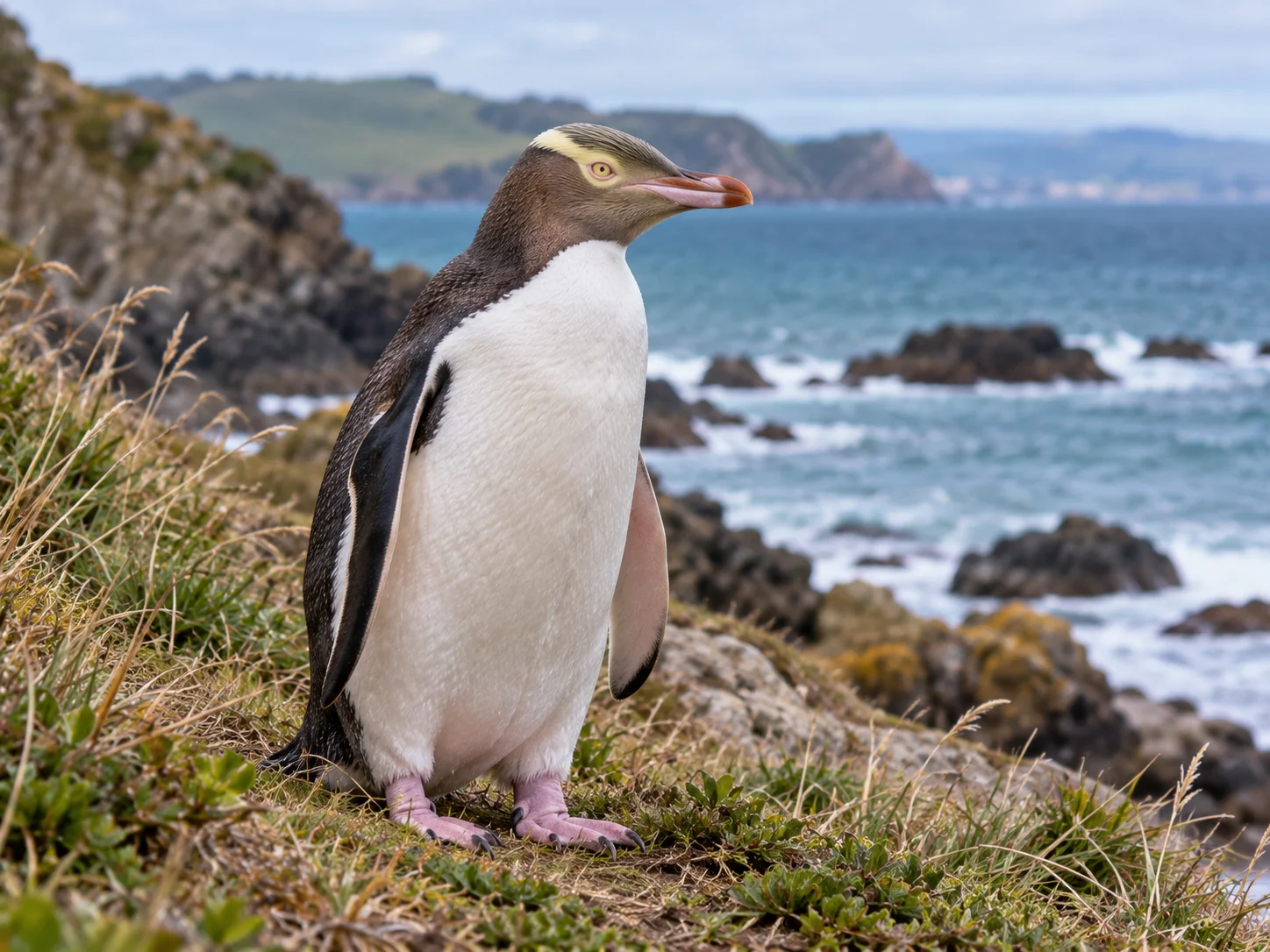
- A pale yellow band of feathers around the eyes and across the back of the head
- Slate-gray crown and face flecked with golden yellow
- A yellow eye, which is where the name comes from
- White chest and belly
- Juveniles: grayer head and no yellow band
That weight range looks impossibly wide for one species, and there is a reason. A penguin is at its heaviest just before it molts, and it can lose 3 to 4 kilograms getting through the molt, because it cannot go to sea for food while it has no waterproof feathers. The same bird at two points in the year is almost two different animals.
The Penguin That Will Not Live in a Crowd
Nest site selection starts in June. A pair chooses forest or scrub with dense vegetation, builds a nest of twigs, grasses and leaves, and tends to come back to the same area year after year.
The crucial detail is the spacing. Nests are placed out of sight of other nests, but close enough for the birds to hear one another. Pairs breed alone or in very loose groups, never in the dense colonies that almost every other penguin forms.
This matters for conservation in a way that is easy to miss. A penguin that needs standing forest and visual privacy cannot be helped by protecting a stretch of open beach. It needs the vegetation behind the beach left alone, which is a much harder thing to ask for.
Habitat and Range
Yellow-eyed penguins breed along the eastern and southeastern coast of New Zealand’s South Island, on Stewart Island, and on the subantarctic Auckland and Campbell Islands.
The population is unevenly split, and the healthier part is the remote part. Enderby Island in the Aucklands averaged 577 breeding pairs a year between 2012 and 2017, which is somewhere between 37 and 49 percent of the entire breeding population of the species.
The mainland is the part failing. Otago Peninsula numbers are down 75 percent since the mid-1990s, and on current trends the species may be gone from the mainland within about twenty years.
Diet and Diving
About 90 percent of the diet is fish, chiefly bottom-dwelling species: silversides, blue cod, red cod and opalfish. Arrow squid, krill and small fish taken around jellyfish make up the rest.
The hunting style is unusual. Most penguins chase prey through open water; this one works the seabed, and up to 90 percent of its dives go all the way to the bottom. It can reach 240 meters down.
Being a specialist has turned into a liability. Red cod, a key prey fish in the 1980s, has declined badly, and the penguin’s diet has narrowed from around 24 species in the 1990s to two. A bird with two things left to eat has no room to absorb a bad year.
Breeding and Life Cycle
Pairs begin breeding at about two years old. Breeding starts in late August, incubation runs from September to November, and both parents share the sitting.
Adults guard the chicks full-time for the first 40 to 50 days. Chicks usually fledge in mid-February, weighing 5 to 6 kilograms.
Some individuals reach 20 years. Males outlive females, enough that by age 10 to 12 there are roughly two males for every female, which is its own problem for a species trying to pair up and breed.
Why It Is Disappearing
A risk assessment in November 2025 named the biggest threats as malnutrition, predation, disease, other trauma, and fishing.
Set nets are a direct killer: a diving penguin that swims into one does not come back up. Malnutrition follows from the collapse of the prey species it depends on.
Disease has done the sharpest damage. In 2004 an outbreak of a previously undescribed throat infection killed 60 percent of the chicks on the Otago Peninsula and in North Otago. In 2023 researchers identified a novel virus as the likely cause of a respiratory illness that had killed roughly a quarter of mainland chicks in the 2021 season, and its mortality rate is above 90 percent.
Ninety percent is the figure to sit with. A disease that kills nine out of ten infected chicks, in a mainland population of 143 pairs, does not need many bad years.
What Is Being Done
A good deal is being done for the yellow-eyed penguin, and it is worth listing, because the species has not been left to it.
- A reserve at Long Point in the Catlins, established in November 2007
- Protection under the United States Endangered Species Act from 2010
- The Dunedin Wildlife Hospital, which treats sick chicks, hatched eggs for the first time in 2022 and hand-reared 214 chicks the following year
- Vaccine research against the diseases killing the chicks
- A set net fishing ban around the Otago Peninsula, introduced September 2025 and made permanent in July 2026
Hand-rearing 214 chicks in a single year, for a species whose mainland population is measured in the low hundreds of pairs, is an extraordinary intervention. It is also a sign of how close to the edge the situation is.
Role in the Ecosystem and in New Zealand
As a seabed-feeding predator, the hoiho links the bottom of the coastal ocean to the land, carrying nutrients ashore and feeding on fish few other seabirds pursue.
Its cultural standing is high. The hoiho appears on the reverse of the New Zealand five-dollar note, which means New Zealanders handle a picture of their rarest penguin constantly without necessarily knowing it is down to 143 mainland pairs.
And it is a hard case for conservation precisely because of what makes it interesting. The one penguin that will not nest in a crowd needs forest, privacy, a particular set of fish on the seabed, and freedom from a virus that kills nine chicks in ten. Protecting a beach is not enough, and everybody involved knows it.