
Meet the Xoloitzcuintli
Start with the name, because everyone does. Xoloitzcuintli is said show-low-eats-QUEENT-lee, and most people give up and call it a Xolo.
Under the difficult name is one of the oldest dog breeds in the world. Xolos have been in Mexico for more than three thousand years, long before horses, cattle or wheat arrived there, and clay statues of them have been dug out of graves older than the Aztec empire.
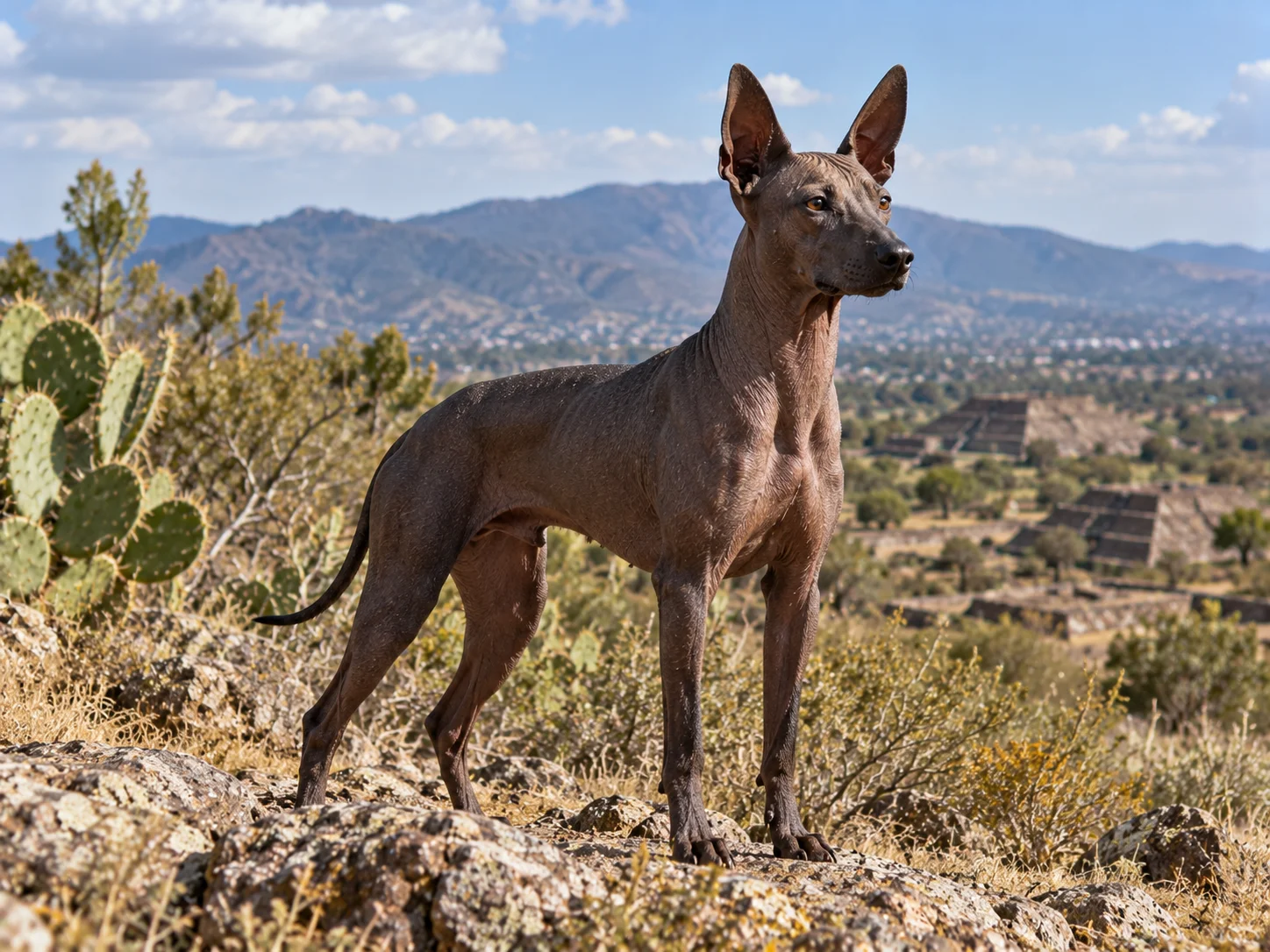
Most Xolos are also completely bald. The skin is smooth, warm to the touch and usually dark slate or black, and a hairless Xolo standing in sunlight looks less like a pet than a piece of sculpture that decided to walk off.
Scientific Name and Classification
The Xoloitzcuintli is a breed of domestic dog, Canis lupus familiaris, which makes it a subspecies of the gray wolf like every other dog on Earth.
- Kingdom: Animalia
- Phylum: Chordata
- Class: Mammalia
- Order: Carnivora
- Family: Canidae
- Genus: Canis
- Species: Canis lupus familiaris
The name is Nahuatl, the language of the Aztecs. It joins Xolotl, a god of fire and lightning, to itzcuintli, the word for dog, so the breed is named after the god who was said to have made it. Canidae is the dog family, which also holds the wolf and every breed from the Akita to the Chihuahua.
Why Most Xolos Have No Hair
The hairlessness comes down to a single gene called FOXI3, and it behaves in an unusual way.
The hairless version of the gene is dominant, so a dog needs only one copy to be bald. But a puppy that inherits two copies does not survive to be born. That means every living hairless Xolo carries one hairless copy and one coated copy, and when two hairless parents have a litter, some of the puppies come out with a full coat of hair.
Those coated puppies are not mistakes. They are purebred Xolos, shown and registered alongside their bald littermates, and breeders need them because a coated dog carries two coated copies and can never pass on the lethal combination.
The same gene affects teeth. Hairless Xolos usually have an incomplete set, often missing premolars, while coated Xolos have a full mouth of teeth, a reminder that hair and teeth grow from the same kind of tissue in a developing animal.
Appearance and Size
Xolos come in three official sizes, and the range between the smallest and the largest is wider than in almost any other breed.
- Toy: 10 to 14 inches (25 to 36 cm) at the shoulder
- Miniature: 14 to 18 inches (36 to 46 cm)
- Standard: 18 to 23 inches (46 to 58 cm)
Weight runs from about 10 pounds (5 kg) for a small toy to 55 pounds (25 kg) for a large standard. All three sizes are the same dog otherwise: lean and rectangular, with a long neck, large upright bat-like ears, almond eyes and a tail that tapers to a point.
Hairless dogs are usually dark (black, slate, liver or bronze), and many have a few coarse hairs on the top of the head and the end of the tail. The skin is tough but it is still skin, so a Xolo sunburns like a person and needs shade and sunscreen in strong light, and a coat in cold weather.
History
To the Aztecs and the peoples before them, the Xolo was not only a companion. It was a guide. Dogs were believed to lead the dead through the underworld, so they were buried with their owners to make the journey with them, and their figures appear in Maya and Toltec graves as well as Aztec ones.
The breed came close to disappearing anyway. By the 1950s so few remained that Mexican authorities organized an expedition in 1954 to search the countryside for survivors. It found ten sound dogs. Every Xolo alive today traces back to that handful, and the breed was formally recognized in Mexico on May 1, 1956.
American recognition came and went and came back. The first Xolo was registered with the American Kennel Club in 1887, the breed was dropped from the stud book in 1959, and it was not fully readmitted until 2011.
Temperament and Lifestyle
A Xolo is calm, watchful and intensely attached to its own household. It tends to pick one or two people and follow them from room to room, and it is reserved rather than friendly with strangers. It is alert enough to make a good watchdog, but it should never be timid or aggressive.
They are also clever, which cuts both ways. Xolos are quick to learn, quick to notice an unlatched gate, and quite capable of working out that the warm spot on the sofa is theirs if nobody is watching it.
That warmth is behind an old belief. A hairless dog feels hotter than a furry one because there is no coat between your hand and its skin, and for centuries people shared their beds with Xolos to ease aching joints on cold nights. The comfort was real. The magic was not. It was simply a warm animal doing what a hot water bottle does.
Diet and Care
Like any domestic dog, a Xolo is fed a complete diet of meat and plant ingredients rather than hunting for itself, and portions are matched to its size and activity.
Grooming is unusual for a dog. There is almost no hair to brush, so care means looking after skin instead: regular washing, sun protection, and something warm to wear outdoors in winter. The breed is generally healthy and long-lived, commonly reaching 13 to 16 years.
A National Symbol of Mexico
The Xolo is the national dog of Mexico, and in 2016 Mexico City named it part of the city’s cultural heritage.
Artists got there first. Frida Kahlo kept Xolos and painted them, and one of those paintings was printed on the back of Mexico’s 500-peso note. Diego Rivera filled his murals in the National Palace with them. The soccer club in Tijuana is nicknamed the Xolos and keeps a live one as a mascot.
And in 2017 the breed reached a far bigger audience, when a scruffy, gap-toothed Xolo named Dante turned up as the companion in the animated film Coco. That is how a great many children outside Mexico met the oldest dog in the Americas without ever learning how to say its name.