Meet the Alusky
An alusky is an Alaskan malamute crossed with a Siberian husky. It is not a breed, it is not recognized by any kennel club, and it has no standard, which means two aluskies from different litters can be quite different dogs.
That matters more than it sounds. When you cross two breeds, you do not get a reliable average of them. You get a lottery across both parents’ traits, and with these two parents every ticket in the lottery is a large, powerful, thickly coated working dog bred to pull a sled all day in the Arctic.
So the honest summary of this dog is: beautiful, affectionate, enormously demanding, and the wrong choice for most households that want one.
Scientific Name and Classification
The alusky is a domestic dog, Canis familiaris. Both parent breeds are the same species, as is every other dog.
- Kingdom: Animalia
- Phylum: Chordata
- Class: Mammalia
- Order: Carnivora
- Family: Canidae
- Species: Canis familiaris
Both parents belong to the spitz group, the northern sled and working dogs with thick double coats, prick ears and curled or plumed tails, and DNA studies place them among the breeds genetically closest to the wolf.
One point worth making plainly, because it is often implied in advertising: a husky or malamute cross is not part wolf. These are domestic dogs with an old lineage, not hybrids, and a dog genuinely crossed with a wolf is a different and legally complicated animal.
What You Actually Get from a Cross
The alusky’s two parent breeds were built for different jobs, and understanding that is the only way to predict anything about the offspring.
- The Alaskan malamute is a freight dog, bred by the Mahlemiut people of northwest Alaska to haul heavy loads at a slow pace. Big, powerful, independent, often pushy with other dogs.
- The Siberian husky is a distance dog, bred by the Chukchi people of Siberia to pull light loads fast over long distances. Lighter, faster, famously friendly, and famously inclined to run.
What they share is what defines the cross: both are endurance working dogs with very high exercise needs, heavy double coats, strong prey drive, independent minds, and a long history of being valued for stamina rather than obedience.
So an alusky reliably inherits the demands of both and unpredictably inherits the rest. It is not a hybrid designed to combine strengths; the term designer dog implies more control over the outcome than anyone actually has in a first-generation cross.
It is also worth knowing that crossbreeding does not guarantee better health. It can reduce the risk of some breed-specific conditions, but a cross inherits the risks of both parent breeds, so hip dysplasia and eye disease remain on the table from either side.
Appearance and Anatomy
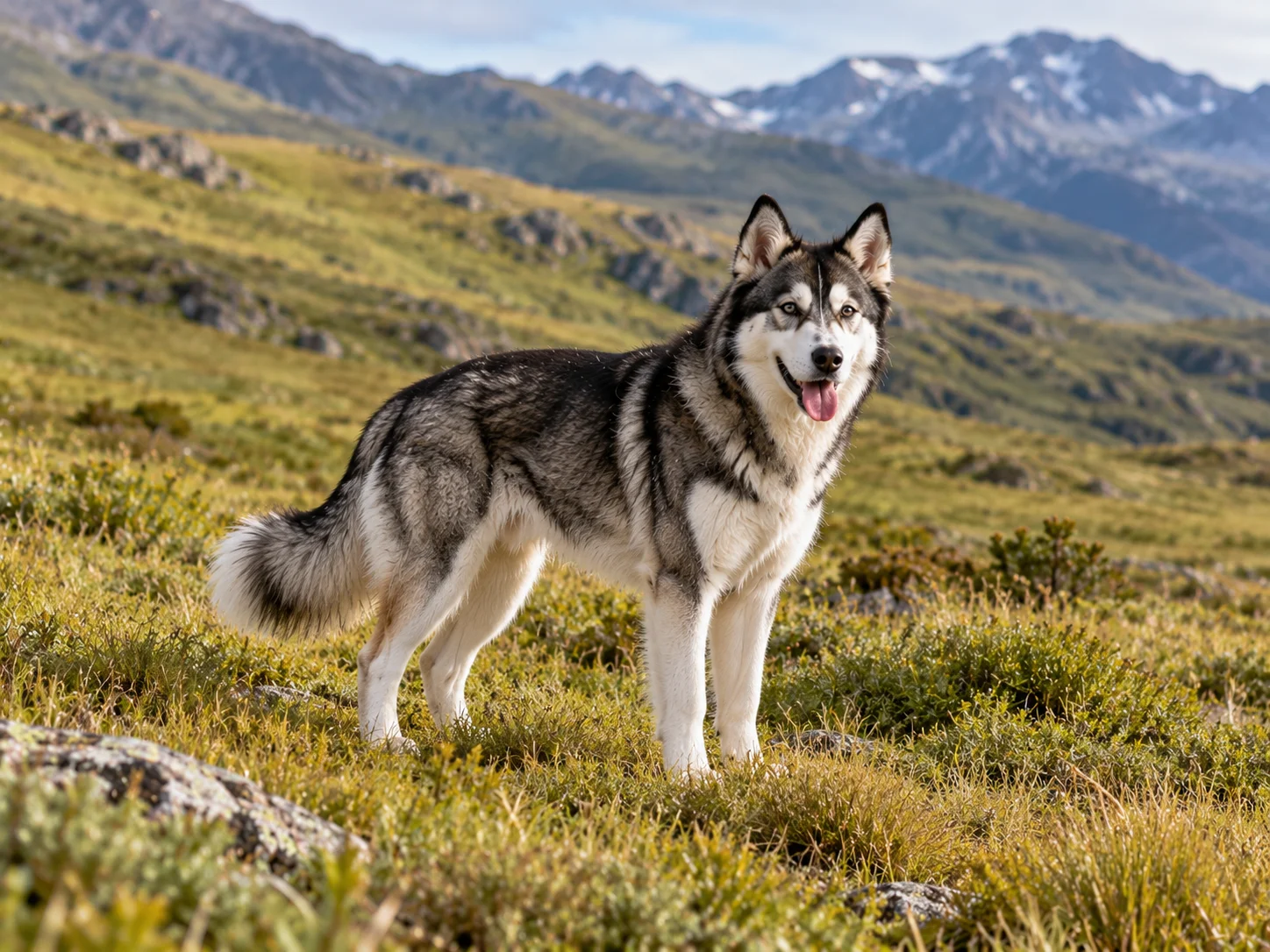
Aluskies stand 20 to 28 inches at the shoulder and weigh 60 to 100 pounds (27 to 45 kg), with a wide range because the parent breeds differ so much in size.
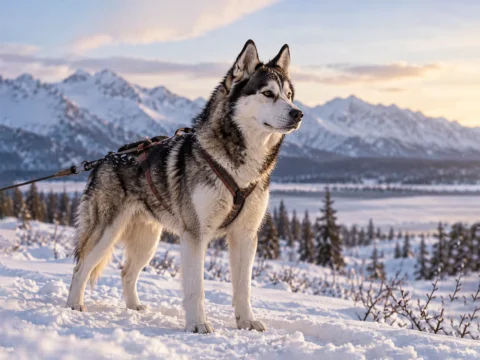
- Coat. A dense double coat, with a woolly undercoat under a coarse weather-shedding outer layer. Gray, black, white, sable, red and combinations.
- Eyes. Brown, blue, amber, or one of each. Heterochromia comes from the husky side and has no bearing on the dog’s vision or health.
- Tail. Plumed, carried over the back or curled.
- Ears and muzzle. Erect ears and a wolf-like face, which is most of why people want one.
That coat is built for Arctic cold and is a real liability in heat. An alusky in a hot climate needs shade, water and air conditioning, and should never be exercised in the middle of a hot day.
Temperament and Behavior
Aluskies are affectionate, people-oriented and playful, and they genuinely love their families. That is the appeal, and it is real.
The difficulties are equally real and should be stated without softening:
- They run. Both parent breeds were bred to run for hours, and an alusky off-leash in an unfenced space will often simply go. Recall is unreliable in these lines, and that is a trait, not a training failure.
- They escape. They climb fences, dig under them and open gates. A secure yard means a tall fence with a dug-in base.
- They have high prey drive. Cats, rabbits and small dogs are at genuine risk.
- They are vocal. Not much barking, but howling, and the husky side produces the talking noise people film and neighbors do not enjoy.
- They are independent. They understand what you want and decide whether it is worth doing. Harsh correction backfires.
- They dig. Instinctively, and comprehensively.
They also do badly alone. These are dogs from cultures where they lived and worked in groups, and an alusky left by itself all day becomes destructive, noisy and miserable.
Diet and Feeding
Like all dogs, the alusky is an omnivore in practice, with a diet built around quality animal protein.
An adult typically eats 3 to 5 cups of good dry food a day, split into two meals rather than one, since both parent breeds are deep-chested and a single large meal raises bloat risk.
Interestingly, northern sled breeds are often efficient eaters and need less food than their size suggests, so overfeeding is a common mistake.
Large-breed puppies should grow slowly on a formula made for them, because fast growth strains developing joints in a dog already at risk of hip dysplasia.
Grooming and Care
Brushing two or three times a week most of the year, and daily for the few weeks twice a year when the undercoat comes out.
The shedding is genuinely extreme. These dogs blow their coat in clumps, and the volume surprises people who have only owned short-coated dogs. If that is unacceptable, this is the wrong dog.
Never shave the coat. The double coat insulates against heat as well as cold, and shaving damages the regrowth and leaves the dog worse off in summer, not better.
Exercise is the central requirement: two hours a day minimum, and not a gentle stroll. Running, hiking, canicross, bikejoring, sledding or skijoring all suit them, and a bored alusky will remodel your house. Mental work matters too, since a dog bred to make decisions needs something to think about.
Health and Life Span
Aluskies live 10 to 15 years, which is good for a dog of this size.
Conditions to watch for, inherited from either parent breed, include hip and elbow dysplasia, progressive retinal atrophy, cataracts, hypothyroidism, bloat, zinc-responsive dermatosis, which is specifically associated with northern breeds, and in malamute lines a form of inherited dwarfism called chondrodysplasia.
Because there is no breed standard and no registry, there is no breed-wide health scheme either. That makes the individual breeder the only safeguard, and the questions to ask are specific: hip and elbow scores for both parents, eye certification, thyroid testing, and the genetic test for chondrodysplasia if there is malamute in the line.
A breeder who cannot produce those results is selling a cross of two large breeds with no health information at all.
Is an Alusky Right for Your Family?
For a small number of households, yes, and for most, no.
An alusky suits someone who is already very active and wants a companion for it, who has a securely fenced yard, who lives in a cool or temperate climate, who is home for much of the day or can take the dog along, who has experience with independent working breeds, and who can live with heavy shedding and howling.
It is a poor choice for a first-time owner, for an apartment, for a hot climate, for a home with cats or small pets, for anyone out at work all day, and for anyone who chose the dog because of how it looks.
That last point deserves emphasis, because it is the whole reason this page is worth writing carefully. Husky-type dogs are among the most frequently surrendered dogs in rescue centers across the United States and Britain, and the reasons given are almost always the same: too much energy, escaping, howling, and shedding. All of it was predictable before the dog was bought.
The Alusky’s Place Among Dogs
Both of the alusky’s parents are among the oldest and most consequential working dogs in human history. The Chukchi and Mahlemiut peoples bred them for survival in places where a dog team was the difference between reaching help and not.
The most famous demonstration is the 1925 serum run to Nome, when relay teams of sled dogs carried diphtheria antitoxin 674 miles through an Alaskan winter in about five and a half days. Balto got the statue; Togo and his driver Leonhard Seppala covered the longest and most dangerous leg, including a crossing of unstable sea ice, and Togo is the dog mushers themselves generally name.
That is the inheritance sitting in an alusky’s legs. It is a dog descended from animals selected for the ability to keep going, in the cold, for days, and it is now frequently bought to live in a warm suburb and wait at home while everyone is out.
Taken on by the right household, an alusky is a magnificent dog. The problem has never been the animal.