
Meet the Akita
Hachiko met his owner at Shibuya Station in Tokyo every evening. In May 1925 the man, a professor named Hidesaburo Ueno, died at work and did not come home.
The dog went back to the station. He kept going back, at roughly the same time each day, for nine years and nine months, until he died there in March 1935.
Hachiko was an Akita, and if you want to understand the breed, that story is not sentimental decoration. It is the temperament.
Scientific Name and Classification
The Akita is a breed of domestic dog, Canis familiaris, not a separate species. Every breed from the chihuahua to the Akita is the same animal.
- Kingdom: Animalia
- Phylum: Chordata
- Class: Mammalia
- Order: Carnivora
- Family: Canidae
- Species: Canis familiaris
The Akita belongs to the spitz group, the northern dogs with thick coats, prick ears and curled tails, and DNA work puts it among the breeds genetically closest to the wolf, along with the shiba inu and the husky types.
Officially there are now two Akitas: the Japanese Akita Inu and the American Akita, recognized as separate breeds by most of the world’s kennel clubs since 1999, though the United States still treats them as one.
Hachiko, and How the Akita Was Saved Twice
Hachiko became famous in his own lifetime. A former student of Ueno’s published articles about him, commuters fed him, and a bronze statue was raised at Shibuya in 1934 with the dog himself present at the unveiling. He is buried beside Ueno, and the statue there now, a 1948 replacement, is one of Tokyo’s best-known meeting spots.
It is worth saying honestly that nobody knows what Hachiko understood. Dogs are creatures of routine and place, and the loyalty reading is a human one. But nine years is a long time for routine alone, and the behavior itself is not in doubt.
The breed came close to disappearing twice. In the early 1900s crossing with imported fighting dogs had nearly erased the original type, and a preservation society was founded in 1927; in 1931 the Akita became one of Japan’s designated natural monuments.
Then came the Second World War. Food was desperately short, dogs were requisitioned for their fur, and almost the entire population was lost. A handful of Akitas survived in remote mountain villages, and the modern breed descends from those few.
The American line began with Helen Keller. She visited Akita Prefecture in 1937, was given a puppy named Kamikaze-go, and brought the first Akita to the United States. After the war, returning servicemen brought back the larger, heavier dogs they had seen, and those became the American Akita.
Origin and History
The Akita comes from Akita Prefecture in the mountains of northern Honshu, Japan, and the type goes back several centuries.
It was a hunting dog, used in pairs on Japanese black bear, and also on wild boar and deer. A dog bred to hold a bear at bay until the hunter arrives needs a specific combination of courage, independence and judgment, and the Akita still has all three.
For a period it was restricted to the nobility, with elaborate rules about how the dogs were kept and their handlers dressed. Later it was used for dog fighting, which is where the crossbreeding that nearly destroyed the type came from.
Today it is a companion and guardian, and in Japan a small Akita figure is still given as a wish for health and recovery.
Appearance and Anatomy
The Akita stands 24 to 28 inches at the shoulder and weighs 70 to 130 pounds (32 to 59 kg), with males at the top of both ranges.
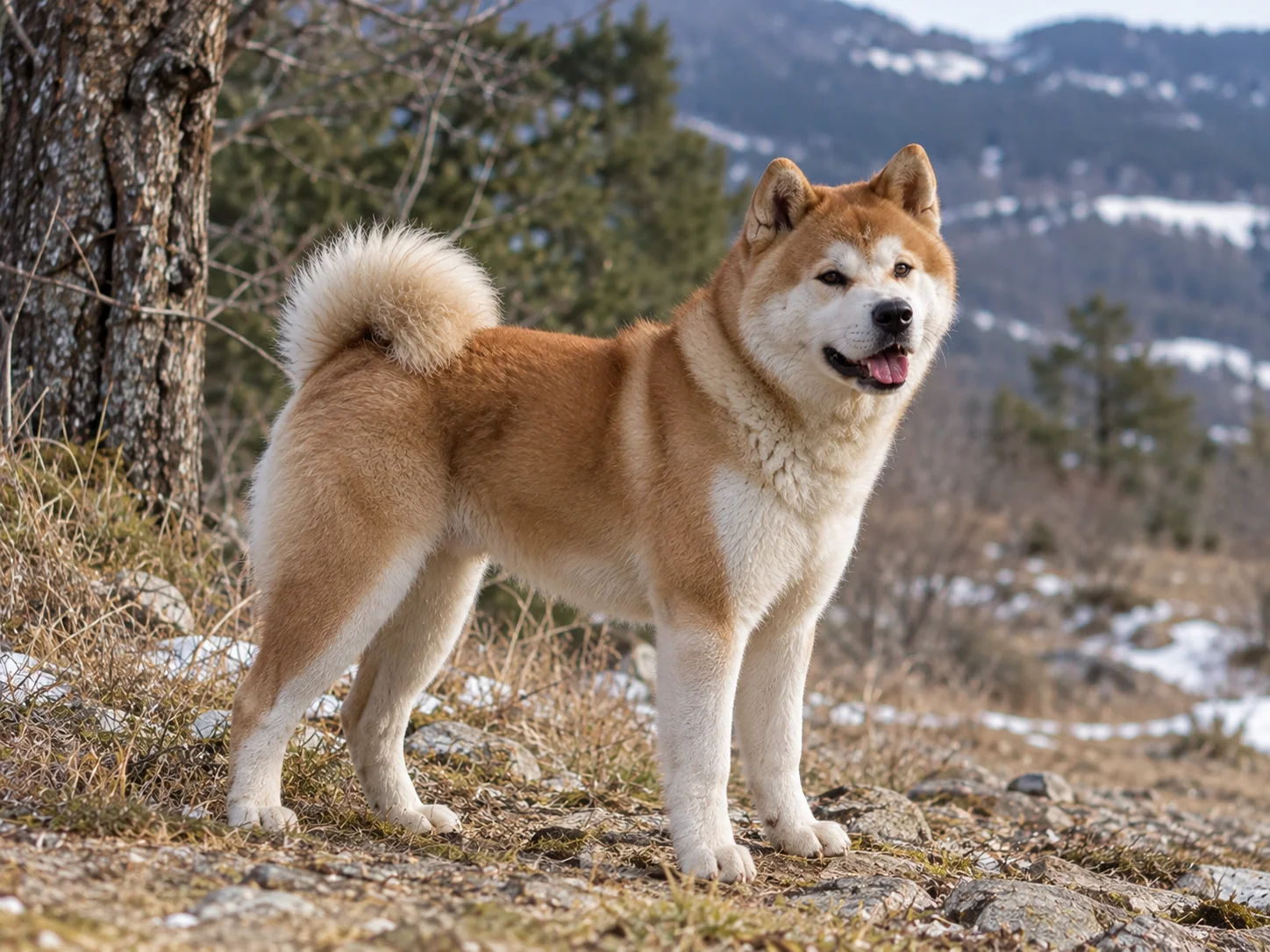
- Head. Broad and flat, often described as a blunt triangle, with small deep-set triangular eyes and small erect ears carried forward in line with the neck.
- Tail. Thick and curled over the back, a breed signature.
- Coat. Double, with a harsh straight outer coat and a dense woolly undercoat. Built for mountain winters.
- Feet. Webbed, with thick pads, good for snow.
- Color. The Japanese Akita allows only red, white, and brindle, always with the pale urajiro markings on the muzzle, chest and underside. The American Akita allows almost any color, including black masks, which the Japanese standard forbids.
The two types differ most in the head. The Japanese Akita has a fox-like face; the American is heavier and more bear-like.
Temperament and Behavior
The Akita is quiet, dignified and deeply attached to its own family, and quite reserved with everyone else.
Owners talk about it being catlike. Akitas are clean, often groom themselves, are easy to house-train, and are famously undemonstrative. An Akita will not pester you for attention; it will simply arrange to be in the same room.
It also barks very little, which means a barking Akita is worth looking into.
The difficult parts are real and should not be glossed over. Akitas are independent and were bred to make their own decisions, so they obey when they see the point. Many are intolerant of other dogs, particularly of the same sex. Prey drive toward cats and small animals is often high. They can be strongly protective of food and territory.
This is a dog that needs early, broad socialisation and calm, consistent handling from someone who knows what they are doing. Harsh correction goes badly with an Akita, and so does inconsistency.
Diet and Feeding
Like all dogs, the Akita is an omnivore in practice, though the diet should be built around good-quality animal protein.
An adult typically eats 3 to 5 cups of quality dry food a day, split into two meals. Split meals matter in a deep-chested breed, where one huge meal raises the risk of bloat.
Puppies need careful feeding. Growing a large-breed puppy too fast strains developing joints, so slow, steady growth on a large-breed puppy formula is better than a fat, fast-growing pup.
Akitas gain weight easily and often guard their food, so feeding somewhere quiet and separate is sensible, especially in a house with children or other animals.
Grooming and Care
Weekly brushing is enough most of the year. Twice a year it is not.
Akitas blow their undercoat in spring and fall, and for two or three weeks the amount of hair is genuinely startling, needing daily work with an undercoat rake. Anyone who cannot live with that should choose a different breed.
The double coat is insulation in both directions, so it should never be shaved. Shaving an Akita damages the coat and makes the dog less comfortable in heat, not more.
Exercise needs are moderate: 1 to 2 hours a day of walking, and a reliably secure yard. Akitas are strong, often dog-reactive, and quite capable of climbing or digging out, so an on-leash walk and a real fence are not optional.
They tolerate cold extremely well and heat poorly.
Health and Life Span
Akitas live around 10 to 14 years, which is good for a dog of this size.
Known problems in the breed include hip and elbow dysplasia, hypothyroidism, progressive retinal atrophy, autoimmune conditions including a thyroid disorder the breed is prone to, bloat, and sebaceous adenitis, a skin condition that is particularly associated with Akitas.
There is one practical fact every Akita owner should know: the breed often reacts badly to some anaesthetics and sedatives at standard doses. A vet who has worked with Akitas will adjust for it, and it is worth raising before any procedure.
Buy from a breeder who screens hips, elbows, eyes and thyroid, and can show you the results.
Is an Akita Right for Your Family?
Sometimes, and it depends more on the owner than on the dog.
An Akita suits an experienced owner who wants a calm, quiet, devoted companion and a natural guardian, who can commit to early socialisation and steady training, who has a securely fenced yard, and who can cope with heavy seasonal shedding and probably with being a one-dog household.
It is a poor choice for a first-time dog owner, for a home with several other pets or small animals, for anyone wanting an obedient dog that is friendly with everybody, or for anyone who will not supervise around visiting children. A 100-pound dog that is wary of strangers needs management, not optimism.
Insurance and local rules are worth checking too, since the Akita appears on some restricted-breed lists.
The Akita’s Place Among Dogs
Among the hundreds of dog breeds, the Akita sits at the ancient end: close to the wolf genetically, shaped for a hard job in a cold place, and never softened into easy obedience.
Its history is also a small case study in how fragile a breed is. Twice in one century the Akita came within a handful of dogs of vanishing, and it exists today because a few people in mountain villages hid theirs through a war.
And it remains the dog people think of when they think about loyalty, because of one animal who kept an appointment at a railway station for nine years with nobody to meet.