Meet the Xingu River Ray
Stingrays belong in the sea. This one lives in a river in Brazil, a thousand miles from salt water, and it has never been anywhere near the ocean. The Xingu river ray (Potamotrygon leopoldi) belongs to the Potamotrygonidae, the one family of stingrays that lives entirely in fresh water.
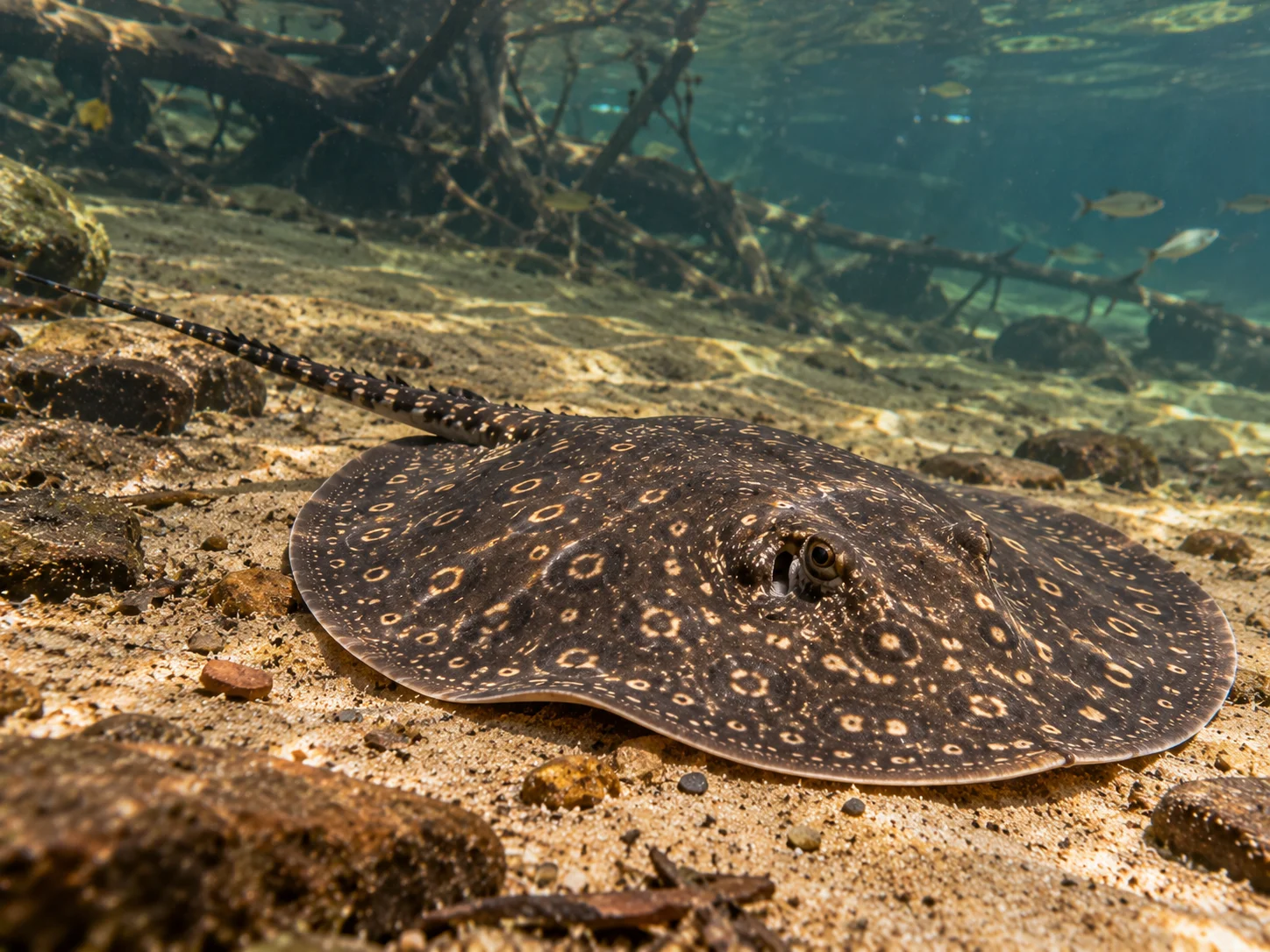
It is also one of the most striking fish in fresh water anywhere: a flat black disc scattered with white spots, like a night sky laid on the riverbed. Aquarium keepers call it the black diamond ray, and the pattern on every individual is different.
And it is found in exactly one place. The Xingu River ray lives only in the Xingu River basin, which means everything that happens to that one river happens to the whole species.
Scientific Name and Classification
The Xingu River ray is Potamotrygon leopoldi, also called the white-blotched river stingray.
- Kingdom: Animalia
- Phylum: Chordata
- Class: Chondrichthyes
- Order: Myliobatiformes
- Family: Potamotrygonidae
- Genus: Potamotrygon
- Species: Potamotrygon leopoldi
Chondrichthyes is the class of cartilaginous fishes, the group that holds every shark and ray. Like a shark, this animal has no true bones at all: its whole skeleton is built from cartilage, the flexible material in the tip of your nose.
Potamotrygonidae is the river stingray family, and it is the only stingray family that spends its entire life in fresh water. Its ancestors were sea rays that moved up South American rivers long ago and never went back.
Appearance and Anatomy
The body is a round, flattened disc reaching about 16 inches (40 cm) across, with a total length including the tail of up to 30 inches (75 cm). Weights of 44 pounds (20 kg) have been reported, and females grow larger than males.
- Deep black upper surface with large white or cream spots
- Pale to dusky underside
- Eyes raised on top of the disc
- Breathing holes (spiracles) behind the eyes
- Whip-like tail carrying one or more venomous spines
The eyes and spiracles sitting on top of the body are what let the ray bury itself and keep working. Buried in sand with only its eyes showing, it draws clean water in through the spiracles rather than sucking sand through its mouth, which is underneath.
The spots are more than decoration for the people who study them. The pattern is unique to each animal and stays stable as it grows, so researchers can identify individual rays the way you might identify a person by a fingerprint.
Habitat and Range
This ray is endemic to the Xingu River basin in Brazil, including the Xingu itself and the Fresco River. Endemic means it lives there and nowhere else on Earth.
It prefers clear water over rocky and sandy bottoms, in warm, slightly acidic conditions, typically 20 to 25 degrees Celsius (68 to 77 Fahrenheit). The Xingu is a clearwater river, which is part of why the species is so sharply patterned: there is light down there to see by.
A range that small is a risk in itself. A fish spread across a continent can lose a river and survive; a fish that has only one river has no spare.
Diet and Feeding
The Xingu River ray hunts at night and rests by day. Daylight hours are spent buried in sand; after dark it moves out over the bottom hunting invertebrates: insect larvae, crustaceans, worms and snails.
Its diet changes as it grows up, because its jaws do. Young rays take soft prey, and as the jaws strengthen an adult can crush hard-shelled animals that would be impossible for a juvenile, which means parents and pups are not competing for the same food.
The Sting
The tail carries a hardened spine connected to venom-producing tissue. It is a defensive weapon, not a hunting one, and the ray uses it when it is stepped on or grabbed.
River stingray stings are serious. They are intensely painful, cause swelling and sometimes tissue damage, infect easily, and have no specific antidote. Across the family they are occasionally fatal, usually where medical help is far away. In Colombia alone more than two thousand river stingray injuries are reported every year.
There is an odd twist in the venom. Its chemical makeup stays the same throughout the ray’s life, but it becomes less toxic as the animal ages, so a small young ray is, drop for drop, the more dangerous one.
None of this makes the ray aggressive. It is a shy fish that would far rather stay buried, and almost every injury happens because somebody did not see it there.
Reproduction and Life Cycle
River stingrays give birth to live young rather than laying eggs, and they feed their developing pups inside the body. Glands in the uterus produce a rich fluid, sometimes called uterine milk, which the embryos absorb, a system much closer to a mammal’s than to most fish.
Across the family, pregnancy runs anywhere from three months to a year and litters range from a single pup to twenty-one, with breeding timed to the flooding and falling of the rivers. The details for this particular species are still poorly known.
Pups arrive as miniature adults, fully formed, already spotted, already armed, and able to feed themselves at once. Growth is slow, and the average time between one generation and the next is estimated at around eleven years.
Conservation Status
The IUCN lists the Xingu River ray as Vulnerable, and three pressures sit behind that.
The first is the aquarium trade. A striking, rare, hard-to-obtain fish attracts high prices, and collecting pressure on a species with one small range adds up quickly. Brazil has placed river stingrays on CITES Appendix III, which requires export paperwork and makes illegal shipments easier to trace.
The second is the river itself. Dams on the Xingu change how much water flows, where it flows and when, and a fish adapted to clear water over rock and sand does badly when that becomes still, silty reservoir.
The third is arithmetic. Slow growth, small litters and roughly eleven years between generations mean this ray cannot replace losses quickly. A species like that can look fine for years and then fall away sharply, which is exactly why a Vulnerable listing arrives before the obvious crash.
Role in the Ecosystem
As a night-hunting bottom feeder, the Xingu River ray keeps invertebrate numbers in check across the riverbed and turns over the sand as it buries and feeds, mixing the sediment that other river life depends on.
It sits near the top of its own small world too. An adult has few predators beyond large fish, a crocodile relative such as the caiman, or an anaconda, and its spine is the reason most of them leave it alone.
Mostly, though, it is a measure of one river. The Xingu River ray cannot move house if the Xingu changes, and that makes it one of the clearest tests of whether a single Amazon tributary is still working as it should.