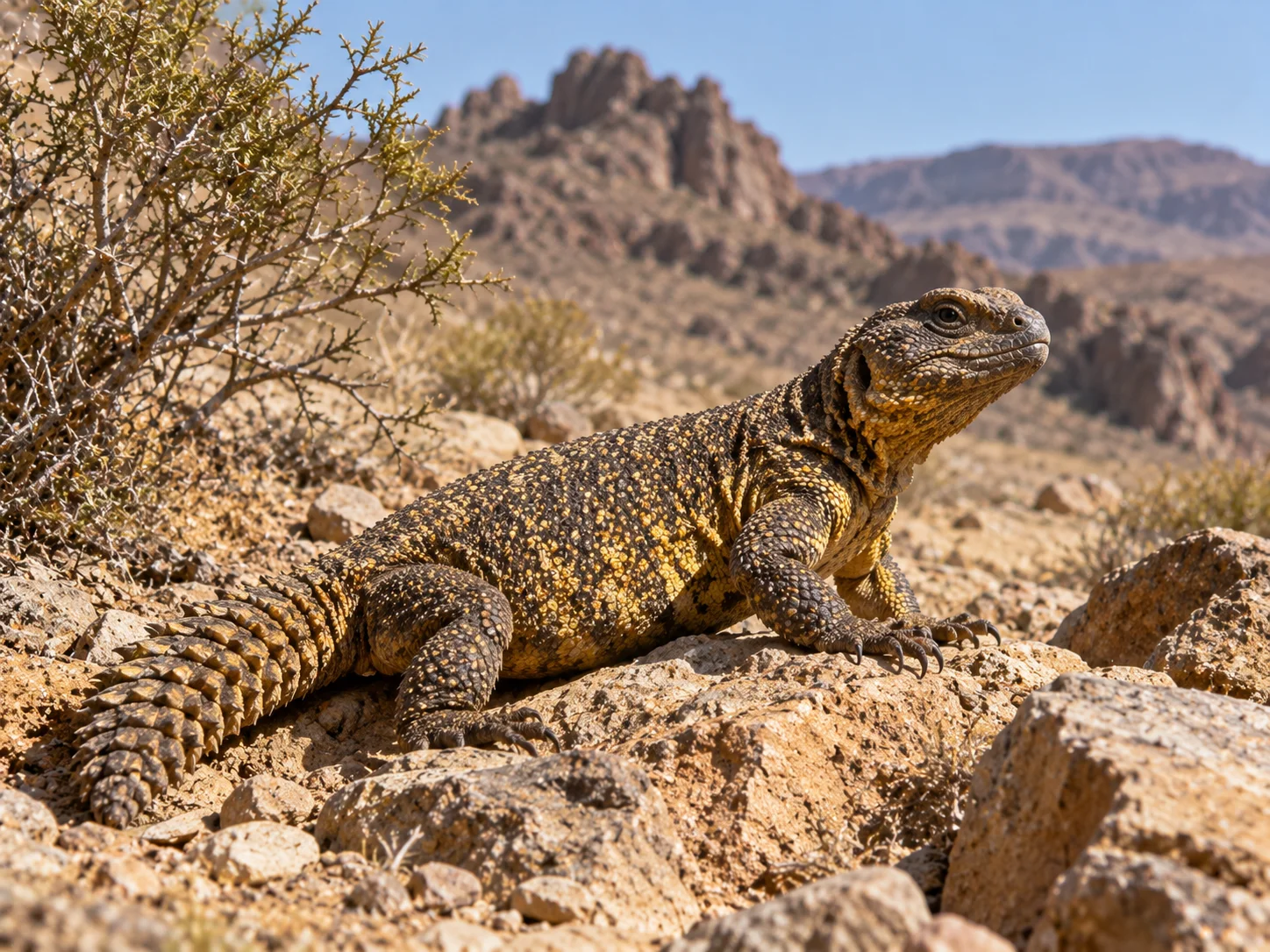
Meet the Uromastyx
Almost every lizard is a hunter. It eats insects, or other lizards, or whatever small animal it can catch and swallow.
The uromastyx eats plants. It spends its days cropping leaves, flowers and seeds in some of the driest country on Earth, and it does it without drinking. The water comes out of the vegetation.
It also sleeps with the door shut. A uromastyx backs into its burrow tail first, leaving a thick club of spines blocking the entrance, so anything that wants to follow it in has to get past the hardest part of the animal.
Scientific Name and Classification
Uromastyx is a genus of about fifteen spiny-tailed lizards, also called dabb lizards, found across North Africa and the Middle East.
- Kingdom: Animalia
- Phylum: Chordata
- Class: Reptilia
- Order: Squamata
- Family: Agamidae
- Genus: Uromastyx
The name comes from Greek: oura for tail and mastix for whip. Agamidae is the family that also holds the agama lizard and the frilled lizard, a group of mostly insect-eating lizards in which the uromastyx is the vegetarian outlier.
A Lizard That Eats Plants
Plant food is hard work. It is low in energy, tough to break down, and needs a long gut and a population of microbes to ferment it, which is why most plant-eaters are large, warm-blooded, or both.
A uromastyx solves it with heat and bacteria. It basks until its body temperature is high enough to run the fermentation in its gut, then processes a meal slowly over hours. Adults take leaves, flowers, seeds and dry vegetation, and they will eat insects occasionally. Young animals do so more often than adults, because growing bodies need the protein.
Getting the microbes in the first place takes a strange step. Hatchlings eat their mother’s droppings. It is the only reliable way to seed a gut with the bacterial community needed to digest desert plants, and without it a young uromastyx cannot process its own diet.
Appearance and Anatomy
Size depends heavily on species. The smallest, U. macfadyeni, reaches about 10 inches (25 cm). The Egyptian uromastyx, U. aegyptia, is the giant of the genus at 36 inches (91 cm) or more. Hatchlings emerge at 3 to 4 inches (7 to 10 cm) and weigh only a few grams.
- Heavy club tail ringed with rows of hard spines
- Flattened body and short, powerful digging limbs
- Blunt head with small teeth, fused in the upper jaw
- Color that shifts with temperature
- Strong claws for excavating burrows
The tail is the defining feature and the whole defensive strategy. It is thick, muscular and ringed with whorls of hard spines, and a cornered uromastyx will swing it at an attacker with real speed while hissing and gaping to show its teeth.
Habitat and Range
Uromastyx live across most of North and northeastern Africa and through the Middle East as far east as Iran, from sea level to above 900 meters (3,000 ft).
They need two things: rock or firm ground they can dig into, and enough vegetation within reach to feed on. Hilly, stony country suits them better than open sand, and a burrow is rarely far from a feeding patch.
The burrow is the center of everything. It runs several feet back into the ground, stays far cooler than the surface through the day and far warmer at night, and the lizard retreats to it whenever the temperature or a predator makes the open ground unwise.
Diet and Feeding
The diet is overwhelmingly plant material: leaves, flowers, seeds and the dry remains of desert vegetation, taken in bulk during the hours when the animal is warm enough to digest.
Water is the quiet achievement. Across much of the range there is no standing water for months, and a uromastyx does not need any. It extracts what it needs from its food and loses very little, excreting waste as near-dry salts rather than liquid urine.
Behavior and Lifestyle
A uromastyx changes color with temperature, and the reason is physics rather than mood. In cool weather it is dull and dark, because dark surfaces absorb more sunlight and warm faster. As it heats up it pales, sometimes dramatically, and the lighter color reflects heat away once enough has been taken on.
The daily routine follows that. The animal emerges in the morning, basks until it reaches working temperature, feeds, retreats underground through the worst of the afternoon heat, and often comes out again before dusk.
At night, or at the first sign of danger, it goes into the burrow tail first. The spined club fills the tunnel mouth, and a predator trying to dig one out meets armor rather than anything soft.
Reproduction and Life Cycle
Females lay between 5 and 40 eggs depending on species and age, about 30 days after mating, usually in a chamber dug off the main burrow. Incubation takes 70 to 80 days.
Hatchlings are independent immediately, apart from the need to acquire gut bacteria. They grow slowly, and the genus is remarkably long-lived for its size: well-kept animals pass 25 years routinely, and lifespans approaching 60 have been reported.
Predators and Threats
Birds of prey are the main natural danger, along with foxes, monitor lizards and large snakes. The burrow and the tail together are the answer to most of them, and a uromastyx that reaches its tunnel in time is usually safe.
The pressure that matters now is collection. Uromastyx are taken from the wild in large numbers for the international pet trade and for use in traditional medicine. In Morocco this continues largely unregulated despite legal protection, and animals are frequently sold in crowded, poor conditions.
Habitat loss adds to it. Overgrazing by livestock strips the vegetation these lizards depend on, and because they are slow-growing and long-lived, populations replace losses slowly.
Conservation Status
With around fifteen species, the genus carries no single conservation status. Individual species are assessed separately, and their situations differ widely depending on range size and how heavily they are collected.
Trade is the common thread. International controls limit commercial export of uromastyx, and the practical question in most range countries is whether those controls are enforced on the ground. Captive breeding has reduced demand for wild animals in some markets, which is the most promising development for the genus as a whole.
Role in the Ecosystem
As one of the few sizeable plant-eaters in true desert, a uromastyx moves energy from vegetation into the animal food web. It is how a hawk or a fox indirectly eats a desert shrub.
Its burrows outlive it, too. Abandoned tunnels are used by insects, scorpions, small mammals and other reptiles, so a population of uromastyx quietly supplies shelter to a whole community in country that offers almost none.
And the oddity is worth keeping hold of. In a family of hunters, on ground that supports almost nothing, this lizard makes its living on leaves, drinks nothing at all, and shuts the door behind it with its own tail.