
Meet the Urial
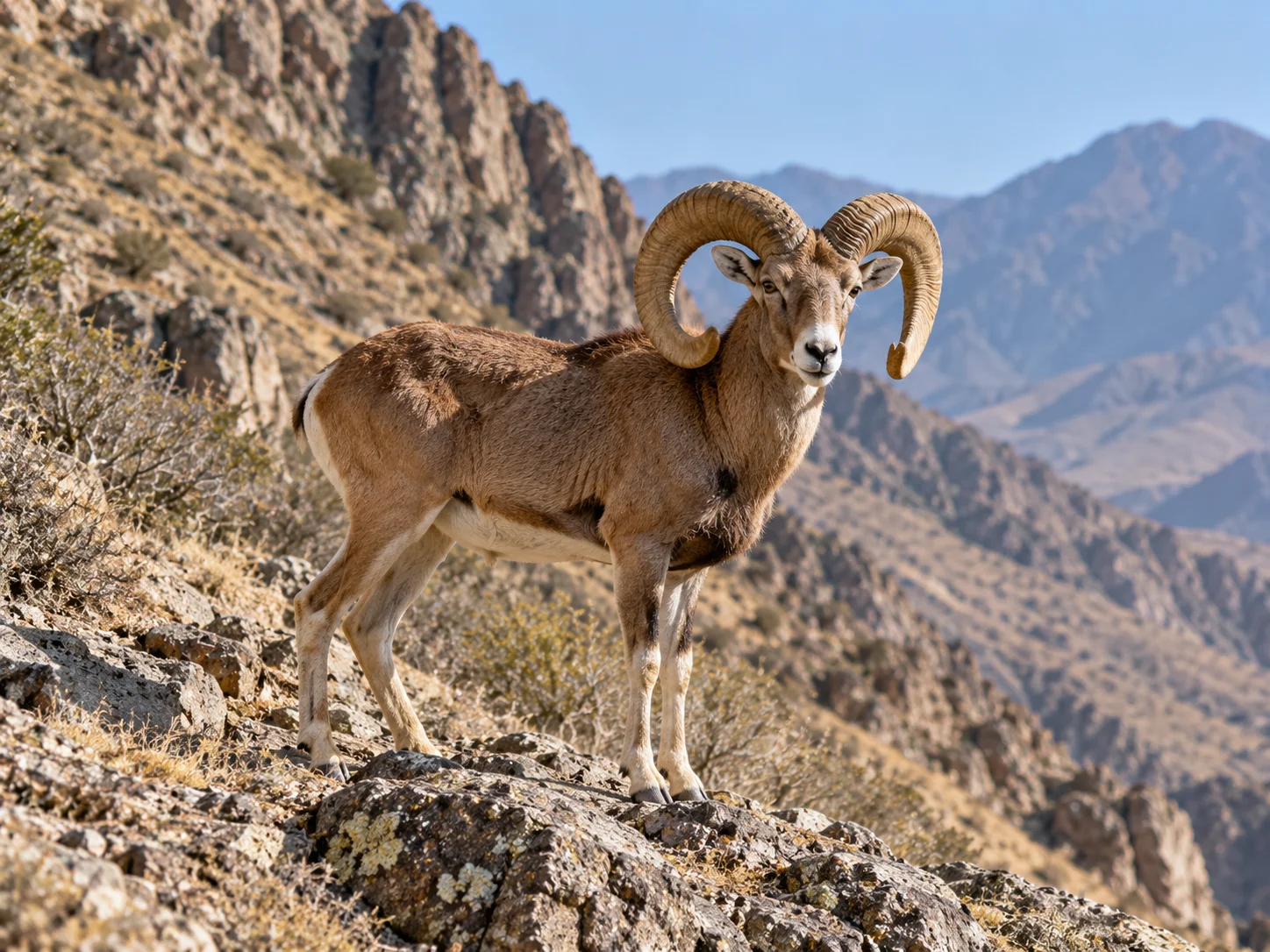
The urial is a wild sheep of the mountains of central and southern Asia, and the rams wear something no domestic sheep has: a long bib of dark hair hanging from the throat and chest, like a beard worn on the front of the neck.
Above it curl the horns, which in a mature ram can run to more than three feet along the outside of the curve. They are the animal’s whole argument during the rut, and the reason it has been hunted for as long as people have lived in those mountains.
It is also a close relative of the animal in every field in Europe. The urial sits near the base of the family tree that produced the domestic sheep, and working out exactly where has kept zoologists arguing for a century.
Scientific Name and Classification
The urial is Ovis vignei, one of the wild sheep in the genus Ovis.
- Kingdom: Animalia
- Phylum: Chordata
- Class: Mammalia
- Order: Artiodactyla
- Family: Bovidae
- Species: Ovis vignei
Six subspecies are generally recognized, spread across the mountain ranges from Iran to Ladakh: the Ladakh urial, the Transcaspian, Blanford’s, the Bukhara, the Afghan and the Punjab urial. Some authorities still file the whole group inside the domestic sheep’s species instead, which is a fair sign of how unsettled the question is.
Urial and the Ancestry of Domestic Sheep
Domestic sheep descend from wild sheep of the Near East, and for a long time the urial was treated as one of the likely ancestors. The modern view puts the mouflon at the center of that story, with the urial as a close relative rather than a direct forebear.
The evidence that complicates it is in the chromosomes. Wild sheep do not all carry the same number, and urials differ from mouflons and from one another across their range. Animals with different counts can still interbreed where their ranges meet, but their offspring are often less fertile, which is exactly the sort of messy boundary that makes species hard to draw.
For anyone looking at a urial on a hillside, the practical point is simpler. This is roughly what a sheep looks like when nobody has bred it for wool: lean, long-legged, fast over rock, and carrying a coat that sheds rather than grows indefinitely.
Appearance and Anatomy
Rams stand about 31 to 35 inches (80 to 90 cm) at the shoulder and weigh roughly 80 to 190 pounds (36 to 87 kg), with ewes at around half to two thirds of that. The coat is reddish-brown, fading paler in winter, with white underparts and dark legs.
- Long dark ruff of hair on the throat and chest of mature rams
- Heavy curling horns reaching up to 39 in (100 cm) in rams
- Short, compressed horns in ewes
- Reddish coat that sheds to a paler winter one
The horns are the obvious feature, sweeping back and down and then curling forward near the tips. They keep growing throughout life and carry ridges that record the animal’s seasons, so a ram’s horns are a rough record of the years he has survived.
Habitat and Range
Urials live in the mountains of central and southern Asia, through the Pamirs, the Hindu Kush and the western Himalaya, from northeastern Iran and Turkmenistan across Afghanistan, Tajikistan and Uzbekistan to northern Pakistan and Ladakh in India.
They prefer gentler ground than the wild goats that share those ranges, favoring grassy slopes, open woodland and arid country with sparse vegetation, and they climb to 4,500 meters (14,800 ft) where the terrain allows. That preference for gentler, lower ground is part of why they have suffered: it is the same ground people graze livestock on.
Diet and Feeding
Urials are grazers first, taking grasses wherever they grow, and switch to browsing shrubs and leaves when grass is scarce. In the driest parts of the range that switch is what carries them through summer.
Like all sheep they are ruminants, fermenting tough plant material in a four-chambered stomach and chewing the cud to break it down further. It is a slow way to eat, and it means a urial spends much of the day either feeding or lying up digesting.
Behavior and Lifestyle
Ewes and young live in herds, while rams form their own bachelor groups for most of the year and join the females only for the rut. Herd sizes shift with the seasons and with how much grazing a slope can support.
During the rut the rams fight by rearing onto their hind legs and driving down into each other, horns first. The sound carries a long way across a valley. Thick skull bone and the mass of the horn bases absorb the impact, and contests are usually settled without serious injury.
They are wary animals and run uphill when disturbed, which is the opposite of what most grazing animals do and makes them hard to approach in open country.
Reproduction and Life Cycle
Gestation lasts about five months, and lambs arrive between April and June when the new grass is coming through. One lamb is usual and twins are uncommon.
Lambs are on their feet within hours, which matters on open ground with no cover to hide in. They stay with the ewe through their first year. Rams take several years to grow horns heavy enough to compete for mating, so a young male may be fully grown long before he gets to breed.
Predators and Threats
Snow leopards and wolves are the main natural predators, with leopards taking urials at lower elevations and eagles occasionally taking lambs.
The larger pressures are human. Urials are hunted for meat and for their horns, and because they favor accessible lower slopes they are easier to reach than the wild goats above them. Domestic herds compete for the same grazing and can pass on disease, and roads and fences cut the range into smaller pieces that separate populations from one another.
Conservation Status
The IUCN lists the urial as Vulnerable, with numbers falling. Some subspecies are in considerably worse shape than the species as a whole, and a few survive in populations small enough to be lost to a single bad season or a burst of hunting.
Where conservation has worked it has usually involved the communities that share the range. Managed trophy hunting programs in parts of Pakistan and Tajikistan return a large share of the fee to the local village, which turns a wild sheep from a competitor for grazing into an asset worth protecting. The approach is argued over, but urial numbers have risen in several of the areas that use it.
Role in the Ecosystem
Urials are the main large grazer across much of their range, and they are a staple prey animal for snow leopards and wolves. Where urial numbers collapse, those predators turn more often to livestock, which puts them straight into conflict with herders and usually ends badly for the predator.
That makes the urial more important than its profile suggests. It is not a famous animal, and it has none of the charisma of the cats that hunt it. But keeping enough wild sheep on the hillside is one of the more reliable ways to keep a snow leopard away from somebody’s goats.