Meet the Vampire Bat
Out of more than 1,400 kinds of bat in the world, only three live on blood. The common vampire bat is the famous one.
It is the only mammal anywhere that eats nothing else. Every other blood-drinker you can think of is an insect or a leech; among animals with fur and warm blood, this diet belongs to three species of bat and no one else.
And the reputation is mostly wrong in an interesting direction. The vampire bat is not a monster that drains its victims (it drinks a spoonful or so from a sleeping cow), but it is one of the few animals known to share food with a hungry neighbor and expect the favor returned later.
Scientific Name and Classification
This page is about the common vampire bat, Desmodus rotundus, the only living species in its genus.
- Kingdom: Animalia
- Phylum: Chordata
- Class: Mammalia
- Order: Chiroptera
- Family: Phyllostomidae
- Genus: Desmodus
- Species: Desmodus rotundus
The other two blood-feeders are the hairy-legged vampire bat and the white-winged vampire bat. All three live in the Americas, and all three sit in a family, Phyllostomidae, the leaf-nosed bats, whose other members eat fruit, nectar and insects. Blood is the exception even among close relatives.
Appearance and Anatomy
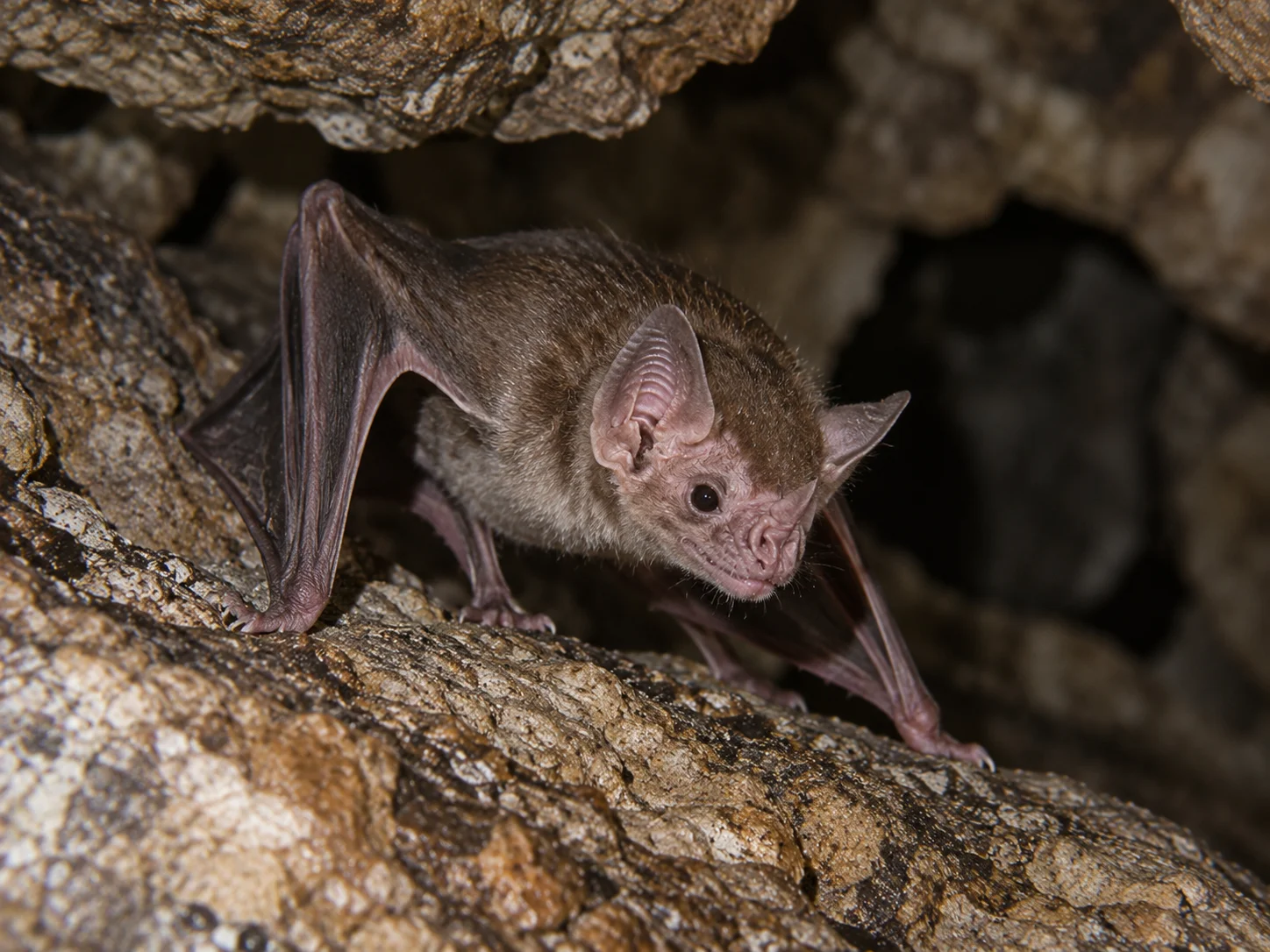
A vampire bat is a small animal. Head and body run about 3 to 3.5 inches (7 to 9 cm), the wingspan is 14 to 16 inches (35 to 40 cm), and a bat weighs roughly 0.5 to 1.8 ounces (15 to 50 g), though that can jump sharply straight after a meal.
- Short gray-brown fur, paler underneath
- Pointed ears and a small, flat, pad-like nose
- Heat sensors in the nose for finding blood vessels
- Razor-edged front teeth with no enamel on the cutting edge
- Strong thumbs and sturdy hind legs for moving on the ground
Two features make the diet possible. The nose carries heat-sensing pits that read warmth through skin, so the bat can find exactly where a blood vessel runs close to the surface before it ever bites. And the upper front teeth are so sharp, and so free of enamel at the edge, that the cut they make is often not felt at all.
Then there is the saliva, which contains an anticoagulant, a substance that stops blood clotting. It has been named draculin, and it keeps the wound flowing while the bat drinks.
A Bat That Runs
Most bats are close to helpless on a flat surface. The vampire bat is not: it can walk, run and jump on the ground, and it does so often.
Its running gait is unlike anything else in the animal world, because the push comes from the front limbs rather than the back. The bat vaults along on its folded wings, using the thumbs as feet, and can spring off the ground in almost any direction.
That ability is the point of the whole design. A bat feeding on a large sleeping animal has to land nearby, approach quietly across open ground, climb onto its host, and get away fast if the host wakes, none of which an ordinary bat could do.
Habitat and Range
Common vampire bats live from Mexico through Central America and across much of South America, as far south as Uruguay, northern Argentina and central Chile, with populations on Trinidad and Margarita.
They roost in caves, hollow trees, old wells, mines and abandoned buildings, usually in colonies of 20 to 100 animals, though roosts of several thousand have been recorded. A single cave can hold dozens of other bat species alongside them.
They hunt at night and will travel 3 to 5 miles (5 to 8 km) from the roost to feed, finding their way by echolocation and smell.
Diet and Feeding
The diet is blood, and in most places that means livestock. Cattle and horses are the usual hosts, and the bats appear to prefer farm animals to wild ones, which are harder to approach.
A feeding bat lands near its host, walks to a spot with blood close to the skin, makes a small cut and laps; it does not suck. It will stay for twenty or thirty minutes, and takes so little that a cow is generally none the worse for it.
Blood is a poor food in one respect: it is mostly water. A bat has to process a great deal of liquid to extract any nourishment, so it begins urinating almost as soon as it starts drinking, shedding water while it is still at the wound in order to carry the useful part home.
The margin is thin. A vampire bat that misses two nights of feeding is in serious danger of starving, which is the key to the most remarkable thing about them.
Vampire Bats Share Food
Reproduction and Life Cycle
Females breed through the year, with a peak in the rainy season, and carry a single pup for about seven months, a very long pregnancy for an animal this small.
The pup takes milk for its first month, then starts on blood its mother brings back, and becomes independent at around five months. Mothers raise their young largely alone and call to them on returning to the roost.
Wild bats may reach about 12 years, and captive females have averaged close to 20, long lives that give those roost friendships time to matter.
Vampire Bats and People
The real concern is not blood loss but disease. Vampire bats can carry rabies, and in parts of South America they pass it to cattle, which is a genuine problem for farmers and the main reason the species is treated as a pest.
Bites on people are uncommon, since livestock are easier targets. Anyone who wakes to find a bat in the room should seek medical advice all the same, because the cut is small enough to sleep through, and young children in particular may not wake at all.
One footnote is worth knowing. The anticoagulant in vampire bat saliva has been studied as the basis for drugs to treat strokes, because something that keeps blood moving is exactly what a blocked vessel needs.
Conservation Status and Role in the Ecosystem
The IUCN lists the common vampire bat as Least Concern. It is widespread, adaptable, and if anything it has benefited from people: every cattle ranch is a reliable food supply that did not exist before.
That success has a cost for other bats. Culling programs aimed at vampire bats often destroy whole roosts, killing fruit-eating and insect-eating species, pollinators and pest controllers like the tiny bumblebee bat‘s relatives, none of which were doing any harm at all.
Which leaves the vampire bat in an odd position: an animal with a terrifying name that takes a spoonful of blood and gives food to its friends, and whose worst effect on the world may be the damage done by people trying to get rid of it.