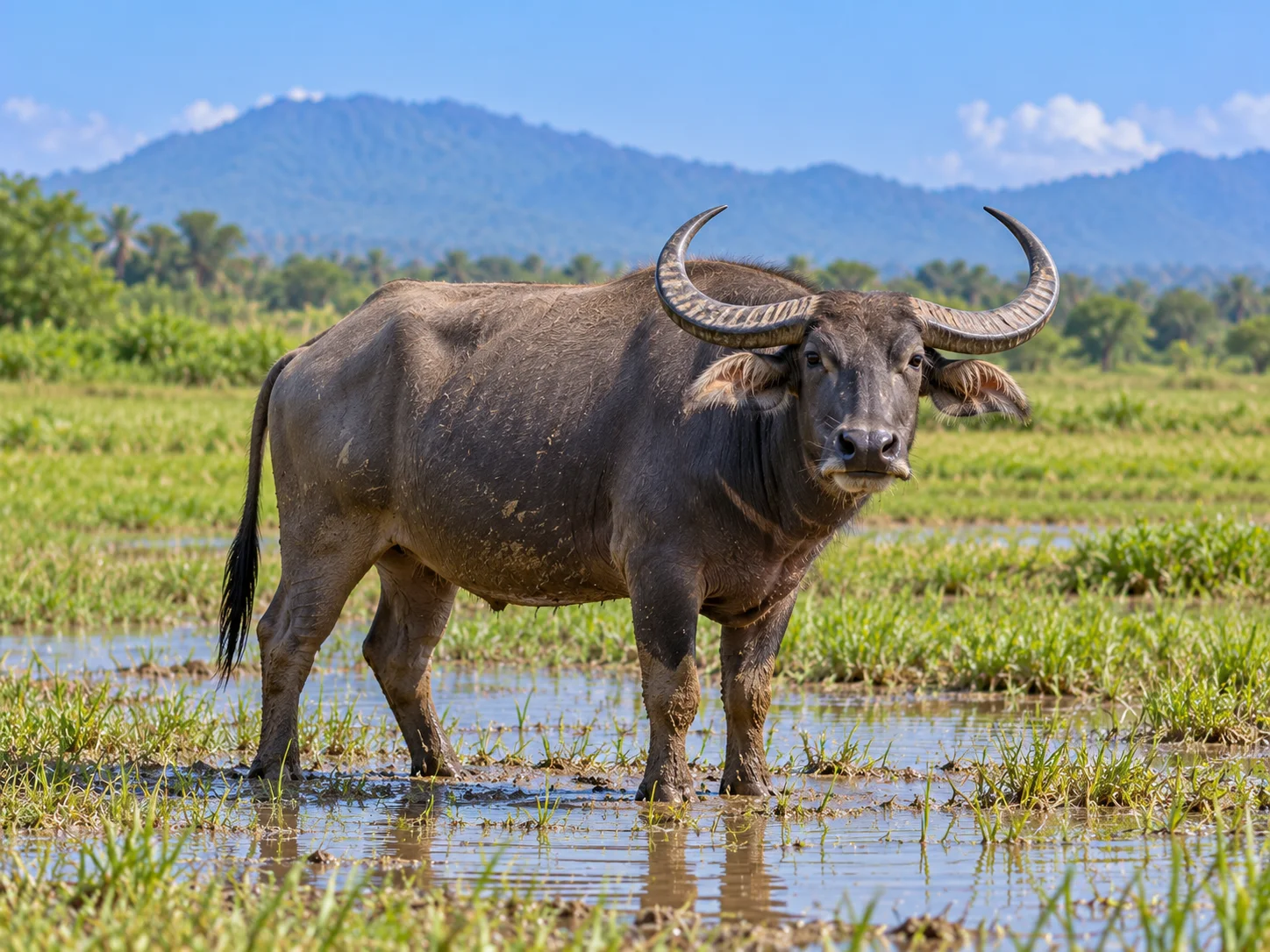
Meet the Water Buffalo
Around half the world’s population depends on rice, and for thousands of years the animal that made rice farming possible was the water buffalo.
Its wide splayed hooves let it work in flooded paddy fields where a tractor would sink and an ox would struggle. People call it the living tractor of Asia, and roughly 200 million of them are alive today.
Its milk matters too. Water buffalo milk is far richer than cow’s milk, and real mozzarella is made from it.
Scientific Name and Classification
The domestic water buffalo’s scientific name is Bubalus bubalis. Its wild ancestor, the wild water buffalo, is usually written Bubalus arnee.
- Kingdom: Animalia
- Phylum: Chordata
- Class: Mammalia
- Order: Artiodactyla
- Family: Bovidae
- Genus: Bubalus
- Species: Bubalus bubalis
Domestic water buffalo come in two main types. River buffalo, found from India westward, have tightly curled horns and are kept mainly for milk. Swamp buffalo, found across Southeast Asia and China, have wide swept-back horns and are kept mainly for work.
They are relatives of cattle but not the same animal, and the two cannot interbreed.
Difference Between Water Buffalo, Cape Buffalo and Bison
Three large bovines get called buffalo, and only one of them should be.
| Water buffalo | African cape buffalo | American bison | |
|---|---|---|---|
| Where | Asia; introduced elsewhere | Africa | North America |
| Domesticated? | Yes, widely | Never | Never truly |
| Horns | Long, curved or swept back | Fused helmet across the skull | Short and curved |
| Build | Heavy body, no hump | Stocky, heavy-shouldered | Huge shoulder hump, shaggy mane |
| Temper | Calm when domesticated | Extremely dangerous | Wild and unpredictable |
The cape buffalo is worth singling out. It has never been domesticated anywhere, is notoriously aggressive, and is among the most dangerous animals in Africa. A working water buffalo led by a child through a rice field is a completely different proposition.
Appearance and Anatomy
Domestic water buffalo stand 4 to 5.5 feet at the shoulder and weigh 660 to 2,200 pounds. Wild water buffalo are substantially larger, reaching 2,600 pounds.
- Hooves. Wide and splayed, with flexible joints, spreading the animal’s weight so it does not sink in mud. This is the single feature that makes it useful in paddy fields.
- Horns. Among the largest of any bovine. Wild water buffalo have the widest horn spread of any living animal, over 6 feet across.
- Skin. Dark gray to black, with sparse hair and very few sweat glands.
- Build. Heavy-bodied and barrel-chested, with a broad muzzle for cropping coarse wet grasses.
Having almost no sweat glands is why wallowing is not a luxury for them. A water buffalo that cannot reach water or mud genuinely overheats.
Habitat and Range
Domestic water buffalo are kept across South and Southeast Asia, China and the Middle East, with India holding by far the largest numbers. They have also been introduced to Italy, Egypt, Brazil and Australia.
They need wet ground: paddy fields, marshes, river margins and swamps.
Truly wild water buffalo are a different and much sadder story. They survive only in scattered pockets of India, Nepal, Bhutan, Thailand and Cambodia.
Australia has a large feral population, descended from animals brought in during the 1800s and released, and there they are treated as a pest that damages wetlands.
Diet and Feeding
Water buffalo are herbivores and ruminants, grazing grasses, reeds, water plants and crop residues such as rice straw.
Their real advantage over cattle is digestive. Water buffalo extract more nutrition from coarse, low-quality, fibrous plants, which is why they thrive on marsh vegetation and leftover straw that would barely keep a cow going.
They feed in the cooler hours and spend the heat of the day in water, chewing the cud.
That efficiency is exactly why they suit small farms: they turn waste into milk, meat and power.
Behavior and Lifestyle
Water buffalo are herd animals, and wild herds are led by an older female with bulls living separately in bachelor groups.
Wallowing structures the day. They submerge in water or coat themselves in mud, which cools them, blocks sun and smothers biting insects. A buffalo will stay in water for hours with only its nose and horns showing.
Domestic buffalo are notably calm and patient, which is why they are trusted to work alongside people in confined fields and are often handled by children.
Wild water buffalo are a different animal entirely: wary, powerful, and dangerous if cornered.
Reproduction and Life Cycle
Pregnancy lasts about 10 to 11 months, longer than a cow’s, and produces a single calf.
Calves weigh 70 to 90 pounds, stand within hours, and nurse for six to nine months.
Females usually have their first calf at about three years old and then calve roughly every other year, a slower rate than cattle.
Water buffalo live 20 to 25 years and often work for 15 or more of them.
Predators and Threats
Tigers are the main natural predator of wild water buffalo, with crocodiles taking animals at the water’s edge and dholes and leopards taking calves. A full-grown buffalo is a serious opponent, and herds form a defensive wall around the young.
For wild water buffalo the threats are human: habitat loss as wetlands are drained for farming, hunting, and disease caught from domestic livestock.
The subtlest threat is interbreeding. Wild buffalo mate with domestic ones, and each hybrid calf dilutes what remains of the wild population, which is now small enough that this matters a great deal.
Conservation Status
The two forms of water buffalo, domestic and wild, could hardly be further apart.
Domestic water buffalo number around 200 million and are in no danger at all. They are one of the most important livestock animals on Earth.
The wild water buffalo is Endangered, with likely fewer than 4,000 mature animals left, most of them in Assam in northeast India. Genuinely pure wild buffalo, with no domestic ancestry, may be rarer still.
It is an unusual situation: one of the most numerous large animals in the world, and its wild ancestor on the edge of disappearing.
Role in the Ecosystem
Wild water buffalo are wetland engineers. Their wallowing creates and maintains pools that hold water into the dry season, and those pools support fish, frogs, turtles and waterbirds. Their grazing keeps marsh grassland open rather than letting it close over.
In farming systems they do something similar at a smaller scale, and their dung fertilizes fields and fuels cooking fires.
Where they do not belong, the effect reverses. Australia’s feral buffalo trample wetlands, muddy waterways and damage habitat that evolved without any large hoofed animal.
Their largest role is still human. The water buffalo made wet rice farming possible across Asia, and a great deal of the continent’s history rests on that one practical fact.