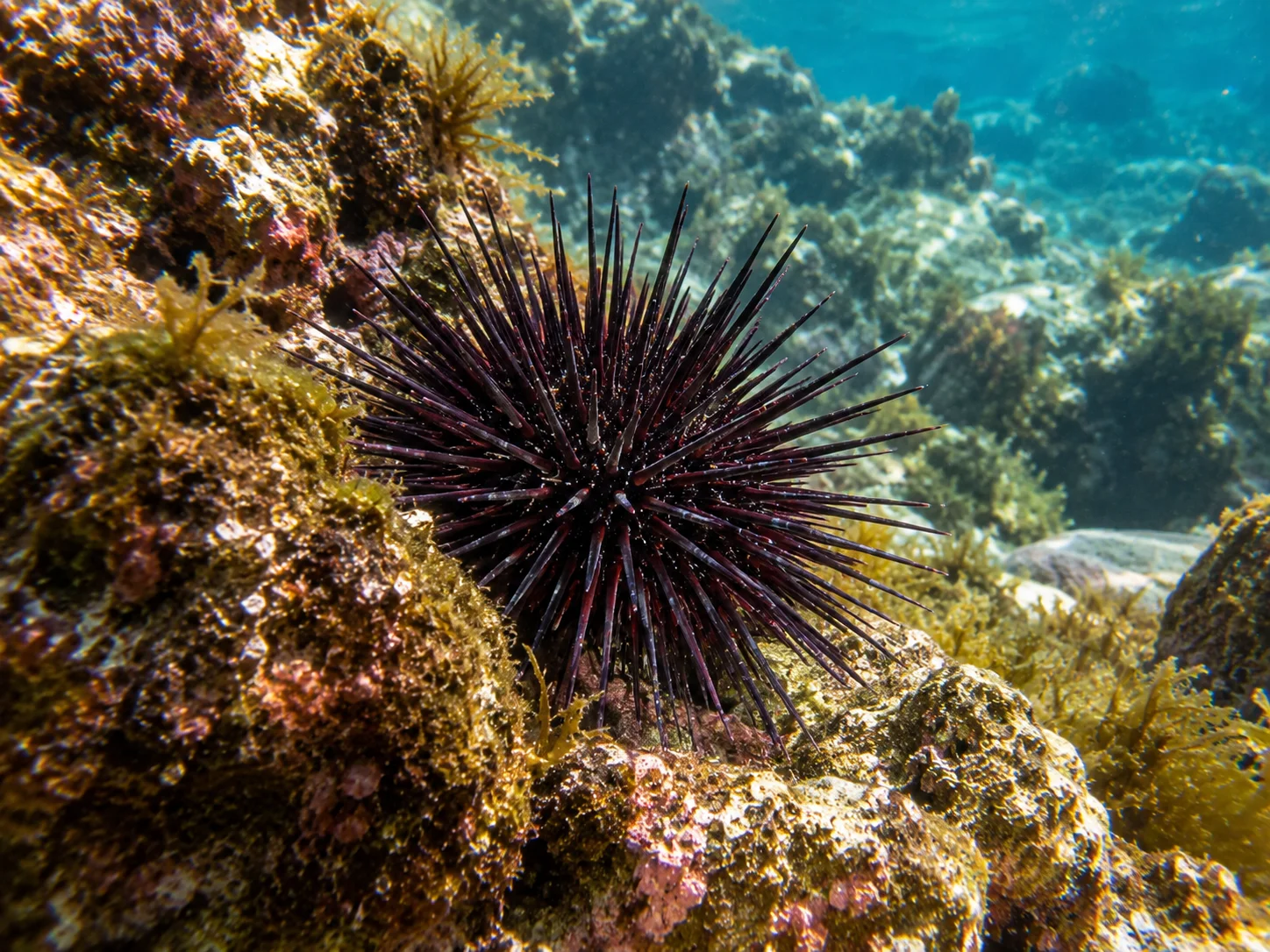
Meet the Urchin
A sea urchin has no brain, no heart and no eyes. It is a ball of calcium plates covered in moving spines, and it spends its life grazing rock.
It is also one of the most consequential animals in the sea. Where urchins are kept in check they trim the seabed and nothing much happens. Where they are not, they can strip a kelp forest down to bare stone and hold it that way for decades.
The difference is usually predators, and the most famous of them is the otter. The relationship between sea otters, urchins and kelp is one of the clearest examples anywhere of how removing a single animal can rearrange an entire coastline.
Scientific Name and Classification
Sea urchins make up the class Echinoidea, with roughly 950 described species.
- Kingdom: Animalia
- Phylum: Echinodermata
- Class: Echinoidea
- Species: about 950 worldwide
Echinodermata is the phylum of spiny-skinned animals, which also holds the starfish, the brittle stars and the sea cucumbers. They share two unusual traits: a body built on fivefold radial symmetry rather than a left and a right side, and a hydraulic plumbing system called the water vascular system that works their hundreds of tube feet.
That makes them properly strange relatives. Echinoderms are more closely related to us than to a crab or a snail, yet an adult urchin has no front, no back and no head at all.
Aristotle’s Lantern: The Urchin’s Teeth
On the underside of every urchin is a mouth containing five teeth, arranged in a circle and driven by a complex frame of plates and muscles. Aristotle described the apparatus more than two thousand years ago, and it still carries his name: Aristotle’s lantern.
The teeth are the remarkable part. They are built in layers that wear at different rates, so as the tip grinds down it breaks away and leaves a fresh edge behind. The tooth sharpens itself through use, continues growing from the base to replace what is lost, and is hard enough to cut into limestone and even granite.
Urchins use that to scrape algae off rock, and in some places to excavate hollows in the rock itself and sit in them. A boring urchin can slowly carve a pit that fits its own body, which shelters it from waves and from anything trying to pull it loose.
Appearance and Anatomy
Most urchins measure 1 to 4 inches (3 to 10 cm) across the shell, and the largest species reach about 14 inches (36 cm). The shell itself is called a test: a rigid case of fused calcium carbonate plates, drilled with thousands of tiny holes that the tube feet pass through.
- Rigid test of fused calcium plates, patterned in five sections
- Movable spines mounted on ball-and-socket joints
- Hundreds of transparent, sticky tube feet
- Five self-sharpening teeth in Aristotle’s lantern
The spines are not fixed decoration. Each sits in a socket and can be swiveled by muscles at its base, so a urchin can point its spines at whatever is touching it. Between them sit tiny pincer-like organs called pedicellariae, which grip at small animals trying to settle on the shell and, in some species, carry venom.
Three families are genuinely dangerous to handle. The flower urchin and its relatives, along with the long-spined diadems, can deliver stings that cause severe pain, and their spines break off in the wound.
Habitat and Range
Urchins live in every ocean on Earth, from pools that empty at low tide to the deepest trenches. Most species stay on temperate and tropical coasts within a few tens of meters of the surface, where there is enough light for the algae they eat.
Some go far deeper. Members of the family Pourtalesiidae have been collected at 6,850 meters (22,470 ft) in the Sunda Trench, in water with no light and no plants, where they live on whatever drifts down from above.
Diet and Feeding
Algae make up most of what an urchin eats, and kelp is the prize where it grows. They also take sea cucumbers, mussels, sponges, brittle stars and other slow or fixed invertebrates, which makes them omnivores rather than strict grazers.
Their method of eating kelp is what causes the trouble. Rather than grazing the blades at the top, urchins chew through the stems at the base. The whole plant then drifts away and dies, so one urchin can destroy a great deal more kelp than it actually consumes.
Behavior and Lifestyle
Urchins move on their tube feet, pushing with their spines, at a pace that is easy to underestimate. A red sea urchin covers about 3 inches (7.5 cm) a day when food is plentiful and up to 20 inches (50 cm) a day when it is scarce, so a hungry population travels.
They have no eyes, but they respond to light across the whole body surface, and some species detect shadows well enough to swing their spines toward an approaching object. An upturned urchin can right itself by working its tube feet and spines until it rolls back over.
Reproduction and Life Cycle
Males and females look identical from the outside. Most species simply release eggs and sperm into the water, where fertilization happens by chance, and a single female may shed millions of eggs at once.
The embryo can become a free-swimming larva within twelve hours. That larva, called an echinopluteus, carries twelve long arms and drifts in the plankton for months, looking nothing whatever like its parents. When it finally settles, metamorphosis into a recognizable juvenile urchin can take as little as an hour.
Lifespans vary enormously. Purple sea urchins mature at two years and live about twenty. Red sea urchins were long assumed to last seven to ten years, until growth studies showed individuals passing a century, with some Canadian animals estimated at around 200 years old and showing little sign of aging.
Predators and Threats
Sea otters are the specialists, cracking urchins open on their chests and eating the gonads inside. Wolf eels feed on little else. Starfish, lobsters, crabs, triggerfish, California sheephead and some sharks all take them, and people harvest them in large numbers for the roe sold as uni.
The pressures running the other way are warming seas and the loss of predators. Both tend to favor urchins, which is why the species is far more often a problem to be managed than a population in danger.
Conservation Status
With around 950 species there is no single conservation status for urchins, and most are common. A few harvested species have been depleted locally by fishing for uni, and some reef species suffer where their habitat is dying.
The more usual conservation problem is the opposite one. Urchin populations that escape control cause serious damage, and a good deal of marine restoration work now involves removing urchins by hand or restoring the predators that used to do it.
Role in the Ecosystem
Kelp forests are among the richest habitats in the sea, and urchins are what stands between them and bare rock. When predators keep urchin numbers down, kelp grows and shelters fish, invertebrates and the animals that feed on them. When predators are removed, urchin numbers climb and the kelp is cut away at the base.
What is left is called an urchin barren: a stretch of seabed covered in urchins and almost nothing else. Barrens can persist for decades, because the urchins survive on very little and keep eating any kelp that tries to regrow. The return of sea otters has reversed the process along parts of the North American Pacific coast, which is the clearest demonstration of the chain anyone has.
For an animal with no brain, that is a remarkable amount of influence, exercised entirely with five teeth, a few hundred tube feet, and a great deal of patience.