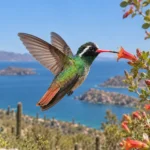
Meet the Hummingbird
A hummingbird’s heart beats over 1,200 times a minute in flight. Its wings move so fast they blur, and the hum they make is where the bird gets its name.
They are the only birds that can fly backwards, and the only ones that can hover in still air for minutes at a time.
All of this costs enormously. A hummingbird lives so close to running out of fuel that it must shut its body down overnight simply to survive until morning.
Scientific Name and Classification
Hummingbirds form the family Trochilidae, with around 360 species, so there is no single two-word name for them.
- Kingdom: Animalia
- Phylum: Chordata
- Class: Aves
- Order: Apodiformes
- Family: Trochilidae
Their closest relatives are swifts, which makes sense once you look at the wings: both are built around extraordinary flight rather than perching or walking. The order name Apodiformes means “footless”, because their feet are so small and weak. A hummingbird can perch but can barely walk.
Hummingbirds live only in the Americas. There are none anywhere else in the wild.
How Do Hummingbirds Hover?
Most birds get lift only on the downstroke. A hummingbird gets it on both.
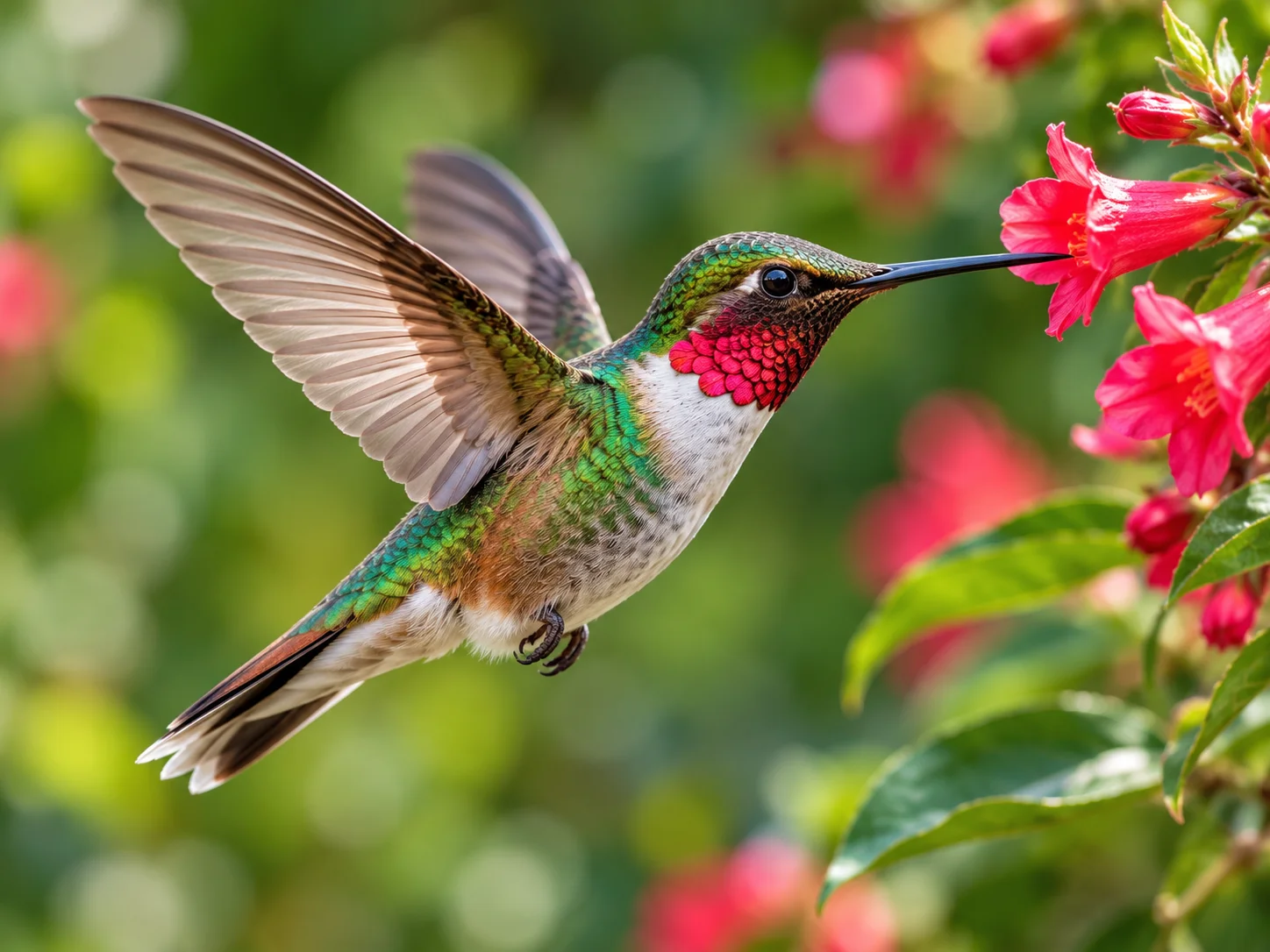
The shoulder joint rotates almost fully, so the wing flips over at the end of each stroke and sweeps back inverted, tracing a figure eight. Lift on the way forward, lift on the way back, and the bird hangs still in the air.
That is also why hummingbirds can fly backwards, sideways and briefly upside down. No other bird can.
Wingbeat rates run from about 50 times a second in small species to over 70 in the smallest, and courtship dives push higher still. The flight muscles make up a quarter to a third of the bird’s entire body weight.
Appearance and Anatomy
Hummingbirds run from the bee hummingbird of Cuba, at 2 inches and about 2 grams, to the giant hummingbird of the Andes at 9 inches. The bee hummingbird is the smallest bird in the world, lighter than a penny.
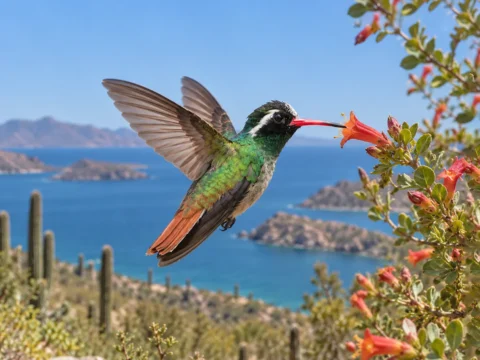
- Bill. Long and fine, and shaped to fit particular flowers. Some are straight, some curved, and the sword-billed hummingbird has a bill longer than its own body.
- Tongue. Forked and grooved, flicking in and out up to 15 times a second. It traps nectar by curling around it, rather than working as a straw.
- Feathers. The brilliant throat colors are not pigment. Microscopic layers in the feathers split light, so the color flares and vanishes as the bird turns.
- Heart. Huge for the body and beating 500 times a minute at rest, over 1,200 in flight.
- Feet. Tiny. Good for perching, useless for walking.
Habitat and Range
Hummingbirds live throughout North, Central and South America, from Alaska down to Tierra del Fuego.
Most species are tropical, and the Andes hold the greatest variety. Ecuador alone has well over a hundred species. Only a handful breed in the United States and Canada, and they migrate south for winter.
They use rainforest, cloud forest, desert, mountainside and suburban gardens, and some Andean species live above 14,000 feet where nights are freezing.
Diet and Feeding
Hummingbirds live on nectar and small insects. The nectar is fuel; the insects and spiders supply the protein they need to build their bodies.
They eat constantly, visiting well over a thousand flowers a day and consuming roughly half their body weight in sugar. A person doing the same would need to eat continuously all day and still fall behind.
They are also good at remembering. A hummingbird keeps track of which flowers it has already emptied and roughly how long each takes to refill, and returns on something like a schedule.
Many species are fiercely territorial about a good patch of flowers and will chase off birds many times their size.
Behavior and Lifestyle
The most remarkable thing a hummingbird does is switch itself off.
Burning fuel at that rate, a hummingbird would starve overnight if it simply slept. So it enters torpor: body temperature falls steeply, the heart slows from 500 beats a minute to perhaps 50, breathing almost stops, and the bird hangs rigid on its perch. It looks dead. In the morning it takes 20 minutes or more to warm up and fly again.
Migration is the other astonishment. The ruby-throated hummingbird crosses the Gulf of Mexico non-stop, roughly 500 miles over open water, in about 20 hours, on a body weighing around 3 grams. It nearly doubles its weight in fat beforehand.
Males court with steep dive displays, climbing high and plunging past the female while the air through their tail feathers produces a loud chirp.
Reproduction and Life Cycle
Females do everything alone. The male’s involvement ends at mating.
She builds a cup nest about the size of a walnut shell from plant down and spider silk. The silk matters: it is elastic, so the nest stretches as the chicks grow.
Two eggs is the usual clutch, each about the size of a pea and among the smallest of any bird. Incubation takes two to three weeks.
Chicks hatch blind and bare and fledge at three to four weeks. The mother feeds them nectar and insects by pushing her bill deep into their throats.
Most hummingbirds live three to five years, though some have reached well over ten.
Predators and Threats
Hawks, owls, frogs, lizards, large spiders and praying mantises all catch hummingbirds, and domestic cats take many. A bird in torpor is especially helpless.
Their defenses are speed and aggression. A hummingbird will dive at a hawk that comes near its nest.
Human threats are habitat loss, pesticides that remove the insects they need, window strikes, and climate change shifting flowering times out of step with migration, so birds arrive to find nothing in bloom.
Conservation Status
There is no single status for hummingbirds, with around 360 species involved.
Common garden species are doing well, and feeders have helped some expand their range. But hummingbirds are among the most threatened bird families overall, because so many species are confined to a single mountain or valley. Several are Critically Endangered, and the Juan Fernandez firecrown, on one Chilean island, numbers only a few hundred birds.
If you feed them, use plain sugar water at roughly four parts water to one part sugar, and never add red dye or honey. Clean the feeder regularly, because mold is dangerous to them.
Role in the Ecosystem
Hummingbirds are major pollinators, and in the Americas they do work that insects cannot. Many plants have evolved specifically around them: long tubular flowers, often red, holding plenty of nectar and offering no landing platform, because a hovering bird does not need one.
Those partnerships can be very tight. The sword-billed hummingbird and certain long-tubed passionflowers rely almost entirely on each other, and neither would manage alone.
They also work at altitudes and in cold conditions where insects are scarce, which makes them the main pollinators high in the Andes.