Meet the Toco Toucan
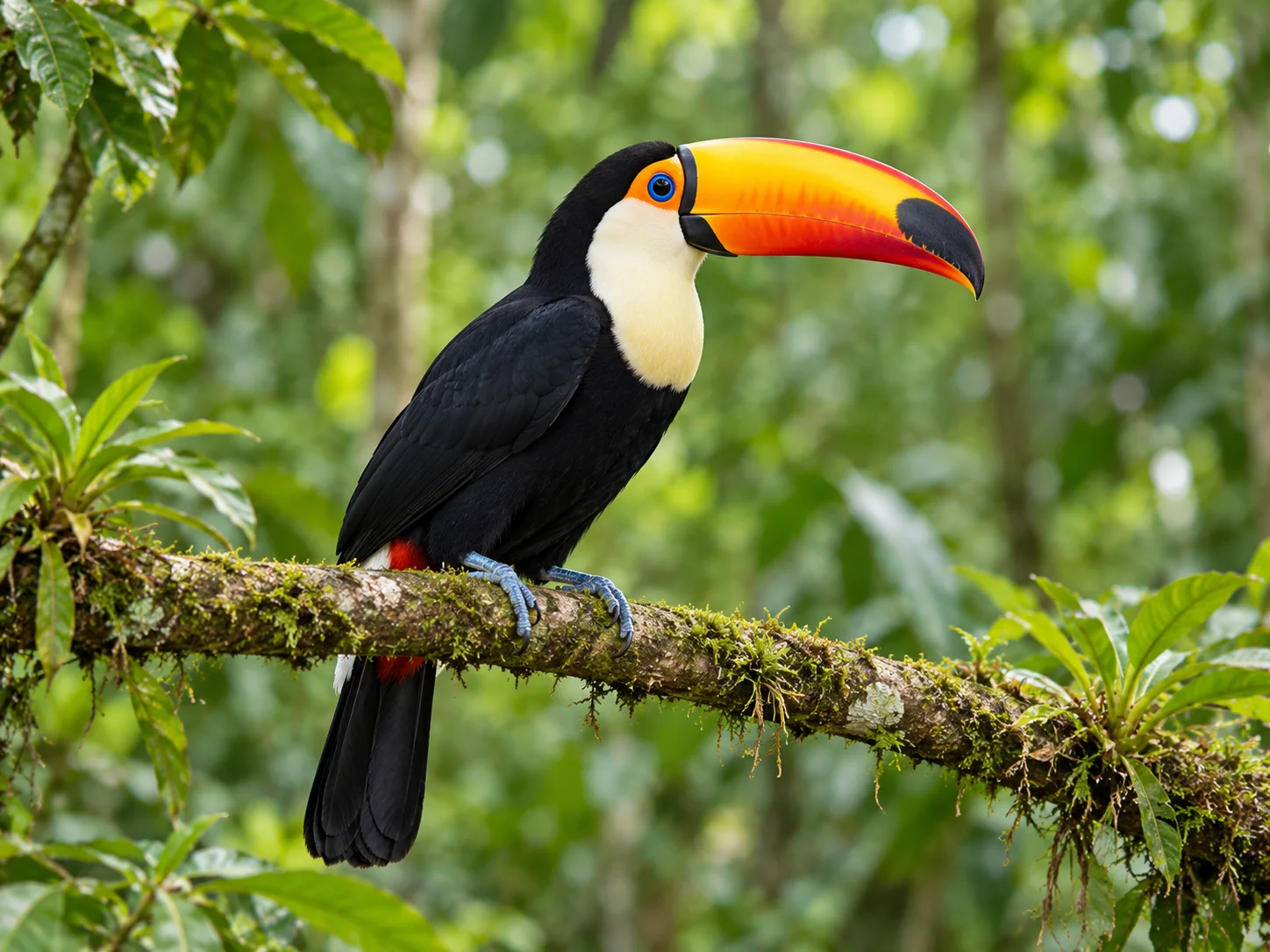
The toco toucan has the largest beak of any bird relative to its body. It is nearly 8 inches long, about a third of the whole bird, bright orange, and it looks like it should topple the toucan straight off its branch. The toco toucan (Ramphastos toco) is the largest of the toucans, a fruit-eating bird of South American forests and savannas.
It does not, because the beak weighs almost nothing. Inside it is mostly hollow, a honeycomb of thin bone struts filled with air.
And the main reason it is so big turned out to have nothing to do with eating. The toucan uses its beak as a radiator.
Scientific Name and Classification
The toco toucan’s scientific name is Ramphastos toco. It is the largest of around 40 toucan species.
- Kingdom: Animalia
- Phylum: Chordata
- Class: Aves
- Order: Piciformes
- Family: Ramphastidae
- Species: Ramphastos toco
Being in Piciformes makes toucans relatives of woodpeckers, which shows in the feet: two toes point forward and two back, a strong grip for clinging to trunks and branches.
Toucans live only in the Americas. There are none in Africa, Asia or anywhere else.
Why Is the Toucan’s Beak So Big?
People proposed answers for two centuries. Darwin thought it was for attracting mates. Others suggested it was for reaching fruit on thin branches, or for frightening other birds away from nests.
Research using thermal cameras found something nobody had expected. The beak is a heat exchanger.
It carries a dense network of blood vessels just under the surface, and the toucan can adjust how much blood flows into it. Send more blood in and heat radiates away; shut it down and heat is conserved. A toco toucan can dump a very large share of its body heat through its beak, and it does this faster and more precisely than almost any other animal can regulate temperature.
At night the toucan tucks its beak under a wing and turns the radiator off, which is also simply how it sleeps.
The other uses are real too. The beak reaches fruit at the end of branches too thin to perch on, intimidates smaller birds, and the serrated edges help grip and peel food. But keeping cool appears to be the big one.
Appearance and Anatomy
Toco toucans measure 22 to 26 inches long including the beak, and weigh 18 to 30 ounces.
- Beak. Up to 8 inches, orange with a black tip. Made of keratin, the same material as fingernails, built around a hollow honeycomb of bone struts, so it weighs very little.
- Eye patch. A ring of bare blue skin surrounded by orange, which makes the eye look much larger than it is.
- Tongue. Long, narrow and frayed at the edges like a feather, used to flick food back into the throat.
- Tail. Jointed in a way that lets the bird flip it right forward over its back, so a sleeping toucan folds into a ball of feathers inside a tree hole.
- Plumage. Black body, white throat, red under the tail.
They are poor fliers. A toucan flaps hard, glides, and drops, and prefers to hop between branches rather than cross open ground.
Habitat and Range
The toco toucan lives across central and eastern South America, in Brazil, Bolivia, Paraguay, Argentina and the Guianas.
Unusually for a toucan, it avoids dense rainforest. It prefers open country: savanna, woodland, palm groves, forest edges, plantations and gardens.
That preference is why it is doing better than most of its relatives, which depend on continuous forest. The toco copes with a landscape that has been broken up.
Diet and Feeding
Toco toucans are omnivores, though fruit makes up most of the diet: figs, palm fruit, berries and whatever else is ripe.
They also take insects, spiders, frogs, lizards, eggs and nestling birds, which surprises people expecting a gentle fruit eater.
The feeding method is memorable. A toucan picks fruit with the tip of its beak, then throws its head back and tosses the food down its throat, because that long beak cannot bring anything to the mouth directly.
They swallow fruit whole and regurgitate the large seeds later, undamaged.
Behavior and Lifestyle
Toucans are social, living in pairs or small flocks of up to a dozen, and they are noisy. The toco’s call is a deep croaking grunt, not the musical song people expect from such a colorful bird.
They play. Toucans fence with their beaks, toss fruit to each other and catch it, and wrestle, apparently for the sake of it.
Sleeping is a feat of folding. A toucan turns its head right around, lays the beak along its back, flips its tail forward over the top, and becomes a ball of feathers small enough to fit in a tree hollow.
They are active by day and move through the canopy in loose single file, one bird after another.
Reproduction and Life Cycle
Toucans nest in tree holes, usually a cavity another bird made or a natural hollow, since their beaks are no good for excavating.
The space is tight for a bird with an 8-inch beak, which is part of why that folding posture matters.
The female lays two to four white eggs, and both parents incubate for about 17 days, taking turns.
Chicks hatch blind, bald and startlingly ugly, with no beak to speak of. The beak grows slowly and is not full size for several months. They stay in the nest for six to eight weeks, fed by both parents.
Toco toucans live about 20 years in the wild and over 25 in captivity.
Predators and Threats
Forest eagles and hawks take adults, while snakes, monkeys, weasels and rats raid nests for eggs and chicks.
Toucans mob predators as a group, several birds harassing a snake or hawk together.
Human pressures are habitat loss and the pet trade. Toucans are captured for sale because they are beautiful, and many die in transport. They are difficult animals to keep properly: they need a great deal of fruit, a lot of space, and company.
Conservation Status
The toco toucan is listed as Least Concern and is the most widespread toucan, partly because it tolerates open and disturbed country.
Several of its relatives are in far worse shape. Toucans that need unbroken rainforest, particularly in the Atlantic forest of Brazil, have declined sharply as that forest has been cleared.
The pet trade remains a pressure, though captive breeding has reduced the number of wild birds taken.
Role in the Ecosystem
Toucans are major seed dispersers, and specifically of large seeds. Because they swallow big fruit whole and bring the seed up later intact, often far from the parent tree, they move seeds that smaller birds cannot handle at all.
Studies in Brazil found that where large toucans disappeared, palm trees began producing smaller seeds over generations, because only small-seeded fruit was still being dispersed. Losing the bird visibly changed the trees.
They also prey on insects and small animals, and eating other birds’ eggs puts them in an unexpected role in the forest food web.
And being spectacular has its own value. The toucan draws attention and funding to South American forest conservation in a way a drab bird never would.